

3 Quantum Optical Phenomena in Nuclear Resonant Scattering
113
tribution becomes, the more pronounced is the resonance behavior of the propagator.
This leads to a strong enhancement of the scattering in the vicinity of sharp nuclear
resonances.
Since we are interested here in coherent elastic scattering (ω = ω
) we consider
only the diagonal elements of the operator M. The currents b of the atom are split into
the nuclear and the electronic part. This gives three contributions to the scattering
operator: the pure electronic part E, the pure nuclear part N, and an interference
term between the nuclear and electronic currents that can be neglected in most cases.
The nuclear contribution to the atomic scattering operator for an unsplit (single-line)
nuclear resonance is given by:
N(k, ω, k
, ω) = e
i(k−k
)·R
f 0 (( 0 /2)
ω − ω 0 − i
with f 0 =
f L M
2k 0
2I e + 1
2I g + 1
1
1 + α
(3.4)
where f L M is the Lamb-Mössbauer factor, I g and I e are the spins of the ground and
excited nuclear states, respectively, and α is the coefficient of internal conversion.
Effectively, the situation of an unsplit ground and excited state justifies a scalar
approach to the scattering problem. As we will see in the next section, is not a
property of the single atom only, but can be greatly affected by cooperative effects,
i.e., by the radiative coupling of many identical atoms.
3.3 The Nuclear Level Width in a Cooperative Atomic
Environment
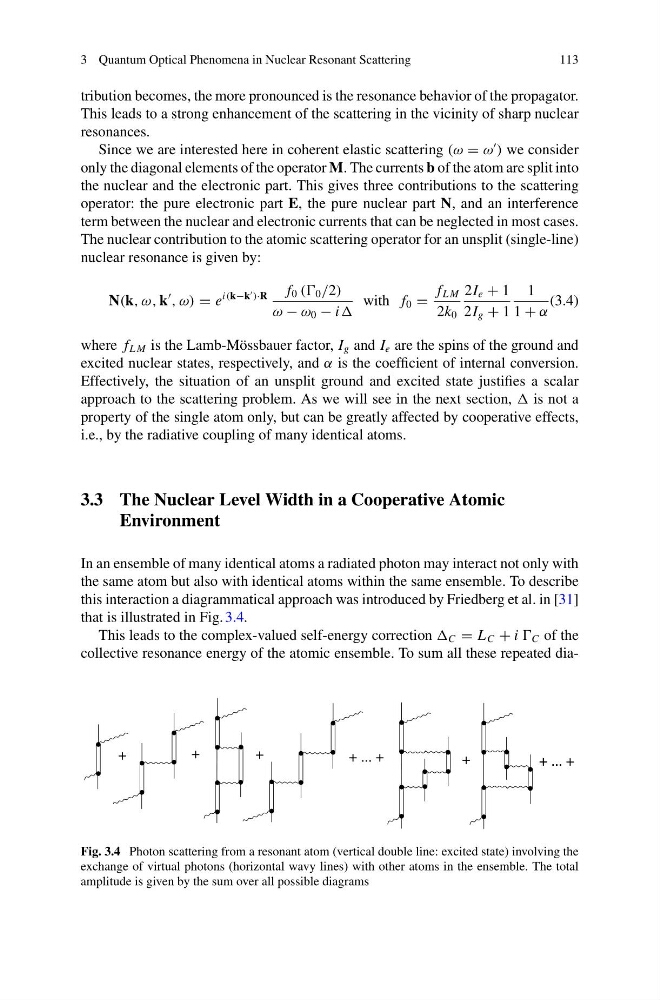
In an ensemble of many identical atoms a radiated photon may interact not only with
the same atom but also with identical atoms within the same ensemble. To describe
this interaction a diagrammatical approach was introduced by Friedberg et al. in [31]
that is illustrated in Fig. 3.4.
This leads to the complex-valued self-energy correction C = L C + i C of the
collective resonance energy of the atomic ensemble. To sum all these repeated diaFig. 3.4 Photon scattering from a resonant atom (vertical double line: excited state) involving the
exchange of virtual photons (horizontal wavy lines) with other atoms in the ensemble. The total
amplitude is given by the sum over all possible diagrams
113
tribution becomes, the more pronounced is the resonance behavior of the propagator.
This leads to a strong enhancement of the scattering in the vicinity of sharp nuclear
resonances.
Since we are interested here in coherent elastic scattering (ω = ω
) we consider
only the diagonal elements of the operator M. The currents b of the atom are split into
the nuclear and the electronic part. This gives three contributions to the scattering
operator: the pure electronic part E, the pure nuclear part N, and an interference
term between the nuclear and electronic currents that can be neglected in most cases.
The nuclear contribution to the atomic scattering operator for an unsplit (single-line)
nuclear resonance is given by:
N(k, ω, k
, ω) = e
i(k−k
)·R
f 0 (( 0 /2)
ω − ω 0 − i
with f 0 =
f L M
2k 0
2I e + 1
2I g + 1
1
1 + α
(3.4)
where f L M is the Lamb-Mössbauer factor, I g and I e are the spins of the ground and
excited nuclear states, respectively, and α is the coefficient of internal conversion.
Effectively, the situation of an unsplit ground and excited state justifies a scalar
approach to the scattering problem. As we will see in the next section, is not a
property of the single atom only, but can be greatly affected by cooperative effects,
i.e., by the radiative coupling of many identical atoms.
3.3 The Nuclear Level Width in a Cooperative Atomic
Environment
In an ensemble of many identical atoms a radiated photon may interact not only with
the same atom but also with identical atoms within the same ensemble. To describe
this interaction a diagrammatical approach was introduced by Friedberg et al. in [31]
that is illustrated in Fig. 3.4.
This leads to the complex-valued self-energy correction C = L C + i C of the
collective resonance energy of the atomic ensemble. To sum all these repeated diaFig. 3.4 Photon scattering from a resonant atom (vertical double line: excited state) involving the
exchange of virtual photons (horizontal wavy lines) with other atoms in the ensemble. The total
amplitude is given by the sum over all possible diagrams