

3 Quantum Optical Phenomena in Nuclear Resonant Scattering
111
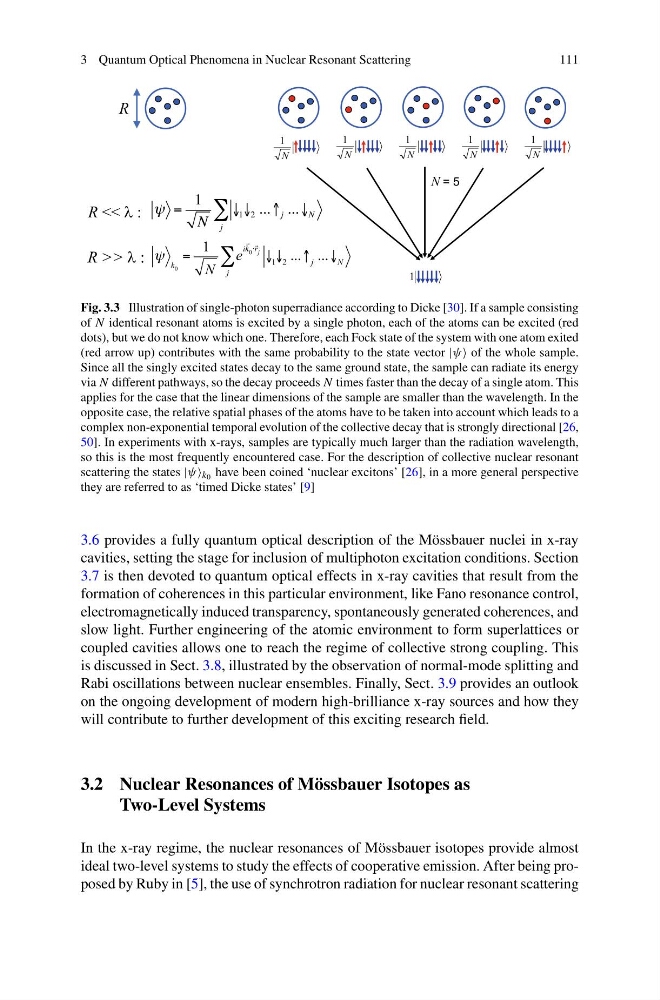
Fig. 3.3 Illustration of single-photon superradiance according to Dicke [30]. If a sample consisting
of N identical resonant atoms is excited by a single photon, each of the atoms can be excited (red
dots), but we do not know which one. Therefore, each Fock state of the system with one atom exited
(red arrow up) contributes with the same probability to the state vector |ψ of the whole sample.
Since all the singly excited states decay to the same ground state, the sample can radiate its energy
via N different pathways, so the decay proceeds N times faster than the decay of a single atom. This
applies for the case that the linear dimensions of the sample are smaller than the wavelength. In the
opposite case, the relative spatial phases of the atoms have to be taken into account which leads to a
complex non-exponential temporal evolution of the collective decay that is strongly directional [26,
50]. In experiments with x-rays, samples are typically much larger than the radiation wavelength,
so this is the most frequently encountered case. For the description of collective nuclear resonant
scattering the states |ψ k0 have been coined ‘nuclear excitons’ [26], in a more general perspective
they are referred to as ‘timed Dicke states’ [9]
3.6 provides a fully quantum optical description of the Mössbauer nuclei in x-ray
cavities, setting the stage for inclusion of multiphoton excitation conditions. Section
3.7 is then devoted to quantum optical effects in x-ray cavities that result from the
formation of coherences in this particular environment, like Fano resonance control,
electromagnetically induced transparency, spontaneously generated coherences, and
slow light. Further engineering of the atomic environment to form superlattices or
coupled cavities allows one to reach the regime of collective strong coupling. This
is discussed in Sect. 3.8, illustrated by the observation of normal-mode splitting and
Rabi oscillations between nuclear ensembles. Finally, Sect. 3.9 provides an outlook
on the ongoing development of modern high-brilliance x-ray sources and how they
will contribute to further development of this exciting research field.
3.2 Nuclear Resonances of Mössbauer Isotopes as
Two-Level Systems
In the x-ray regime, the nuclear resonances of Mössbauer isotopes provide almost
ideal two-level systems to study the effects of cooperative emission. After being proposed by Ruby in [5], the use of synchrotron radiation for nuclear resonant scattering
111
Fig. 3.3 Illustration of single-photon superradiance according to Dicke [30]. If a sample consisting
of N identical resonant atoms is excited by a single photon, each of the atoms can be excited (red
dots), but we do not know which one. Therefore, each Fock state of the system with one atom exited
(red arrow up) contributes with the same probability to the state vector |ψ of the whole sample.
Since all the singly excited states decay to the same ground state, the sample can radiate its energy
via N different pathways, so the decay proceeds N times faster than the decay of a single atom. This
applies for the case that the linear dimensions of the sample are smaller than the wavelength. In the
opposite case, the relative spatial phases of the atoms have to be taken into account which leads to a
complex non-exponential temporal evolution of the collective decay that is strongly directional [26,
50]. In experiments with x-rays, samples are typically much larger than the radiation wavelength,
so this is the most frequently encountered case. For the description of collective nuclear resonant
scattering the states |ψ k0 have been coined ‘nuclear excitons’ [26], in a more general perspective
they are referred to as ‘timed Dicke states’ [9]
3.6 provides a fully quantum optical description of the Mössbauer nuclei in x-ray
cavities, setting the stage for inclusion of multiphoton excitation conditions. Section
3.7 is then devoted to quantum optical effects in x-ray cavities that result from the
formation of coherences in this particular environment, like Fano resonance control,
electromagnetically induced transparency, spontaneously generated coherences, and
slow light. Further engineering of the atomic environment to form superlattices or
coupled cavities allows one to reach the regime of collective strong coupling. This
is discussed in Sect. 3.8, illustrated by the observation of normal-mode splitting and
Rabi oscillations between nuclear ensembles. Finally, Sect. 3.9 provides an outlook
on the ongoing development of modern high-brilliance x-ray sources and how they
will contribute to further development of this exciting research field.
3.2 Nuclear Resonances of Mössbauer Isotopes as
Two-Level Systems
In the x-ray regime, the nuclear resonances of Mössbauer isotopes provide almost
ideal two-level systems to study the effects of cooperative emission. After being proposed by Ruby in [5], the use of synchrotron radiation for nuclear resonant scattering