

2 Synchrotron-Radiation-Based Energy-Domain Mössbauer …
87
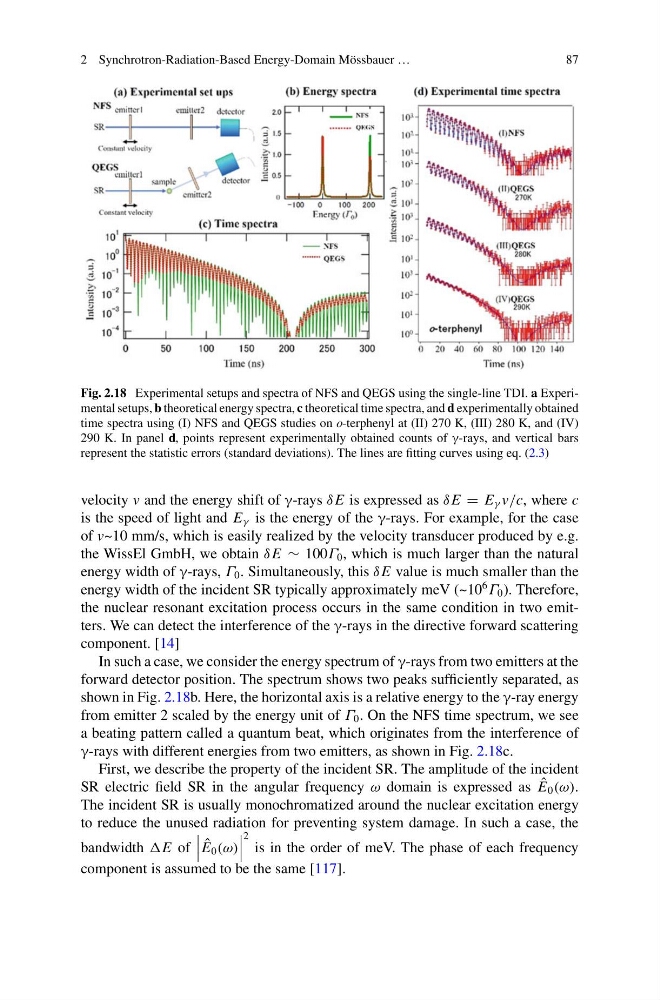
Fig. 2.18 Experimental setups and spectra of NFS and QEGS using the single-line TDI. a Experimental setups, b theoretical energy spectra, c theoretical time spectra, and d experimentally obtained
time spectra using (I) NFS and QEGS studies on o-terphenyl at (II) 270 K, (III) 280 K, and (IV)
290 K. In panel d, points represent experimentally obtained counts of γ-rays, and vertical bars
represent the statistic errors (standard deviations). The lines are fitting curves using eq. (2.3)
velocity v and the energy shift of γ-rays δ E is expressed as δ E = E γ v/c, where c
is the speed of light and E γ is the energy of the γ-rays. For example, for the case
of v~10 mm/s, which is easily realized by the velocity transducer produced by e.g.
the WissEl GmbH, we obtain δ E ∼ 100Γ 0 , which is much larger than the natural
energy width of γ-rays, Γ 0 . Simultaneously, this δ E value is much smaller than the
energy width of the incident SR typically approximately meV (~10
6
Γ 0 ). Therefore,
the nuclear resonant excitation process occurs in the same condition in two emitters. We can detect the interference of the γ-rays in the directive forward scattering
component. [14]
In such a case, we consider the energy spectrum of γ-rays from two emitters at the
forward detector position. The spectrum shows two peaks sufficiently separated, as
shown in Fig. 2.18b. Here, the horizontal axis is a relative energy to the γ-ray energy
from emitter 2 scaled by the energy unit of Γ 0 . On the NFS time spectrum, we see
a beating pattern called a quantum beat, which originates from the interference of
γ-rays with different energies from two emitters, as shown in Fig. 2.18c.
First, we describe the property of the incident SR. The amplitude of the incident
SR electric field SR in the angular frequency ω domain is expressed as ˆ
E 0 (ω).
The incident SR is usually monochromatized around the nuclear excitation energy
to reduce the unused radiation for preventing system damage. In such a case, the
bandwidth E of
ˆ
E 0 (ω)
2
is in the order of meV. The phase of each frequency
component is assumed to be the same [117].
87
Fig. 2.18 Experimental setups and spectra of NFS and QEGS using the single-line TDI. a Experimental setups, b theoretical energy spectra, c theoretical time spectra, and d experimentally obtained
time spectra using (I) NFS and QEGS studies on o-terphenyl at (II) 270 K, (III) 280 K, and (IV)
290 K. In panel d, points represent experimentally obtained counts of γ-rays, and vertical bars
represent the statistic errors (standard deviations). The lines are fitting curves using eq. (2.3)
velocity v and the energy shift of γ-rays δ E is expressed as δ E = E γ v/c, where c
is the speed of light and E γ is the energy of the γ-rays. For example, for the case
of v~10 mm/s, which is easily realized by the velocity transducer produced by e.g.
the WissEl GmbH, we obtain δ E ∼ 100Γ 0 , which is much larger than the natural
energy width of γ-rays, Γ 0 . Simultaneously, this δ E value is much smaller than the
energy width of the incident SR typically approximately meV (~10
6
Γ 0 ). Therefore,
the nuclear resonant excitation process occurs in the same condition in two emitters. We can detect the interference of the γ-rays in the directive forward scattering
component. [14]
In such a case, we consider the energy spectrum of γ-rays from two emitters at the
forward detector position. The spectrum shows two peaks sufficiently separated, as
shown in Fig. 2.18b. Here, the horizontal axis is a relative energy to the γ-ray energy
from emitter 2 scaled by the energy unit of Γ 0 . On the NFS time spectrum, we see
a beating pattern called a quantum beat, which originates from the interference of
γ-rays with different energies from two emitters, as shown in Fig. 2.18c.
First, we describe the property of the incident SR. The amplitude of the incident
SR electric field SR in the angular frequency ω domain is expressed as ˆ
E 0 (ω).
The incident SR is usually monochromatized around the nuclear excitation energy
to reduce the unused radiation for preventing system damage. In such a case, the
bandwidth E of
ˆ
E 0 (ω)
2
is in the order of meV. The phase of each frequency
component is assumed to be the same [117].