

2 Synchrotron-Radiation-Based Energy-Domain Mössbauer …
85
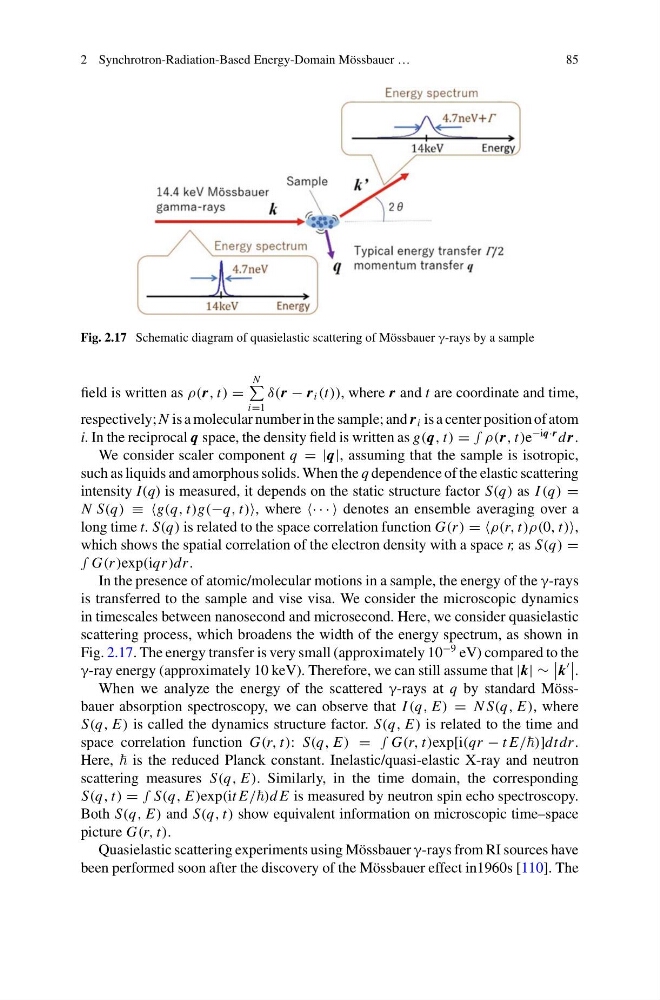
Fig. 2.17 Schematic diagram of quasielastic scattering of Mössbauer γ-rays by a sample
field is written as ρ(r, t) =
N
i=1
δ(r − r i (t)), where r and t are coordinate and time,
respectively; N is a molecular number in the sample; and r i is a center position of atom
i. In the reciprocal q space, the density field is written as g(q, t) = ∫ ρ(r, t)e
−iq·r d r.
We consider scaler component q = |q|, assuming that the sample is isotropic,
such as liquids and amorphous solids. When the q dependence of the elastic scattering
intensity I(q) is measured, it depends on the static structure factor S(q) as I (q) =
N S(q) ≡ g(q, t)g(−q, t), where · · · denotes an ensemble averaging over a
long time t. S(q) is related to the space correlation function G(r ) = ρ(r, t)ρ(0, t),
which shows the spatial correlation of the electron density with a space r, as S(q) =
∫ G(r )exp(iqr)dr.
In the presence of atomic/molecular motions in a sample, the energy of the γ-rays
is transferred to the sample and vise visa. We consider the microscopic dynamics
in timescales between nanosecond and microsecond. Here, we consider quasielastic
scattering process, which broadens the width of the energy spectrum, as shown in
Fig. 2.17. The energy transfer is very small (approximately 10
−9 eV) compared to the
γ-ray energy (approximately 10 keV). Therefore, we can still assume that |k| ∼
k
.
When we analyze the energy of the scattered γ-rays at q by standard Mössbauer absorption spectroscopy, we can observe that I (q, E) = N S(q, E), where
S(q, E) is called the dynamics structure factor. S(q, E) is related to the time and
space correlation function G(r, t): S(q, E) = ∫ G(r, t)exp[i(qr − t E/)]dtdr.
Here, is the reduced Planck constant. Inelastic/quasi-elastic X-ray and neutron
scattering measures S(q, E). Similarly, in the time domain, the corresponding
S(q, t) = ∫ S(q, E)exp(it E/)d E is measured by neutron spin echo spectroscopy.
Both S(q, E) and S(q, t) show equivalent information on microscopic time–space
picture G(r, t).
Quasielastic scattering experiments using Mössbauer γ-rays from RI sources have
been performed soon after the discovery of the Mössbauer effect in1960s [110]. The
85
Fig. 2.17 Schematic diagram of quasielastic scattering of Mössbauer γ-rays by a sample
field is written as ρ(r, t) =
N
i=1
δ(r − r i (t)), where r and t are coordinate and time,
respectively; N is a molecular number in the sample; and r i is a center position of atom
i. In the reciprocal q space, the density field is written as g(q, t) = ∫ ρ(r, t)e
−iq·r d r.
We consider scaler component q = |q|, assuming that the sample is isotropic,
such as liquids and amorphous solids. When the q dependence of the elastic scattering
intensity I(q) is measured, it depends on the static structure factor S(q) as I (q) =
N S(q) ≡ g(q, t)g(−q, t), where · · · denotes an ensemble averaging over a
long time t. S(q) is related to the space correlation function G(r ) = ρ(r, t)ρ(0, t),
which shows the spatial correlation of the electron density with a space r, as S(q) =
∫ G(r )exp(iqr)dr.
In the presence of atomic/molecular motions in a sample, the energy of the γ-rays
is transferred to the sample and vise visa. We consider the microscopic dynamics
in timescales between nanosecond and microsecond. Here, we consider quasielastic
scattering process, which broadens the width of the energy spectrum, as shown in
Fig. 2.17. The energy transfer is very small (approximately 10
−9 eV) compared to the
γ-ray energy (approximately 10 keV). Therefore, we can still assume that |k| ∼
k
.
When we analyze the energy of the scattered γ-rays at q by standard Mössbauer absorption spectroscopy, we can observe that I (q, E) = N S(q, E), where
S(q, E) is called the dynamics structure factor. S(q, E) is related to the time and
space correlation function G(r, t): S(q, E) = ∫ G(r, t)exp[i(qr − t E/)]dtdr.
Here, is the reduced Planck constant. Inelastic/quasi-elastic X-ray and neutron
scattering measures S(q, E). Similarly, in the time domain, the corresponding
S(q, t) = ∫ S(q, E)exp(it E/)d E is measured by neutron spin echo spectroscopy.
Both S(q, E) and S(q, t) show equivalent information on microscopic time–space
picture G(r, t).
Quasielastic scattering experiments using Mössbauer γ-rays from RI sources have
been performed soon after the discovery of the Mössbauer effect in1960s [110]. The