

4.2 Aqueous Solutions
85
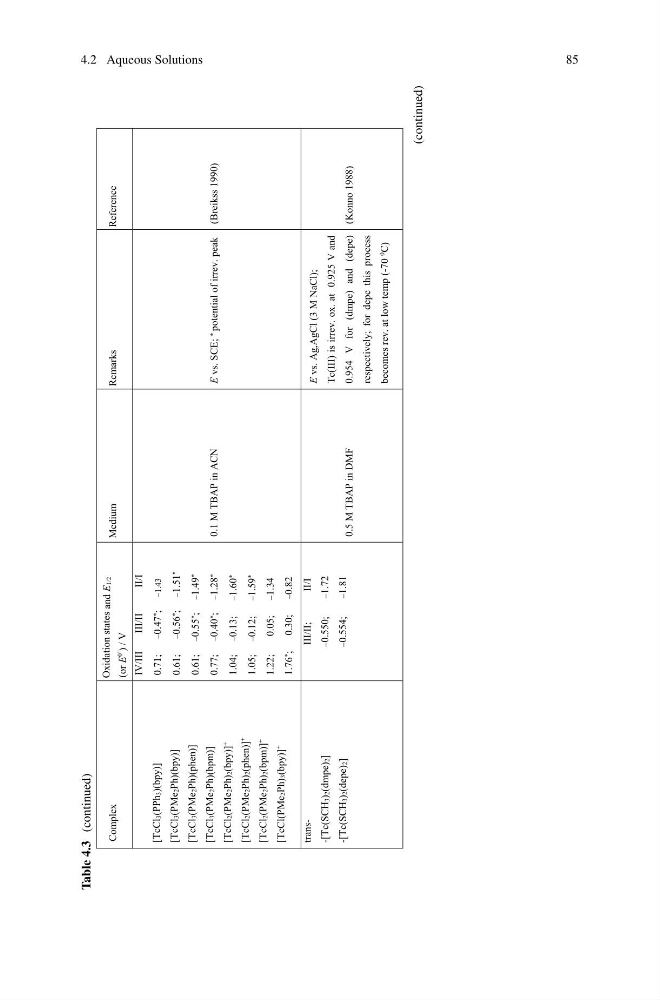
Table 4.3
(continued)
[TcCl3(PPh3)(bpy)]
[TcCl3(PMe2Ph)(bpy)]
[TcCl3(PMe2Ph)(phen)]
[TcCl3(PMe2Ph)(bpm)]
[TcCl2(PMe2Ph)2(bpy)]
+
[TcCl2(PMe2Ph)2(phen)]
+
[TcCl2(PMe2Ph)2(bpm)]
+
[TcCl(PMe2Ph)3(bpy)]
+
IV/III
III/II
II/I
0.71;
0.47
;
0.61;
0.56
; 1.51
0.61; 0.55
; 1.49
0.77; 0.40
; 1.28
1.04; 0.13;
1.60
1.05; 0.12;
1.59
1.22;
0.05; 1.34
1.76
;
0.30;
0.82
0.1 M TBAP in ACN
E vs. SCE;
potential of irrev. peak (Breikss 1990)
trans-[Tc(SCH3)2(dmpe)2]
-[Tc(SCH3)2(depe)2]
III/II;
II/I
0.550;
1.72
0.554;
1.81
0.5 M TBAP in DMF
E vs. Ag,AgCl (3 M NaCl);
Tc(III) is irrev. ox. at 0.925 V and
0.954 V for (dmpe) and (depe)
respectively; for depe this process
becomes rev. at low temp (-70
0
C)
(Konno 1988)
Complex
Oxidation states
and E1/2
(or E
0’
) / V
Medium
Remarks
Reference
(continued)
85
Table 4.3
(continued)
[TcCl3(PPh3)(bpy)]
[TcCl3(PMe2Ph)(bpy)]
[TcCl3(PMe2Ph)(phen)]
[TcCl3(PMe2Ph)(bpm)]
[TcCl2(PMe2Ph)2(bpy)]
+
[TcCl2(PMe2Ph)2(phen)]
+
[TcCl2(PMe2Ph)2(bpm)]
+
[TcCl(PMe2Ph)3(bpy)]
+
IV/III
III/II
II/I
0.71;
0.47
;
0.61;
0.56
; 1.51
0.61; 0.55
; 1.49
0.77; 0.40
; 1.28
1.04; 0.13;
1.60
1.05; 0.12;
1.59
1.22;
0.05; 1.34
1.76
;
0.30;
0.82
0.1 M TBAP in ACN
E vs. SCE;
potential of irrev. peak (Breikss 1990)
trans-[Tc(SCH3)2(dmpe)2]
-[Tc(SCH3)2(depe)2]
III/II;
II/I
0.550;
1.72
0.554;
1.81
0.5 M TBAP in DMF
E vs. Ag,AgCl (3 M NaCl);
Tc(III) is irrev. ox. at 0.925 V and
0.954 V for (dmpe) and (depe)
respectively; for depe this process
becomes rev. at low temp (-70
0
C)
(Konno 1988)
Complex
Oxidation states
and E1/2
(or E
0’
) / V
Medium
Remarks
Reference
(continued)