

4.1 Nonaqueous Solutions
71
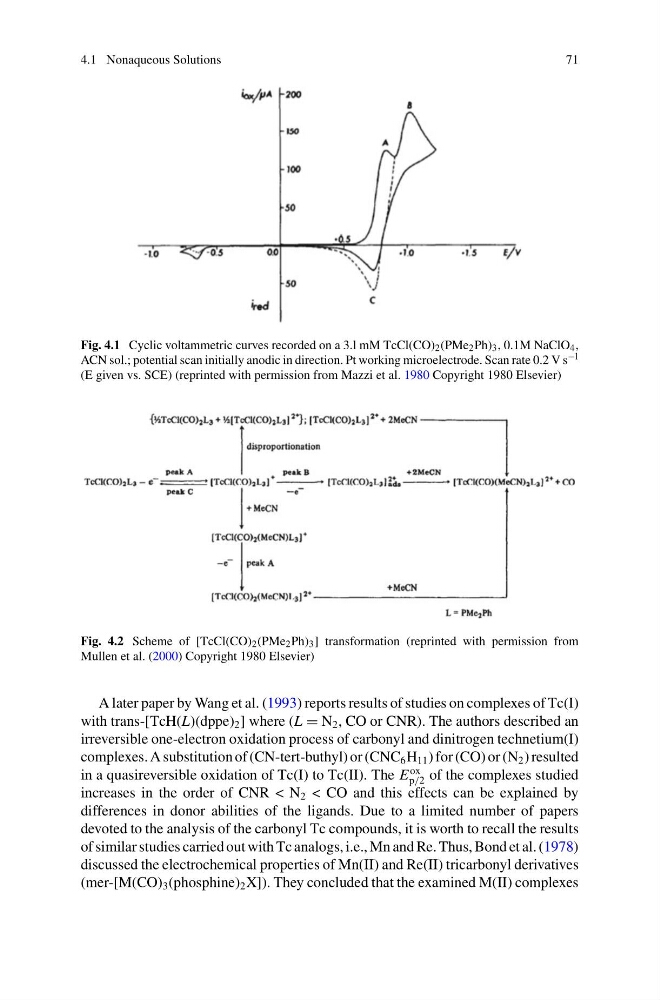
Fig. 4.1 Cyclic voltammetric curves recorded on a 3.l mM TcCl(CO) 2 (PMe 2 Ph) 3 , 0.1M NaClO 4 ,
ACN sol.; potential scan initially anodic in direction. Pt working microelectrode. Scan rate 0.2 V s −l
(E given vs. SCE) (reprinted with permission from Mazzi et al. 1980 Copyright 1980 Elsevier)
Fig. 4.2 Scheme of [TcCl(CO) 2 (PMe 2 Ph) 3 ] transformation (reprinted with permission from
Mullen et al. (2000) Copyright 1980 Elsevier)
A later paper by Wang et al. (1993) reports results of studies on complexes of Tc(I)
with trans-[TcH(L)(dppe) 2 ] where (L = N 2 , CO or CNR). The authors described an
irreversible one-electron oxidation process of carbonyl and dinitrogen technetium(I)
complexes. A substitution of (CN-tert-buthyl) or (CNC 6 H 11 ) for (CO) or (N 2 ) resulted
in a quasireversible oxidation of Tc(I) to Tc(II). The E
ox
p/2 of the complexes studied
increases in the order of CNR < N 2 < CO and this effects can be explained by
differences in donor abilities of the ligands. Due to a limited number of papers
devoted to the analysis of the carbonyl Tc compounds, it is worth to recall the results
of similar studies carried out with Tc analogs, i.e., Mn and Re. Thus, Bond et al. (1978)
discussed the electrochemical properties of Mn(II) and Re(II) tricarbonyl derivatives
(mer-[M(CO) 3 (phosphine) 2 X]). They concluded that the examined M(II) complexes
71
Fig. 4.1 Cyclic voltammetric curves recorded on a 3.l mM TcCl(CO) 2 (PMe 2 Ph) 3 , 0.1M NaClO 4 ,
ACN sol.; potential scan initially anodic in direction. Pt working microelectrode. Scan rate 0.2 V s −l
(E given vs. SCE) (reprinted with permission from Mazzi et al. 1980 Copyright 1980 Elsevier)
Fig. 4.2 Scheme of [TcCl(CO) 2 (PMe 2 Ph) 3 ] transformation (reprinted with permission from
Mullen et al. (2000) Copyright 1980 Elsevier)
A later paper by Wang et al. (1993) reports results of studies on complexes of Tc(I)
with trans-[TcH(L)(dppe) 2 ] where (L = N 2 , CO or CNR). The authors described an
irreversible one-electron oxidation process of carbonyl and dinitrogen technetium(I)
complexes. A substitution of (CN-tert-buthyl) or (CNC 6 H 11 ) for (CO) or (N 2 ) resulted
in a quasireversible oxidation of Tc(I) to Tc(II). The E
ox
p/2 of the complexes studied
increases in the order of CNR < N 2 < CO and this effects can be explained by
differences in donor abilities of the ligands. Due to a limited number of papers
devoted to the analysis of the carbonyl Tc compounds, it is worth to recall the results
of similar studies carried out with Tc analogs, i.e., Mn and Re. Thus, Bond et al. (1978)
discussed the electrochemical properties of Mn(II) and Re(II) tricarbonyl derivatives
(mer-[M(CO) 3 (phosphine) 2 X]). They concluded that the examined M(II) complexes