

42
3 Technetium Coordinated by Inorganic Ligands in Aqueous …
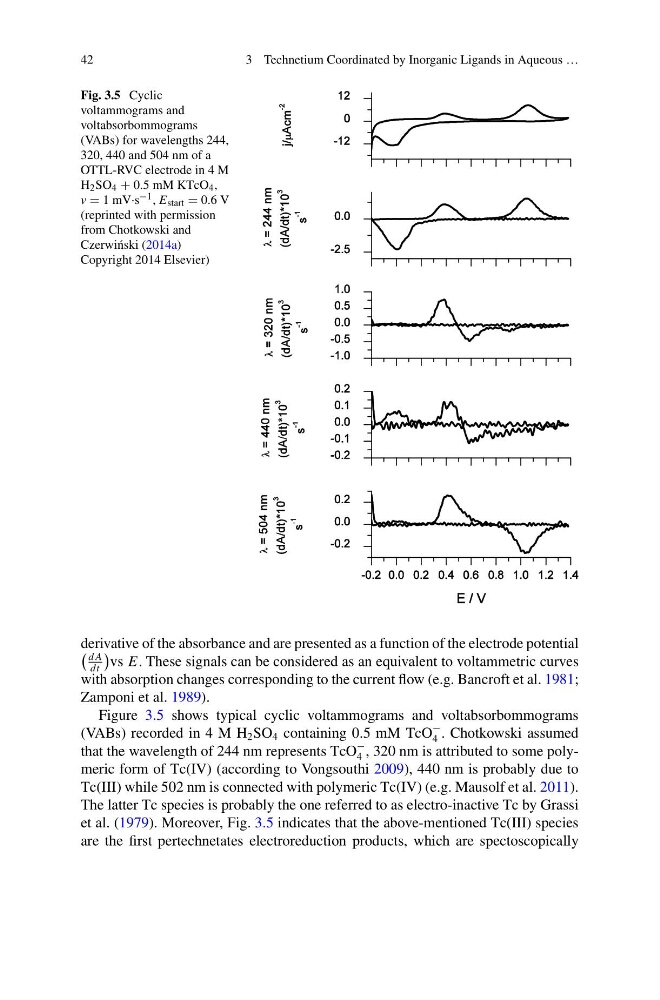
Fig. 3.5 Cyclic
voltammograms and
voltabsorbommograms
(VABs) for wavelengths 244,
320, 440 and 504 nm of a
OTTL-RVC electrode in 4 M
H 2 SO 4 + 0.5 mM KTcO 4 ,
v = 1 mV·s −1 , E start = 0.6 V
(reprinted with permission
from Chotkowski and
Czerwi´ nski (2014a)
Copyright 2014 Elsevier)
derivative of the absorbance and are presented as a function of the electrode potential
d A
dt
vs E. These signals can be considered as an equivalent to voltammetric curves
with absorption changes corresponding to the current flow (e.g. Bancroft et al. 1981;
Zamponi et al. 1989).
Figure 3.5 shows typical cyclic voltammograms and voltabsorbommograms
(VABs) recorded in 4 M H 2 SO 4 containing 0.5 mM TcO
−
4 . Chotkowski assumed
that the wavelength of 244 nm represents TcO
−
4 , 320 nm is attributed to some polymeric form of Tc(IV) (according to Vongsouthi 2009), 440 nm is probably due to
Tc(III) while 502 nm is connected with polymeric Tc(IV) (e.g. Mausolf et al. 2011).
The latter Tc species is probably the one referred to as electro-inactive Tc by Grassi
et al. (1979). Moreover, Fig. 3.5 indicates that the above-mentioned Tc(III) species
are the first pertechnetates electroreduction products, which are spectoscopically
3 Technetium Coordinated by Inorganic Ligands in Aqueous …
Fig. 3.5 Cyclic
voltammograms and
voltabsorbommograms
(VABs) for wavelengths 244,
320, 440 and 504 nm of a
OTTL-RVC electrode in 4 M
H 2 SO 4 + 0.5 mM KTcO 4 ,
v = 1 mV·s −1 , E start = 0.6 V
(reprinted with permission
from Chotkowski and
Czerwi´ nski (2014a)
Copyright 2014 Elsevier)
derivative of the absorbance and are presented as a function of the electrode potential
d A
dt
vs E. These signals can be considered as an equivalent to voltammetric curves
with absorption changes corresponding to the current flow (e.g. Bancroft et al. 1981;
Zamponi et al. 1989).
Figure 3.5 shows typical cyclic voltammograms and voltabsorbommograms
(VABs) recorded in 4 M H 2 SO 4 containing 0.5 mM TcO
−
4 . Chotkowski assumed
that the wavelength of 244 nm represents TcO
−
4 , 320 nm is attributed to some polymeric form of Tc(IV) (according to Vongsouthi 2009), 440 nm is probably due to
Tc(III) while 502 nm is connected with polymeric Tc(IV) (e.g. Mausolf et al. 2011).
The latter Tc species is probably the one referred to as electro-inactive Tc by Grassi
et al. (1979). Moreover, Fig. 3.5 indicates that the above-mentioned Tc(III) species
are the first pertechnetates electroreduction products, which are spectoscopically