

144
6 Determination of Trace Amounts of Tc by Electrochemical Methods
Electroanalytical methods create interesting alternative to expensive advanced
mass spectrometry methods. They allow to determine the technetium at a μmol
dm
−3 and even nmol dm
−3 level.
6.1 Acidic and Neutral Solutions
Lewis et al. (1985) determined electrochemically technetium concentration in acetate
buffer solutions with pH of 4.8. Anodic stripping voltammperometry (ASV) and
chronocoulometry on a wax-impregnated graphite electrode (WIGE) were selected
as the electroanalytical techniques. The preconcentration of technetium at the electrode was carried out at −0.90 V versus Hg, Hg 2 Cl 2(NaClsat.) for 10 min under stirring
conditions. Application of more negative potentials was excluded due to interferences with currents from the hydrogen evolution. The researchers assumed that the
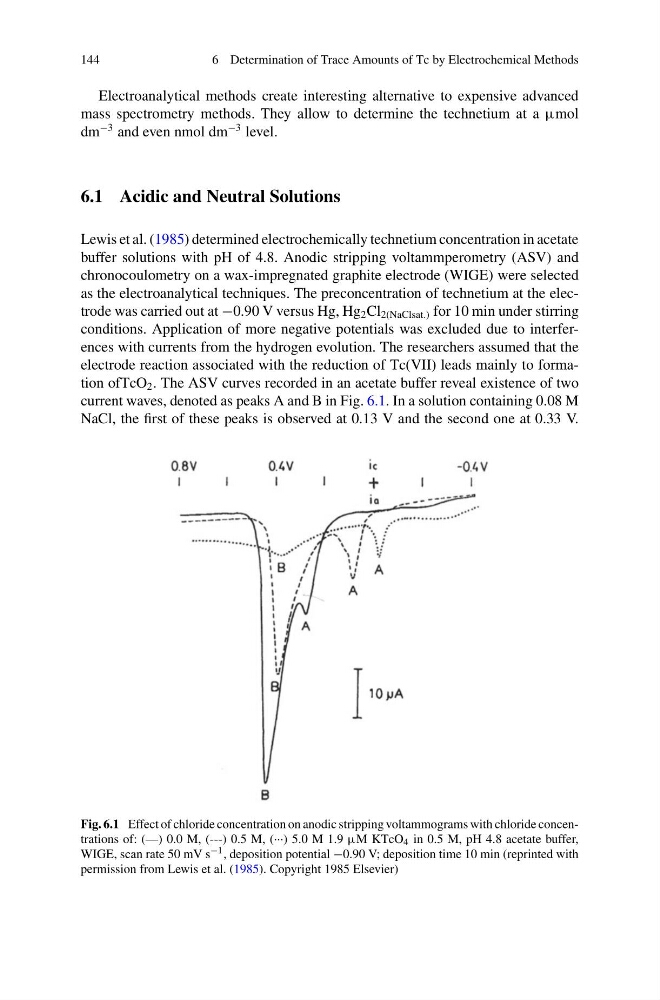
electrode reaction associated with the reduction of Tc(VII) leads mainly to formation ofTcO 2 . The ASV curves recorded in an acetate buffer reveal existence of two
current waves, denoted as peaks A and B in Fig. 6.1. In a solution containing 0.08 M
NaCl, the first of these peaks is observed at 0.13 V and the second one at 0.33 V.
Fig. 6.1 Effect of chloride concentration on anodic stripping voltammograms with chloride concentrations of: (—) 0.0 M, (---) 0.5 M, (···) 5.0 M 1.9 μM KTcO 4 in 0.5 M, pH 4.8 acetate buffer,
WIGE, scan rate 50 mV s −1 , deposition potential −0.90 V; deposition time 10 min (reprinted with
permission from Lewis et al. (1985). Copyright 1985 Elsevier)
6 Determination of Trace Amounts of Tc by Electrochemical Methods
Electroanalytical methods create interesting alternative to expensive advanced
mass spectrometry methods. They allow to determine the technetium at a μmol
dm
−3 and even nmol dm
−3 level.
6.1 Acidic and Neutral Solutions
Lewis et al. (1985) determined electrochemically technetium concentration in acetate
buffer solutions with pH of 4.8. Anodic stripping voltammperometry (ASV) and
chronocoulometry on a wax-impregnated graphite electrode (WIGE) were selected
as the electroanalytical techniques. The preconcentration of technetium at the electrode was carried out at −0.90 V versus Hg, Hg 2 Cl 2(NaClsat.) for 10 min under stirring
conditions. Application of more negative potentials was excluded due to interferences with currents from the hydrogen evolution. The researchers assumed that the
electrode reaction associated with the reduction of Tc(VII) leads mainly to formation ofTcO 2 . The ASV curves recorded in an acetate buffer reveal existence of two
current waves, denoted as peaks A and B in Fig. 6.1. In a solution containing 0.08 M
NaCl, the first of these peaks is observed at 0.13 V and the second one at 0.33 V.
Fig. 6.1 Effect of chloride concentration on anodic stripping voltammograms with chloride concentrations of: (—) 0.0 M, (---) 0.5 M, (···) 5.0 M 1.9 μM KTcO 4 in 0.5 M, pH 4.8 acetate buffer,
WIGE, scan rate 50 mV s −1 , deposition potential −0.90 V; deposition time 10 min (reprinted with
permission from Lewis et al. (1985). Copyright 1985 Elsevier)