

114
5 Metallic Technetium, Corrosion, Technetium Alloys …
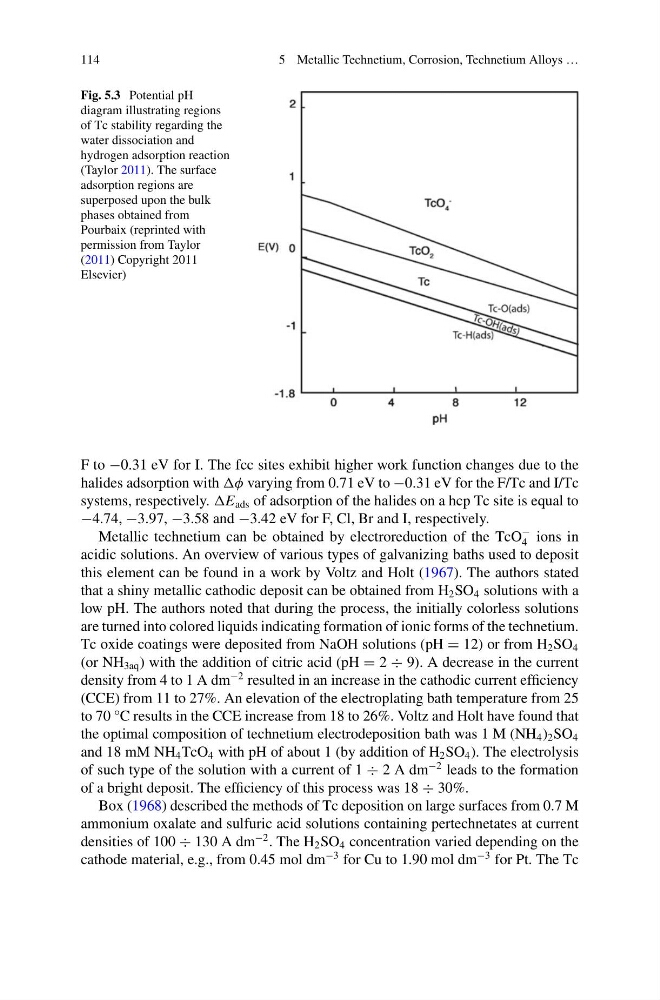
Fig. 5.3 Potential pH
diagram illustrating regions
of Tc stability regarding the
water dissociation and
hydrogen adsorption reaction
(Taylor 2011). The surface
adsorption regions are
superposed upon the bulk
phases obtained from
Pourbaix (reprinted with
permission from Taylor
(2011) Copyright 2011
Elsevier)
F to −0.31 eV for I. The fcc sites exhibit higher work function changes due to the
halides adsorption with φ varying from 0.71 eV to −0.31 eV for the F/Tc and I/Tc
systems, respectively. E ads of adsorption of the halides on a hcp Tc site is equal to
−4.74, −3.97, −3.58 and −3.42 eV for F, Cl, Br and I, respectively.
Metallic technetium can be obtained by electroreduction of the TcO
−
4 ions in
acidic solutions. An overview of various types of galvanizing baths used to deposit
this element can be found in a work by Voltz and Holt (1967). The authors stated
that a shiny metallic cathodic deposit can be obtained from H 2 SO 4 solutions with a
low pH. The authors noted that during the process, the initially colorless solutions
are turned into colored liquids indicating formation of ionic forms of the technetium.
Tc oxide coatings were deposited from NaOH solutions (pH = 12) or from H 2 SO 4
(or NH 3aq ) with the addition of citric acid (pH = 2 ÷ 9). A decrease in the current
density from 4 to 1 A dm
−2 resulted in an increase in the cathodic current efficiency
(CCE) from 11 to 27%. An elevation of the electroplating bath temperature from 25
to 70 °C results in the CCE increase from 18 to 26%. Voltz and Holt have found that
the optimal composition of technetium electrodeposition bath was 1 M (NH 4 ) 2 SO 4
and 18 mM NH 4 TcO 4 with pH of about 1 (by addition of H 2 SO 4 ). The electrolysis
of such type of the solution with a current of 1 ÷ 2 A dm
−2 leads to the formation
of a bright deposit. The efficiency of this process was 18 ÷ 30%.
Box (1968) described the methods of Tc deposition on large surfaces from 0.7 M
ammonium oxalate and sulfuric acid solutions containing pertechnetates at current
densities of 100 ÷ 130 A dm
−2 . The H 2 SO 4 concentration varied depending on the
cathode material, e.g., from 0.45 mol dm
−3 for Cu to 1.90 mol dm
−3 for Pt. The Tc
5 Metallic Technetium, Corrosion, Technetium Alloys …
Fig. 5.3 Potential pH
diagram illustrating regions
of Tc stability regarding the
water dissociation and
hydrogen adsorption reaction
(Taylor 2011). The surface
adsorption regions are
superposed upon the bulk
phases obtained from
Pourbaix (reprinted with
permission from Taylor
(2011) Copyright 2011
Elsevier)
F to −0.31 eV for I. The fcc sites exhibit higher work function changes due to the
halides adsorption with φ varying from 0.71 eV to −0.31 eV for the F/Tc and I/Tc
systems, respectively. E ads of adsorption of the halides on a hcp Tc site is equal to
−4.74, −3.97, −3.58 and −3.42 eV for F, Cl, Br and I, respectively.
Metallic technetium can be obtained by electroreduction of the TcO
−
4 ions in
acidic solutions. An overview of various types of galvanizing baths used to deposit
this element can be found in a work by Voltz and Holt (1967). The authors stated
that a shiny metallic cathodic deposit can be obtained from H 2 SO 4 solutions with a
low pH. The authors noted that during the process, the initially colorless solutions
are turned into colored liquids indicating formation of ionic forms of the technetium.
Tc oxide coatings were deposited from NaOH solutions (pH = 12) or from H 2 SO 4
(or NH 3aq ) with the addition of citric acid (pH = 2 ÷ 9). A decrease in the current
density from 4 to 1 A dm
−2 resulted in an increase in the cathodic current efficiency
(CCE) from 11 to 27%. An elevation of the electroplating bath temperature from 25
to 70 °C results in the CCE increase from 18 to 26%. Voltz and Holt have found that
the optimal composition of technetium electrodeposition bath was 1 M (NH 4 ) 2 SO 4
and 18 mM NH 4 TcO 4 with pH of about 1 (by addition of H 2 SO 4 ). The electrolysis
of such type of the solution with a current of 1 ÷ 2 A dm
−2 leads to the formation
of a bright deposit. The efficiency of this process was 18 ÷ 30%.
Box (1968) described the methods of Tc deposition on large surfaces from 0.7 M
ammonium oxalate and sulfuric acid solutions containing pertechnetates at current
densities of 100 ÷ 130 A dm
−2 . The H 2 SO 4 concentration varied depending on the
cathode material, e.g., from 0.45 mol dm
−3 for Cu to 1.90 mol dm
−3 for Pt. The Tc