

72
situation in Italy changed again. The Papal Government was reestablished and the
Jesuits could return to Rome. The premature death of Fr. Francesco De Vico
(1805–1848) had left vacant the directorship of the Collegio Romano Observatory,
but Fr. Benedetto Sestini (1816–1890), De Vico’s former assistant and presumptive
successor, preferred to remain at work in the United States. This circumstance
opened the door to Secchi, who at 30 years old was appointed Director of the
Collegio Romano Observatory. Assigning a physicist the job of an astronomer
turned out to be crucial for the future scientific programme of the observatory.
After testing the old instruments and making some restoration of the rooms,
Secchi became aware of the unsuitability of the observatory’s location. In the years
following the suppression of the Society of Jesus, the priest astronomer Giuseppe
Calandrelli (1749–1827) had installed some astronomical instruments in a tower of
the Collegio Romano; and when the restored Society returned to the Collegio
Romano, some equipment had been upgraded. But given the flexure and general
instability of the tower, it had become clear that the tower was unsuitable for accurate measurements of astronomical observations. It was necessary to find a new
location.
In 1851, while repeating Foucault’s famous experiment by suspending a pendulum from the ceiling of the Jesuit Church of St. Ignatius, which was located at the
back of the Collegio Romano, Secchi certainly would have explored its roof. This
circumstance probably recalled to his mind a project by Ruggiero Boscovich SJ
(1711-1787), who had proposed to build a new observatory atop St. Ignatius Church.
The astronomical instruments could be very solidly based on the pillars which originally had been constructed to support a dome that had never been built - a trompel’oeil design on the flat ceiling of the church by the Jesuit architect and painter
Andrea Pozzo (1642–1709) had substituted for the original planned dome.
In 1852, Secchi obtained permission from his Superiors and started to build the
new observatory (Altamore et al., here), with the financial help of Pope Pius IX
(1792–1878), who was an amateur astronomer. There Secchi installed the main preexisting instruments and a new Merz telescope, the largest in Italy at that time. He
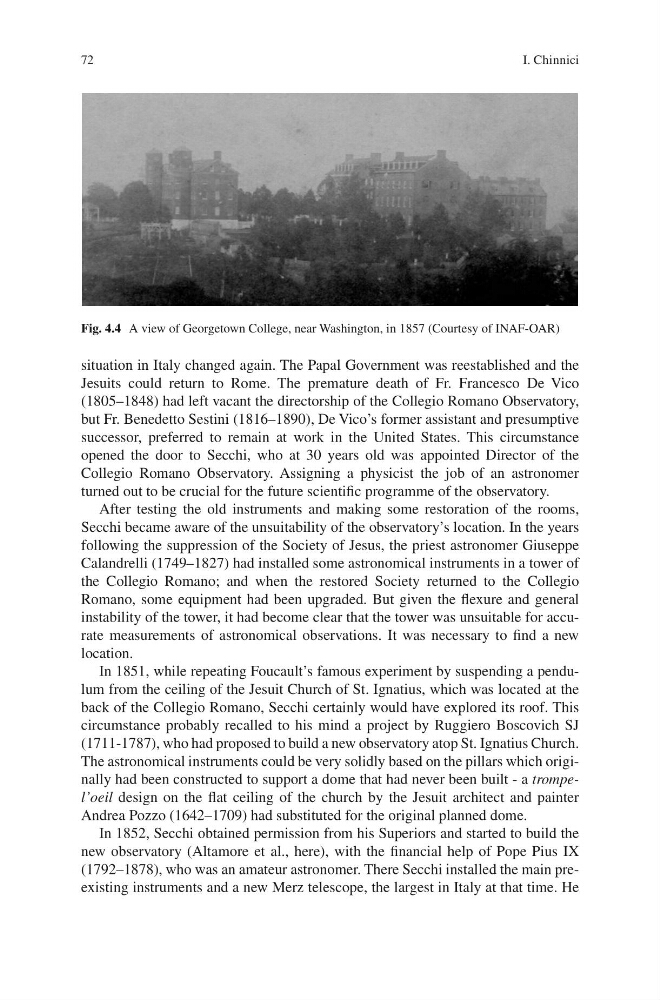
Fig. 4.4 A view of Georgetown College, near Washington, in 1857 (Courtesy of INAF-OAR)
I. Chinnici
situation in Italy changed again. The Papal Government was reestablished and the
Jesuits could return to Rome. The premature death of Fr. Francesco De Vico
(1805–1848) had left vacant the directorship of the Collegio Romano Observatory,
but Fr. Benedetto Sestini (1816–1890), De Vico’s former assistant and presumptive
successor, preferred to remain at work in the United States. This circumstance
opened the door to Secchi, who at 30 years old was appointed Director of the
Collegio Romano Observatory. Assigning a physicist the job of an astronomer
turned out to be crucial for the future scientific programme of the observatory.
After testing the old instruments and making some restoration of the rooms,
Secchi became aware of the unsuitability of the observatory’s location. In the years
following the suppression of the Society of Jesus, the priest astronomer Giuseppe
Calandrelli (1749–1827) had installed some astronomical instruments in a tower of
the Collegio Romano; and when the restored Society returned to the Collegio
Romano, some equipment had been upgraded. But given the flexure and general
instability of the tower, it had become clear that the tower was unsuitable for accurate measurements of astronomical observations. It was necessary to find a new
location.
In 1851, while repeating Foucault’s famous experiment by suspending a pendulum from the ceiling of the Jesuit Church of St. Ignatius, which was located at the
back of the Collegio Romano, Secchi certainly would have explored its roof. This
circumstance probably recalled to his mind a project by Ruggiero Boscovich SJ
(1711-1787), who had proposed to build a new observatory atop St. Ignatius Church.
The astronomical instruments could be very solidly based on the pillars which originally had been constructed to support a dome that had never been built - a trompel’oeil design on the flat ceiling of the church by the Jesuit architect and painter
Andrea Pozzo (1642–1709) had substituted for the original planned dome.
In 1852, Secchi obtained permission from his Superiors and started to build the
new observatory (Altamore et al., here), with the financial help of Pope Pius IX
(1792–1878), who was an amateur astronomer. There Secchi installed the main preexisting instruments and a new Merz telescope, the largest in Italy at that time. He
Fig. 4.4 A view of Georgetown College, near Washington, in 1857 (Courtesy of INAF-OAR)
I. Chinnici