

57
3.5 Secchi’s Views on Christian Faith and Scientific Research
During the years in which Secchi directed the Observatory of the Roman College, a
lively debate was emerging in Europe about the evolutionary vision of life and the
origin of the human being, following the works published by Charles Darwin.
Secchi does not tackle explicitly the issue of the origin of man, but he offers a view
on the confrontation between creation and evolution. As in other issues, he underlines the insufficiency of matter to explain the phenomenology of living beings,
especially that of human thought and freedom. It is not because of an anthropomorphic projection that we place thought and intelligence at the origin of all things, he
says; we do so because, thanks to our experimental knowledge, we are aware of
matter and its properties and we recognize they are inadequate to provide a complete and exhaustive explanation of reality and of its ultimate causes (Secchi
1879: 202).
The idea of subsequent transformations, taken with due moderation, is not irreconcilable
with reason, nor with religion. In fact, if one does not want everything to be caused by the
brute innate forces of matter, but admits that these forces derive from a First Cause who
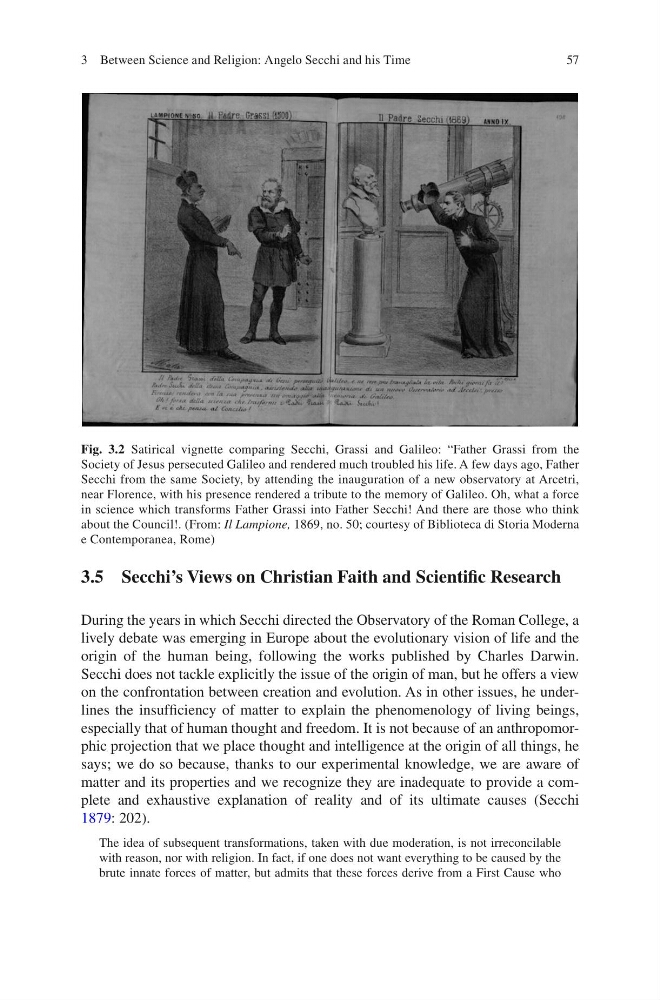
Fig. 3.2 Satirical vignette comparing Secchi, Grassi and Galileo: “Father Grassi from the
Society of Jesus persecuted Galileo and rendered much troubled his life. A few days ago, Father
Secchi from the same Society, by attending the inauguration of a new observatory at Arcetri,
near Florence, with his presence rendered a tribute to the memory of Galileo. Oh, what a force
in science which transforms Father Grassi into Father Secchi! And there are those who think
about the Council!. (From: Il Lampione, 1869, no. 50; courtesy of Biblioteca di Storia Moderna
e Contemporanea, Rome)
3 Between Science and Religion: Angelo Secchi and his Time
3.5 Secchi’s Views on Christian Faith and Scientific Research
During the years in which Secchi directed the Observatory of the Roman College, a
lively debate was emerging in Europe about the evolutionary vision of life and the
origin of the human being, following the works published by Charles Darwin.
Secchi does not tackle explicitly the issue of the origin of man, but he offers a view
on the confrontation between creation and evolution. As in other issues, he underlines the insufficiency of matter to explain the phenomenology of living beings,
especially that of human thought and freedom. It is not because of an anthropomorphic projection that we place thought and intelligence at the origin of all things, he
says; we do so because, thanks to our experimental knowledge, we are aware of
matter and its properties and we recognize they are inadequate to provide a complete and exhaustive explanation of reality and of its ultimate causes (Secchi
1879: 202).
The idea of subsequent transformations, taken with due moderation, is not irreconcilable
with reason, nor with religion. In fact, if one does not want everything to be caused by the
brute innate forces of matter, but admits that these forces derive from a First Cause who
Fig. 3.2 Satirical vignette comparing Secchi, Grassi and Galileo: “Father Grassi from the
Society of Jesus persecuted Galileo and rendered much troubled his life. A few days ago, Father
Secchi from the same Society, by attending the inauguration of a new observatory at Arcetri,
near Florence, with his presence rendered a tribute to the memory of Galileo. Oh, what a force
in science which transforms Father Grassi into Father Secchi! And there are those who think
about the Council!. (From: Il Lampione, 1869, no. 50; courtesy of Biblioteca di Storia Moderna
e Contemporanea, Rome)
3 Between Science and Religion: Angelo Secchi and his Time