

19
a Palmieri
1
electrometer for measuring atmospheric electricity; the electrical section
also measured terrestrial electrical currents, with instrumentation connected to the
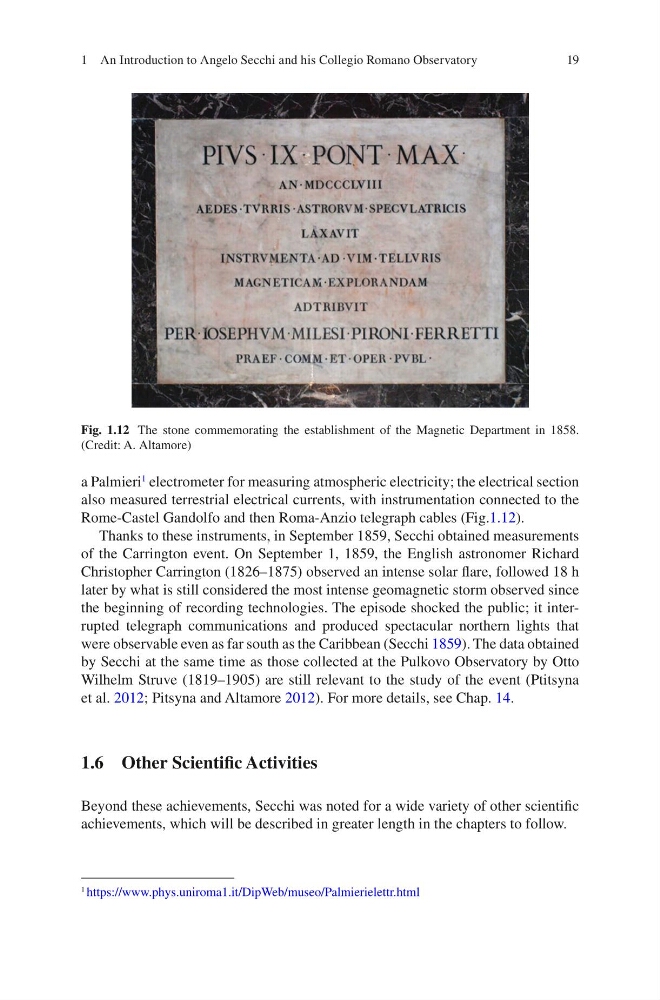
Rome-Castel Gandolfo and then Roma-Anzio telegraph cables (Fig.1.12).
Thanks to these instruments, in September 1859, Secchi obtained measurements
of the Carrington event. On September 1, 1859, the English astronomer Richard
Christopher Carrington (1826–1875) observed an intense solar flare, followed 18 h
later by what is still considered the most intense geomagnetic storm observed since
the beginning of recording technologies. The episode shocked the public; it interrupted telegraph communications and produced spectacular northern lights that
were observable even as far south as the Caribbean (Secchi 1859). The data obtained
by Secchi at the same time as those collected at the Pulkovo Observatory by Otto
Wilhelm Struve (1819–1905) are still relevant to the study of the event (Ptitsyna
et al. 2012; Pitsyna and Altamore 2012). For more details, see Chap. 14.
1.6 Other Scientific Activities
Beyond these achievements, Secchi was noted for a wide variety of other scientific
achievements, which will be described in greater length in the chapters to follow.
1 https://www.phys.uniroma1.it/DipWeb/museo/Palmierielettr.html
Fig. 1.12 The stone commemorating the establishment of the Magnetic Department in 1858.
(Credit: A. Altamore)
1 An Introduction to Angelo Secchi and his Collegio Romano Observatory
a Palmieri
1
electrometer for measuring atmospheric electricity; the electrical section
also measured terrestrial electrical currents, with instrumentation connected to the
Rome-Castel Gandolfo and then Roma-Anzio telegraph cables (Fig.1.12).
Thanks to these instruments, in September 1859, Secchi obtained measurements
of the Carrington event. On September 1, 1859, the English astronomer Richard
Christopher Carrington (1826–1875) observed an intense solar flare, followed 18 h
later by what is still considered the most intense geomagnetic storm observed since
the beginning of recording technologies. The episode shocked the public; it interrupted telegraph communications and produced spectacular northern lights that
were observable even as far south as the Caribbean (Secchi 1859). The data obtained
by Secchi at the same time as those collected at the Pulkovo Observatory by Otto
Wilhelm Struve (1819–1905) are still relevant to the study of the event (Ptitsyna
et al. 2012; Pitsyna and Altamore 2012). For more details, see Chap. 14.
1.6 Other Scientific Activities
Beyond these achievements, Secchi was noted for a wide variety of other scientific
achievements, which will be described in greater length in the chapters to follow.
1 https://www.phys.uniroma1.it/DipWeb/museo/Palmierielettr.html
Fig. 1.12 The stone commemorating the establishment of the Magnetic Department in 1858.
(Credit: A. Altamore)
1 An Introduction to Angelo Secchi and his Collegio Romano Observatory