

16
beginning to be applied to astronomy in those years. During the 1860 total solar
eclipse, observed at the Desierto de Las Palmas in Spain, Secchi obtained photographic images of the prominences. When these were compared with those collected by the British astronomer Warren de la Rue (1815–1889) at Rivabellosa, it
was possible to definitively confirm their solar nature and rule out a lunar or instrumental origin of the phenomenon.
The application of spectroscopic techniques allowed Secchi and Tacchini (working simultaneously with almost identical instruments in Rome and Palermo) to
obtain extremely detailed drawings of solar prominences through eye observations
with a refined spectroscopic scanning technique in the H-alpha line. These observations also allowed them to follow the time evolution of the structure of the chromosphere. A detailed description of this work will be found in Chap. 7 (Figs. 1.10
and 1.11).
With his determination to find correlations between variations of the Earth’s
magnetic field and solar phenomena, Angelo Secchi can also be considered a pioneer in studies of the Sun–Earth Connection, sometimes called Space Weather. This
is the study of the interactions of solar activity with the Earth’s magnetic field. The
goal today is to be able to predict these phenomena, because they can pose a serious
risk to the smooth functioning of modern telecommunications, electricity grids,
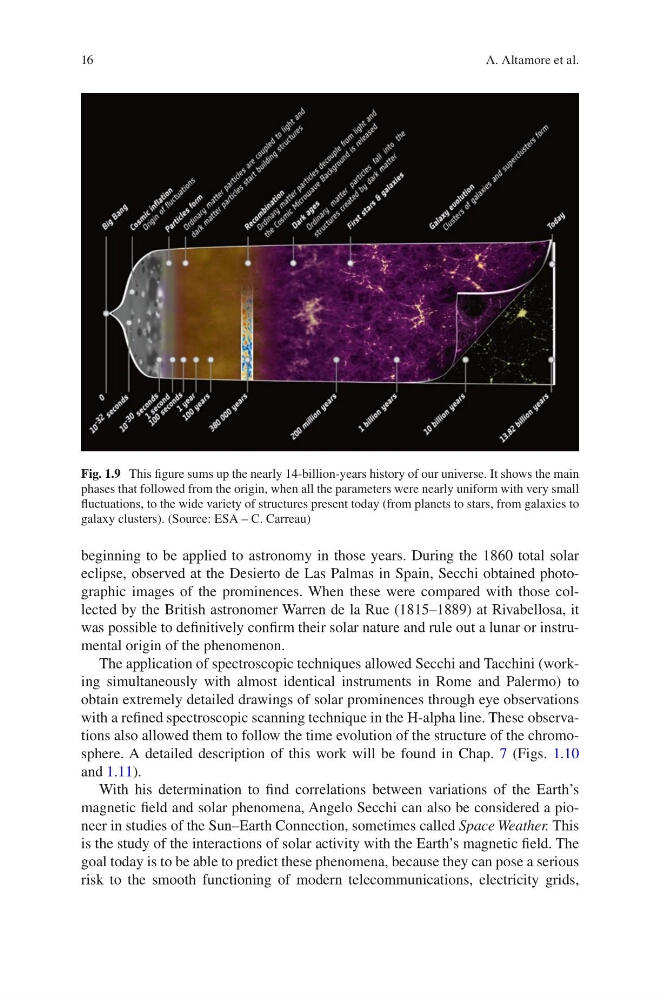
Fig. 1.9 This figure sums up the nearly 14-billion-years history of our universe. It shows the main
phases that followed from the origin, when all the parameters were nearly uniform with very small
fluctuations, to the wide variety of structures present today (from planets to stars, from galaxies to
galaxy clusters). (Source: ESA – C. Carreau)
A. Altamore et al.
beginning to be applied to astronomy in those years. During the 1860 total solar
eclipse, observed at the Desierto de Las Palmas in Spain, Secchi obtained photographic images of the prominences. When these were compared with those collected by the British astronomer Warren de la Rue (1815–1889) at Rivabellosa, it
was possible to definitively confirm their solar nature and rule out a lunar or instrumental origin of the phenomenon.
The application of spectroscopic techniques allowed Secchi and Tacchini (working simultaneously with almost identical instruments in Rome and Palermo) to
obtain extremely detailed drawings of solar prominences through eye observations
with a refined spectroscopic scanning technique in the H-alpha line. These observations also allowed them to follow the time evolution of the structure of the chromosphere. A detailed description of this work will be found in Chap. 7 (Figs. 1.10
and 1.11).
With his determination to find correlations between variations of the Earth’s
magnetic field and solar phenomena, Angelo Secchi can also be considered a pioneer in studies of the Sun–Earth Connection, sometimes called Space Weather. This
is the study of the interactions of solar activity with the Earth’s magnetic field. The
goal today is to be able to predict these phenomena, because they can pose a serious
risk to the smooth functioning of modern telecommunications, electricity grids,
Fig. 1.9 This figure sums up the nearly 14-billion-years history of our universe. It shows the main
phases that followed from the origin, when all the parameters were nearly uniform with very small
fluctuations, to the wide variety of structures present today (from planets to stars, from galaxies to
galaxy clusters). (Source: ESA – C. Carreau)
A. Altamore et al.