

14
via better models of their evolution and to understanding the ages of clusters and so
to the evolution of galaxies, starting with our own Milky Way.
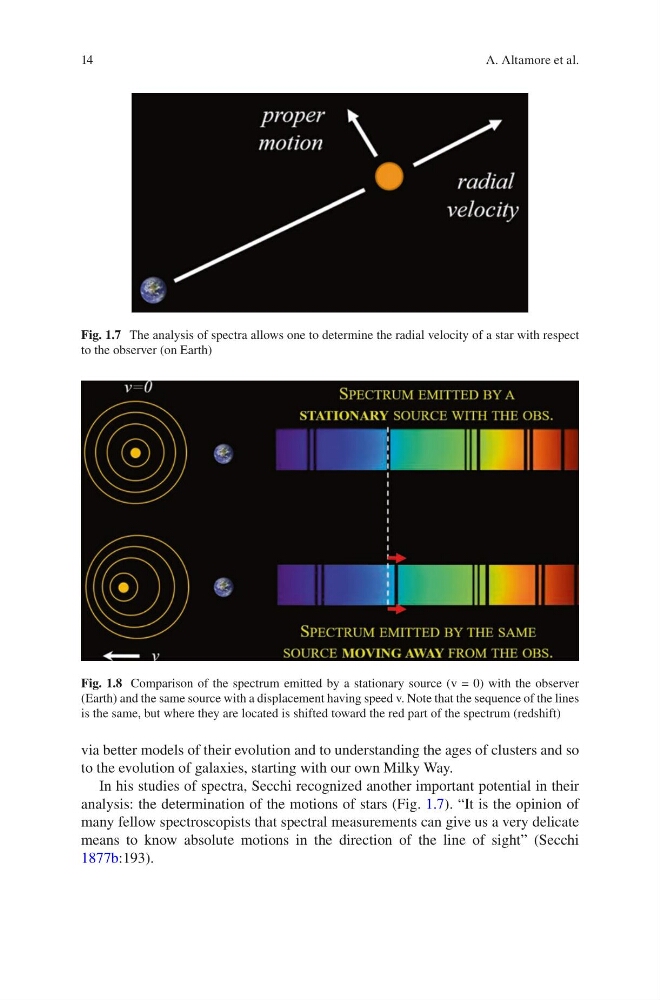
In his studies of spectra, Secchi recognized another important potential in their
analysis: the determination of the motions of stars (Fig. 1.7). “It is the opinion of
many fellow spectroscopists that spectral measurements can give us a very delicate
means to know absolute motions in the direction of the line of sight” (Secchi
1877b:193).
Fig. 1.7 The analysis of spectra allows one to determine the radial velocity of a star with respect
to the observer (on Earth)
Fig. 1.8 Comparison of the spectrum emitted by a stationary source (v = 0) with the observer
(Earth) and the same source with a displacement having speed v. Note that the sequence of the lines
is the same, but where they are located is shifted toward the red part of the spectrum (redshift)
A. Altamore et al.
via better models of their evolution and to understanding the ages of clusters and so
to the evolution of galaxies, starting with our own Milky Way.
In his studies of spectra, Secchi recognized another important potential in their
analysis: the determination of the motions of stars (Fig. 1.7). “It is the opinion of
many fellow spectroscopists that spectral measurements can give us a very delicate
means to know absolute motions in the direction of the line of sight” (Secchi
1877b:193).
Fig. 1.7 The analysis of spectra allows one to determine the radial velocity of a star with respect
to the observer (on Earth)
Fig. 1.8 Comparison of the spectrum emitted by a stationary source (v = 0) with the observer
(Earth) and the same source with a displacement having speed v. Note that the sequence of the lines
is the same, but where they are located is shifted toward the red part of the spectrum (redshift)
A. Altamore et al.