

332
Bianchi was pushed by Mussolini himself to locate the new observatory outside
of Rome, but not too far away so that it could be reached quickly and easily. He
chose Monte Porzio Catone, a small town in the Colli Albani area, just below the
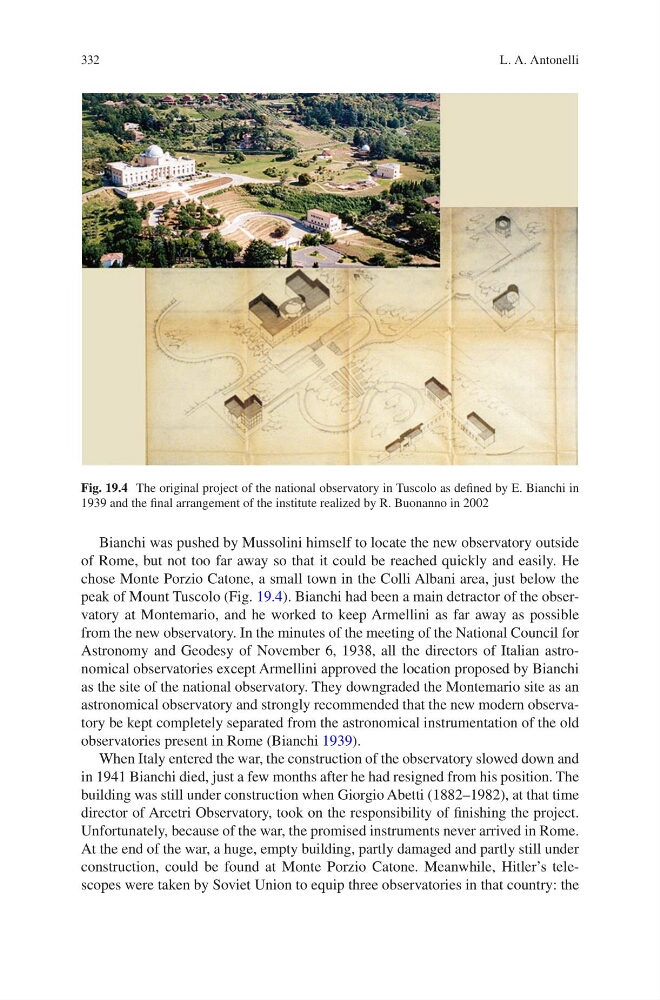
peak of Mount Tuscolo (Fig. 19.4). Bianchi had been a main detractor of the observatory at Montemario, and he worked to keep Armellini as far away as possible
from the new observatory. In the minutes of the meeting of the National Council for
Astronomy and Geodesy of November 6, 1938, all the directors of Italian astronomical observatories except Armellini approved the location proposed by Bianchi
as the site of the national observatory. They downgraded the Montemario site as an
astronomical observatory and strongly recommended that the new modern observatory be kept completely separated from the astronomical instrumentation of the old
observatories present in Rome (Bianchi 1939).
When Italy entered the war, the construction of the observatory slowed down and
in 1941 Bianchi died, just a few months after he had resigned from his position. The
building was still under construction when Giorgio Abetti (1882–1982), at that time
director of Arcetri Observatory, took on the responsibility of finishing the project.
Unfortunately, because of the war, the promised instruments never arrived in Rome.
At the end of the war, a huge, empty building, partly damaged and partly still under
construction, could be found at Monte Porzio Catone. Meanwhile, Hitler’s telescopes were taken by Soviet Union to equip three observatories in that country: the
Fig. 19.4 The original project of the national observatory in Tuscolo as defined by E. Bianchi in
1939 and the final arrangement of the institute realized by R. Buonanno in 2002
L. A. Antonelli
Bianchi was pushed by Mussolini himself to locate the new observatory outside
of Rome, but not too far away so that it could be reached quickly and easily. He
chose Monte Porzio Catone, a small town in the Colli Albani area, just below the
peak of Mount Tuscolo (Fig. 19.4). Bianchi had been a main detractor of the observatory at Montemario, and he worked to keep Armellini as far away as possible
from the new observatory. In the minutes of the meeting of the National Council for
Astronomy and Geodesy of November 6, 1938, all the directors of Italian astronomical observatories except Armellini approved the location proposed by Bianchi
as the site of the national observatory. They downgraded the Montemario site as an
astronomical observatory and strongly recommended that the new modern observatory be kept completely separated from the astronomical instrumentation of the old
observatories present in Rome (Bianchi 1939).
When Italy entered the war, the construction of the observatory slowed down and
in 1941 Bianchi died, just a few months after he had resigned from his position. The
building was still under construction when Giorgio Abetti (1882–1982), at that time
director of Arcetri Observatory, took on the responsibility of finishing the project.
Unfortunately, because of the war, the promised instruments never arrived in Rome.
At the end of the war, a huge, empty building, partly damaged and partly still under
construction, could be found at Monte Porzio Catone. Meanwhile, Hitler’s telescopes were taken by Soviet Union to equip three observatories in that country: the
Fig. 19.4 The original project of the national observatory in Tuscolo as defined by E. Bianchi in
1939 and the final arrangement of the institute realized by R. Buonanno in 2002
L. A. Antonelli