

326
In 1824, the Jesuits returned to the Collegio Romano, and Dominique Dumouchel
(1773–1840) was appointed director of the observatory. He immediately looked for
funds for new instruments and was able to obtain a Cauchoix telescope, an incredibly good instrument (Cauchoix 1836) that would be used for scientific observations
for more than a century. In 1838 Francesco De Vico (1805–1848) became the new
director of the observatory, and in 1841 he acquired a new meridian circle by Ertel.
He discovered many comets, and under his direction, the astronomer Benedetto
Sestini (1816–1890) cataloged 2540 stars based on their colors.
With the revolution of 1848 establishing the Roman Republic, the Papal Court
and all of the Jesuits, including the astronomers of the Collegio Romano, had to
leave the city. The Collegio Romano astronomers brought some of their instruments
with them to the USA, but De Vico died in London. In 1849, the Jesuits were able
to come back to Rome, and Angelo Secchi (1818–1878) became the new director of
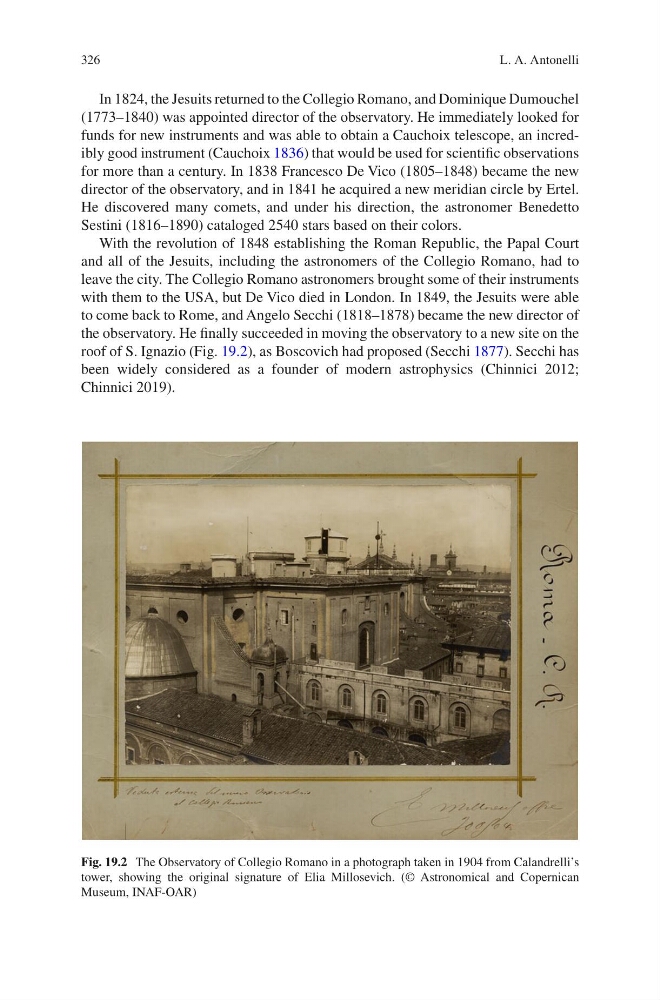
the observatory. He finally succeeded in moving the observatory to a new site on the
roof of S. Ignazio (Fig. 19.2), as Boscovich had proposed (Secchi 1877). Secchi has
been widely considered as a founder of modern astrophysics (Chinnici 2012;
Chinnici 2019).
Fig. 19.2 The Observatory of Collegio Romano in a photograph taken in 1904 from Calandrelli’s
tower, showing the original signature of Elia Millosevich. (© Astronomical and Copernican
Museum, INAF-OAR)
L. A. Antonelli
In 1824, the Jesuits returned to the Collegio Romano, and Dominique Dumouchel
(1773–1840) was appointed director of the observatory. He immediately looked for
funds for new instruments and was able to obtain a Cauchoix telescope, an incredibly good instrument (Cauchoix 1836) that would be used for scientific observations
for more than a century. In 1838 Francesco De Vico (1805–1848) became the new
director of the observatory, and in 1841 he acquired a new meridian circle by Ertel.
He discovered many comets, and under his direction, the astronomer Benedetto
Sestini (1816–1890) cataloged 2540 stars based on their colors.
With the revolution of 1848 establishing the Roman Republic, the Papal Court
and all of the Jesuits, including the astronomers of the Collegio Romano, had to
leave the city. The Collegio Romano astronomers brought some of their instruments
with them to the USA, but De Vico died in London. In 1849, the Jesuits were able
to come back to Rome, and Angelo Secchi (1818–1878) became the new director of
the observatory. He finally succeeded in moving the observatory to a new site on the
roof of S. Ignazio (Fig. 19.2), as Boscovich had proposed (Secchi 1877). Secchi has
been widely considered as a founder of modern astrophysics (Chinnici 2012;
Chinnici 2019).
Fig. 19.2 The Observatory of Collegio Romano in a photograph taken in 1904 from Calandrelli’s
tower, showing the original signature of Elia Millosevich. (© Astronomical and Copernican
Museum, INAF-OAR)
L. A. Antonelli