

315
from the Observatory finally convinced Ellsworth to finance the tower, whose work
had been at an impasse due to the rising prices of postwar inflation (Abetti 1960;
Gasperini et al. 2004). The solar tower was eventually inaugurated in 1925. Although
it was already an aged instrument (essentially, a copy of the one built by Hale in
1908) and located in a place with poor atmospheric and meteorological conditions,
the tower was essential to the development of solar physics studies in Italy
(Righini 2003).
A major achievement of Abetti’s directorship (which lasted until 1952) was the
formation of a school of astrophysicists. Limiting the list to the collaborators of
Abetti who later became directors of Italian observatories, we can find Guglielmo
Righini (1908–1978), a solar physicist who succeeded Abetti as director of Arcetri;
Attilio Colacevich (1906–1953) interested in stellar spectroscopy and optics; Mario
Girolamo Fracastoro (1914–1994) and Margherita Hack (1922–2013), stellar spectroscopists; and Mario Rigutti (b. 1926) and Giovanni Godoli (1927–2006), solar
physicists (Fracastoro 1983). As late as 1974, five of the nine directors of Italian
observatories were from the school of Arcetri (Castellani 2005).
18.7 A Renewed Interest in Italy
At the beginning of 1920, the Società degli Spettroscopisti Italiani was transformed
into Società Astronomica Italiana. As the new president Vincenzo Cerulli
(1859–1927) wrote in the preface of the first volume of the Memorie della Società
Astronomica Italiana, the renaming resulted from the “Società having once been
just a gathering of spectroscopists only, but [now] having extended its activity to all
branches of astronomy (a.t.)” (Cerulli 1920). Moreover, there was hope of getting
new funding and eventually expanding the Society into public outreach, following
the model of other societies abroad. The new Memorie was open “to sciences akin
to astronomy, such as geodesy, celestial mechanics and radiation physics (a.t.)” but
also to the history of astronomy (Cerulli 1920). The change, which transformed
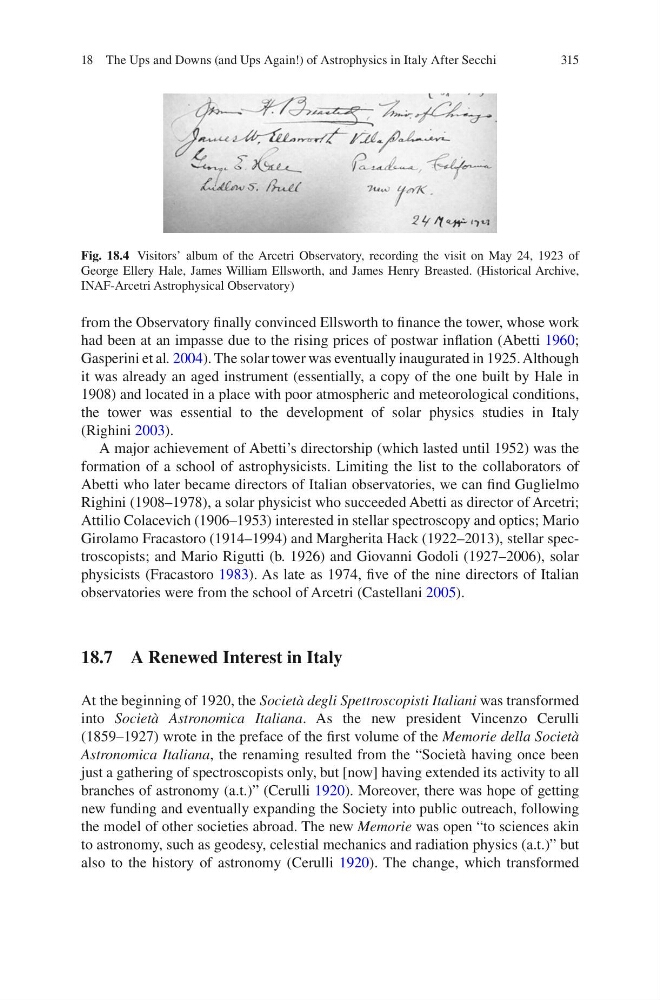
Fig. 18.4 Visitors’ album of the Arcetri Observatory, recording the visit on May 24, 1923 of
George Ellery Hale, James William Ellsworth, and James Henry Breasted. (Historical Archive,
INAF-Arcetri Astrophysical Observatory)
18 The Ups and Downs (and Ups Again!) of Astrophysics in Italy After Secchi
from the Observatory finally convinced Ellsworth to finance the tower, whose work
had been at an impasse due to the rising prices of postwar inflation (Abetti 1960;
Gasperini et al. 2004). The solar tower was eventually inaugurated in 1925. Although
it was already an aged instrument (essentially, a copy of the one built by Hale in
1908) and located in a place with poor atmospheric and meteorological conditions,
the tower was essential to the development of solar physics studies in Italy
(Righini 2003).
A major achievement of Abetti’s directorship (which lasted until 1952) was the
formation of a school of astrophysicists. Limiting the list to the collaborators of
Abetti who later became directors of Italian observatories, we can find Guglielmo
Righini (1908–1978), a solar physicist who succeeded Abetti as director of Arcetri;
Attilio Colacevich (1906–1953) interested in stellar spectroscopy and optics; Mario
Girolamo Fracastoro (1914–1994) and Margherita Hack (1922–2013), stellar spectroscopists; and Mario Rigutti (b. 1926) and Giovanni Godoli (1927–2006), solar
physicists (Fracastoro 1983). As late as 1974, five of the nine directors of Italian
observatories were from the school of Arcetri (Castellani 2005).
18.7 A Renewed Interest in Italy
At the beginning of 1920, the Società degli Spettroscopisti Italiani was transformed
into Società Astronomica Italiana. As the new president Vincenzo Cerulli
(1859–1927) wrote in the preface of the first volume of the Memorie della Società
Astronomica Italiana, the renaming resulted from the “Società having once been
just a gathering of spectroscopists only, but [now] having extended its activity to all
branches of astronomy (a.t.)” (Cerulli 1920). Moreover, there was hope of getting
new funding and eventually expanding the Society into public outreach, following
the model of other societies abroad. The new Memorie was open “to sciences akin
to astronomy, such as geodesy, celestial mechanics and radiation physics (a.t.)” but
also to the history of astronomy (Cerulli 1920). The change, which transformed
Fig. 18.4 Visitors’ album of the Arcetri Observatory, recording the visit on May 24, 1923 of
George Ellery Hale, James William Ellsworth, and James Henry Breasted. (Historical Archive,
INAF-Arcetri Astrophysical Observatory)
18 The Ups and Downs (and Ups Again!) of Astrophysics in Italy After Secchi