

312
The enthusiasm of the young astronomer working with state-of-the-art instrumentation must have been evident. Just a couple of weeks after Abetti’s arrival, Hale
wrote to Riccò: “We are enjoying a visit from Dr. Abetti, who seems to me one of
the brightest and most promising of all the younger men now at work in astronomy.
It is a pleasure to think that the splendid pioneer work of the Italian spectroscopists
is to be carried forward by a man of such ability and training” (Hale 1908).
Abetti left Mount Wilson in May 1909. He passed some time in Pasadena at the
physics laboratory and workshop of the Observatory; on his way back to Italy, he
also visited other institutes, including the Harvard College Observatory, the place
where stellar spectral classification was further developed after Secchi’s initial work
(Abetti 1909).
Hale, who strongly believed in international cooperation, saw in Abetti’s interest
in solar towers the possibility of reviving a project for a solar observatory in Italy
that he had discussed with Tacchini in 1894. However, plans for an Italian solar
tower remained dormant for a while. Abetti took a position as assistant at the
Collegio Romano Observatory, complaining that he had to “do much more astrometry than astrophysics” (Foderà Serio 2005).
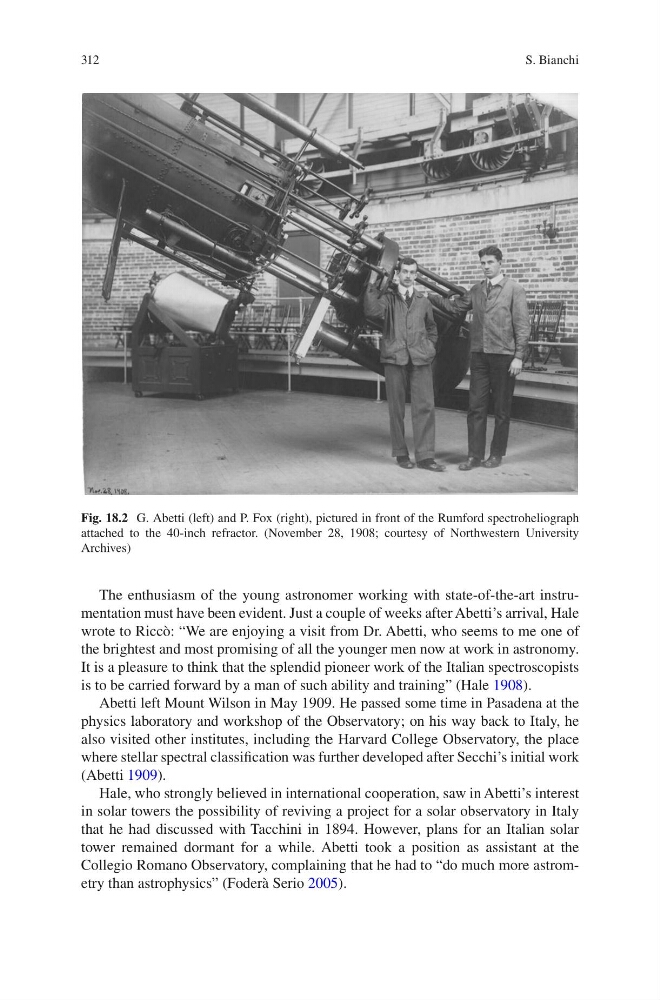
Fig. 18.2 G. Abetti (left) and P. Fox (right), pictured in front of the Rumford spectroheliograph
attached to the 40-inch refractor. (November 28, 1908; courtesy of Northwestern University
Archives)
S. Bianchi
The enthusiasm of the young astronomer working with state-of-the-art instrumentation must have been evident. Just a couple of weeks after Abetti’s arrival, Hale
wrote to Riccò: “We are enjoying a visit from Dr. Abetti, who seems to me one of
the brightest and most promising of all the younger men now at work in astronomy.
It is a pleasure to think that the splendid pioneer work of the Italian spectroscopists
is to be carried forward by a man of such ability and training” (Hale 1908).
Abetti left Mount Wilson in May 1909. He passed some time in Pasadena at the
physics laboratory and workshop of the Observatory; on his way back to Italy, he
also visited other institutes, including the Harvard College Observatory, the place
where stellar spectral classification was further developed after Secchi’s initial work
(Abetti 1909).
Hale, who strongly believed in international cooperation, saw in Abetti’s interest
in solar towers the possibility of reviving a project for a solar observatory in Italy
that he had discussed with Tacchini in 1894. However, plans for an Italian solar
tower remained dormant for a while. Abetti took a position as assistant at the
Collegio Romano Observatory, complaining that he had to “do much more astrometry than astrophysics” (Foderà Serio 2005).
Fig. 18.2 G. Abetti (left) and P. Fox (right), pictured in front of the Rumford spectroheliograph
attached to the 40-inch refractor. (November 28, 1908; courtesy of Northwestern University
Archives)
S. Bianchi