

307
prominences seen at the border of the eclipsed disk were solar, rather than lunar or
atmospheric phenomena. After the discovery by Lockyer and Janssen that prominences could be seen even without an eclipse by putting a spectroscope’s slit tangential to the solar limb, in 1869 Respighi started the first series of systematic daily
observations of the whole limb, the only ones available until 1871 (Armellini 1939).
The solar eclipse of December 22, 1870, whose totality path passed through
Sicily, gave further opportunity for the community to grow. A program of observations was set up, including specific spectroscopic studies of the chromosphere,
prominences, and corona (Olostro Cirella and Gargano 2016). The organizing
Committee met in September 1869 in Florence, where the attendees participated in
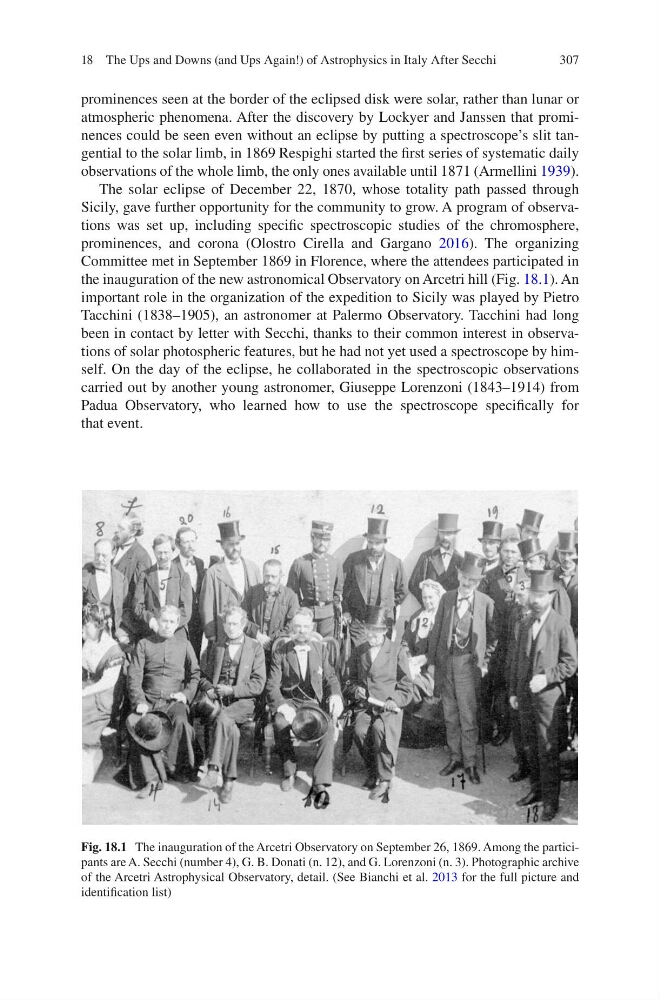
the inauguration of the new astronomical Observatory on Arcetri hill (Fig. 18.1). An
important role in the organization of the expedition to Sicily was played by Pietro
Tacchini (1838–1905), an astronomer at Palermo Observatory. Tacchini had long
been in contact by letter with Secchi, thanks to their common interest in observations of solar photospheric features, but he had not yet used a spectroscope by himself. On the day of the eclipse, he collaborated in the spectroscopic observations
carried out by another young astronomer, Giuseppe Lorenzoni (1843–1914) from
Padua Observatory, who learned how to use the spectroscope specifically for
that event.
Fig. 18.1 The inauguration of the Arcetri Observatory on September 26, 1869. Among the participants are A. Secchi (number 4), G. B. Donati (n. 12), and G. Lorenzoni (n. 3). Photographic archive
of the Arcetri Astrophysical Observatory, detail. (See Bianchi et al. 2013 for the full picture and
identification list)
18 The Ups and Downs (and Ups Again!) of Astrophysics in Italy After Secchi
prominences seen at the border of the eclipsed disk were solar, rather than lunar or
atmospheric phenomena. After the discovery by Lockyer and Janssen that prominences could be seen even without an eclipse by putting a spectroscope’s slit tangential to the solar limb, in 1869 Respighi started the first series of systematic daily
observations of the whole limb, the only ones available until 1871 (Armellini 1939).
The solar eclipse of December 22, 1870, whose totality path passed through
Sicily, gave further opportunity for the community to grow. A program of observations was set up, including specific spectroscopic studies of the chromosphere,
prominences, and corona (Olostro Cirella and Gargano 2016). The organizing
Committee met in September 1869 in Florence, where the attendees participated in
the inauguration of the new astronomical Observatory on Arcetri hill (Fig. 18.1). An
important role in the organization of the expedition to Sicily was played by Pietro
Tacchini (1838–1905), an astronomer at Palermo Observatory. Tacchini had long
been in contact by letter with Secchi, thanks to their common interest in observations of solar photospheric features, but he had not yet used a spectroscope by himself. On the day of the eclipse, he collaborated in the spectroscopic observations
carried out by another young astronomer, Giuseppe Lorenzoni (1843–1914) from
Padua Observatory, who learned how to use the spectroscope specifically for
that event.
Fig. 18.1 The inauguration of the Arcetri Observatory on September 26, 1869. Among the participants are A. Secchi (number 4), G. B. Donati (n. 12), and G. Lorenzoni (n. 3). Photographic archive
of the Arcetri Astrophysical Observatory, detail. (See Bianchi et al. 2013 for the full picture and
identification list)
18 The Ups and Downs (and Ups Again!) of Astrophysics in Italy After Secchi