

262
16.2 The Norcia Earthquake and the Seismic Building
Regulation (1859–1860)
An earthquake on August 22, 1859 destroyed the city of Norcia in the Apostolic
Delegation of Spoleto (Gazzetta Universale di Foligno 1859; Descrizione 1859;
Manocchi 1860; Piermarini 1860). Soon after, on August 29, Angelo Secchi was
called in by the municipal authorities to reassure the population, among whom had
spread the false information that the disaster was due to the birth of a volcano
(Secchi 1860; Altamore et al. 2015; Argentieri and Parotto, Chap. 14, in this
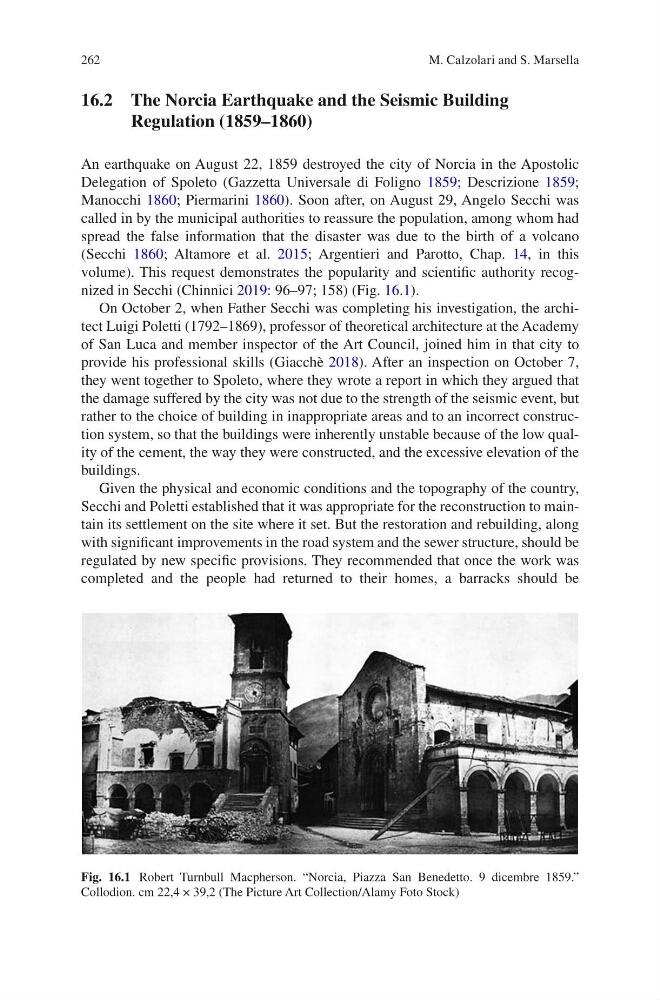
volume). This request demonstrates the popularity and scientific authority recognized in Secchi (Chinnici 2019: 96–97; 158) (Fig. 16.1).
On October 2, when Father Secchi was completing his investigation, the architect Luigi Poletti (1792–1869), professor of theoretical architecture at the Academy
of San Luca and member inspector of the Art Council, joined him in that city to
provide his professional skills (Giacchè 2018). After an inspection on October 7,
they went together to Spoleto, where they wrote a report in which they argued that
the damage suffered by the city was not due to the strength of the seismic event, but
rather to the choice of building in inappropriate areas and to an incorrect construction system, so that the buildings were inherently unstable because of the low quality of the cement, the way they were constructed, and the excessive elevation of the
buildings.
Given the physical and economic conditions and the topography of the country,
Secchi and Poletti established that it was appropriate for the reconstruction to maintain its settlement on the site where it set. But the restoration and rebuilding, along
with significant improvements in the road system and the sewer structure, should be
regulated by new specific provisions. They recommended that once the work was
completed and the people had returned to their homes, a barracks should be
Fig. 16.1 Robert Turnbull Macpherson. “Norcia, Piazza San Benedetto. 9 dicembre 1859.”
Collodion. cm 22,4 × 39,2 (The Picture Art Collection/Alamy Foto Stock)
M. Calzolari and S. Marsella
16.2 The Norcia Earthquake and the Seismic Building
Regulation (1859–1860)
An earthquake on August 22, 1859 destroyed the city of Norcia in the Apostolic
Delegation of Spoleto (Gazzetta Universale di Foligno 1859; Descrizione 1859;
Manocchi 1860; Piermarini 1860). Soon after, on August 29, Angelo Secchi was
called in by the municipal authorities to reassure the population, among whom had
spread the false information that the disaster was due to the birth of a volcano
(Secchi 1860; Altamore et al. 2015; Argentieri and Parotto, Chap. 14, in this
volume). This request demonstrates the popularity and scientific authority recognized in Secchi (Chinnici 2019: 96–97; 158) (Fig. 16.1).
On October 2, when Father Secchi was completing his investigation, the architect Luigi Poletti (1792–1869), professor of theoretical architecture at the Academy
of San Luca and member inspector of the Art Council, joined him in that city to
provide his professional skills (Giacchè 2018). After an inspection on October 7,
they went together to Spoleto, where they wrote a report in which they argued that
the damage suffered by the city was not due to the strength of the seismic event, but
rather to the choice of building in inappropriate areas and to an incorrect construction system, so that the buildings were inherently unstable because of the low quality of the cement, the way they were constructed, and the excessive elevation of the
buildings.
Given the physical and economic conditions and the topography of the country,
Secchi and Poletti established that it was appropriate for the reconstruction to maintain its settlement on the site where it set. But the restoration and rebuilding, along
with significant improvements in the road system and the sewer structure, should be
regulated by new specific provisions. They recommended that once the work was
completed and the people had returned to their homes, a barracks should be
Fig. 16.1 Robert Turnbull Macpherson. “Norcia, Piazza San Benedetto. 9 dicembre 1859.”
Collodion. cm 22,4 × 39,2 (The Picture Art Collection/Alamy Foto Stock)
M. Calzolari and S. Marsella