

259
Secchi submitted a report on this instrument to the Accademia Pontificia dei Nuovi
Lincei (Pontifical Academy of New Lynxes, forerunner to the Pontifical Academy of
Sciences) on January 27, 1856, explaining the principles of its construction and giving
the basis of its design. In a footnote he references the Civiltà Cattolica article. It is an
altitude-based sundial, “esteemed unique by archaeologists of this type, and you really
do not find anything like this described by any of the [ancient] authors dealing with
sundials”.
41
In the drawing we observe seven fan- shaped lines that delimit six sectors
for the months of the year, written in abbreviated form, divided into two semesters.
The instrument had to be oriented with the slit towards the sun, taking care to keep it
in a vertical plane and moving the alidade to the appropriate month. The indication of
the hour was provided by the point of light that was created by the alidade, and, as the
height of the sun changed during the day, it moved along the monthly line. The hours
during the year were read on six concentric time curves, corresponding to the six basic
hours of the Roman common day. Secchi also delved into the method of construction
of the sundial, elaborating a geometric construction on the basis of the Analemma of
Ptolemy
42
and thus generalizing this method.
43
15.6 Conclusions
Even if it did not constitute a sizable part of his work as a scientist, this minor excursion in the life of Angelo Secchi allows one to gain a deeper insight into the attention that he gave to the education of the community and the spread of astronomical
41 Atti dell’Accademia Pontificia dei Nuovi Lincei (Proceedings of the Pontifical Academy of New
Lynxes), vol. IX, p. 37.
42 A similar dial was made in Aiello del Friuli by Paolo Alberi and Roberto Pantanali.
43 This method was useful for measuring the equinoctial time, used in Rome by astronomers and
jurists (Nelle Antichità di Ercolano, Prefazione al vol, III, Note).
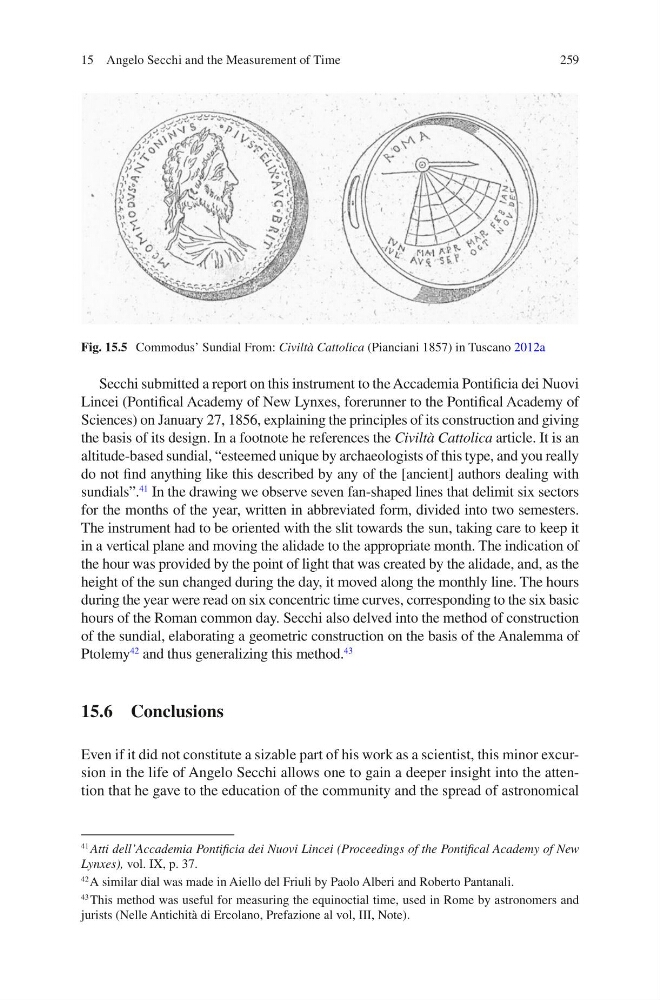
Fig. 15.5 Commodus’ Sundial From: Civiltà Cattolica (Pianciani 1857) in Tuscano 2012a
15 Angelo Secchi and the Measurement of Time
Secchi submitted a report on this instrument to the Accademia Pontificia dei Nuovi
Lincei (Pontifical Academy of New Lynxes, forerunner to the Pontifical Academy of
Sciences) on January 27, 1856, explaining the principles of its construction and giving
the basis of its design. In a footnote he references the Civiltà Cattolica article. It is an
altitude-based sundial, “esteemed unique by archaeologists of this type, and you really
do not find anything like this described by any of the [ancient] authors dealing with
sundials”.
41
In the drawing we observe seven fan- shaped lines that delimit six sectors
for the months of the year, written in abbreviated form, divided into two semesters.
The instrument had to be oriented with the slit towards the sun, taking care to keep it
in a vertical plane and moving the alidade to the appropriate month. The indication of
the hour was provided by the point of light that was created by the alidade, and, as the
height of the sun changed during the day, it moved along the monthly line. The hours
during the year were read on six concentric time curves, corresponding to the six basic
hours of the Roman common day. Secchi also delved into the method of construction
of the sundial, elaborating a geometric construction on the basis of the Analemma of
Ptolemy
42
and thus generalizing this method.
43
15.6 Conclusions
Even if it did not constitute a sizable part of his work as a scientist, this minor excursion in the life of Angelo Secchi allows one to gain a deeper insight into the attention that he gave to the education of the community and the spread of astronomical
41 Atti dell’Accademia Pontificia dei Nuovi Lincei (Proceedings of the Pontifical Academy of New
Lynxes), vol. IX, p. 37.
42 A similar dial was made in Aiello del Friuli by Paolo Alberi and Roberto Pantanali.
43 This method was useful for measuring the equinoctial time, used in Rome by astronomers and
jurists (Nelle Antichità di Ercolano, Prefazione al vol, III, Note).
Fig. 15.5 Commodus’ Sundial From: Civiltà Cattolica (Pianciani 1857) in Tuscano 2012a
15 Angelo Secchi and the Measurement of Time