

237
14.4.2 Secchi’s Legacy: Rome, the “Moral Capital”
of Italian Geophysics
After these first steps in seismology, the development of a national seismic survey
began, as described by Beltrano (1996a, b), Beltrano et al. (2003), and Foresta
Martin & Calcara (2010). Following the lead of Secchi and other pioneer scientists,
Rome progressively became the center of development of the new discipline. The
“Ufficio Centrale di Meteorologia,” (Central Bureau for Meteorology) established
in 1876 and beginning operation in 1879, was directed by Pietro Tacchini
(1838–1905), former astronomer in Palermo and one of Secchi’s main scientific
collaborators (Mangianti 1996; Chinnici and Gasperini 2013). After Secchi’s death,
the Collegio Romano Observatory was annexed to the new office, passing into
Italian state control.
Shortly after the unification of Italy, the new Kingdom had to deal with two
strong earthquakes: first, the Casamicciola event on the island of Ischia in 1883 (IX
degree MCS), and then that of Diano Marina in Liguria (IX–X degree MCS) in
1887. After these two natural disasters, the need became clear for a national seismic
survey, building on the already existing weather forecasting network (Beltrano and
Esposito 1996; Iafrate 2011). Thus in 1887, following the proposal of Pietro
Blaserna (1836–1918), president of the Royal Geodynamic Committee, the
Bureau took on new responsibilities (annexing the seismological observatories of
Salò, Casamicciola, Rocca di Papa, and Catania) and became the “Ufficio Centrale
di Meteorologia e Geodinamica,” (Central Bureau for Meteorology and
Geodynamics) still under the direction of Tacchini. The utility of this Bureau as a
center for seismological studies, arising from the need to embody private and public
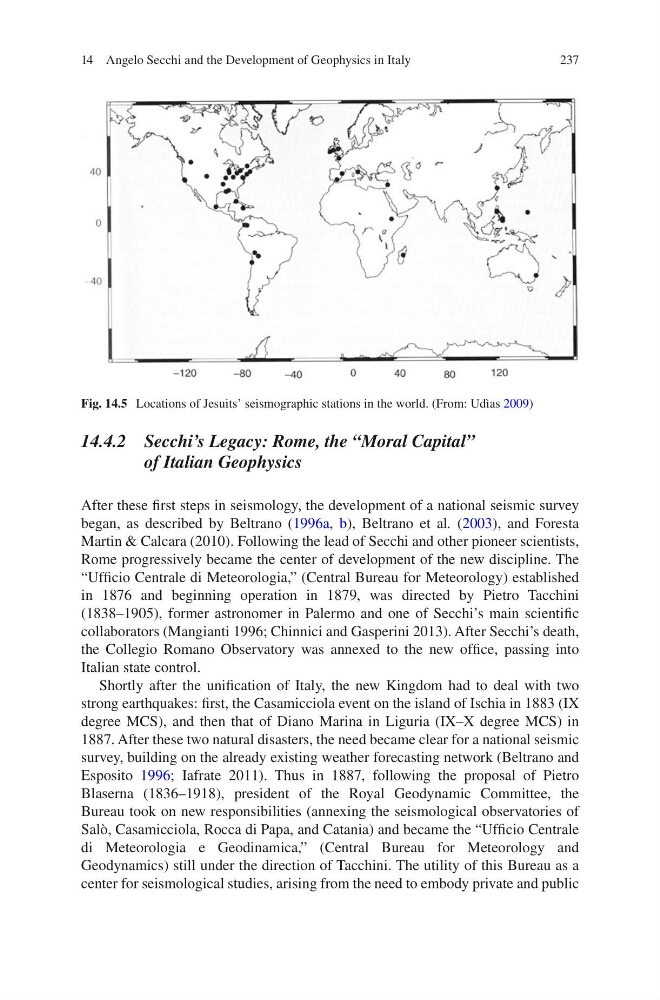
Fig. 14.5 Locations of Jesuits’ seismographic stations in the world. (From: Udìas 2009)
14 Angelo Secchi and the Development of Geophysics in Italy
14.4.2 Secchi’s Legacy: Rome, the “Moral Capital”
of Italian Geophysics
After these first steps in seismology, the development of a national seismic survey
began, as described by Beltrano (1996a, b), Beltrano et al. (2003), and Foresta
Martin & Calcara (2010). Following the lead of Secchi and other pioneer scientists,
Rome progressively became the center of development of the new discipline. The
“Ufficio Centrale di Meteorologia,” (Central Bureau for Meteorology) established
in 1876 and beginning operation in 1879, was directed by Pietro Tacchini
(1838–1905), former astronomer in Palermo and one of Secchi’s main scientific
collaborators (Mangianti 1996; Chinnici and Gasperini 2013). After Secchi’s death,
the Collegio Romano Observatory was annexed to the new office, passing into
Italian state control.
Shortly after the unification of Italy, the new Kingdom had to deal with two
strong earthquakes: first, the Casamicciola event on the island of Ischia in 1883 (IX
degree MCS), and then that of Diano Marina in Liguria (IX–X degree MCS) in
1887. After these two natural disasters, the need became clear for a national seismic
survey, building on the already existing weather forecasting network (Beltrano and
Esposito 1996; Iafrate 2011). Thus in 1887, following the proposal of Pietro
Blaserna (1836–1918), president of the Royal Geodynamic Committee, the
Bureau took on new responsibilities (annexing the seismological observatories of
Salò, Casamicciola, Rocca di Papa, and Catania) and became the “Ufficio Centrale
di Meteorologia e Geodinamica,” (Central Bureau for Meteorology and
Geodynamics) still under the direction of Tacchini. The utility of this Bureau as a
center for seismological studies, arising from the need to embody private and public
Fig. 14.5 Locations of Jesuits’ seismographic stations in the world. (From: Udìas 2009)
14 Angelo Secchi and the Development of Geophysics in Italy