

220
diameter, its color, the sun’s angle, observations from different positions onboard
the corvette and from one of his sloops, as well as other factors as they affected the
disappearance of the disk at a given depth.
It is evident that the general method of lowering a disk marked with either colored or white paint, sometimes even porcelain dinner plates or other objects of
bright reflectance, had been known before Secchi and had frequently been applied
in different forms. But the experiments performed by Secchi and Cialdi in 1864 on
such an intensive scale were unprecedented. It was the rigorous and detailed investigation of Father Angelo Secchi that led to this method being called the Secchi disk
depth measurement.
The method was first named for Secchi by Alphonse Forel (1841–1912), the
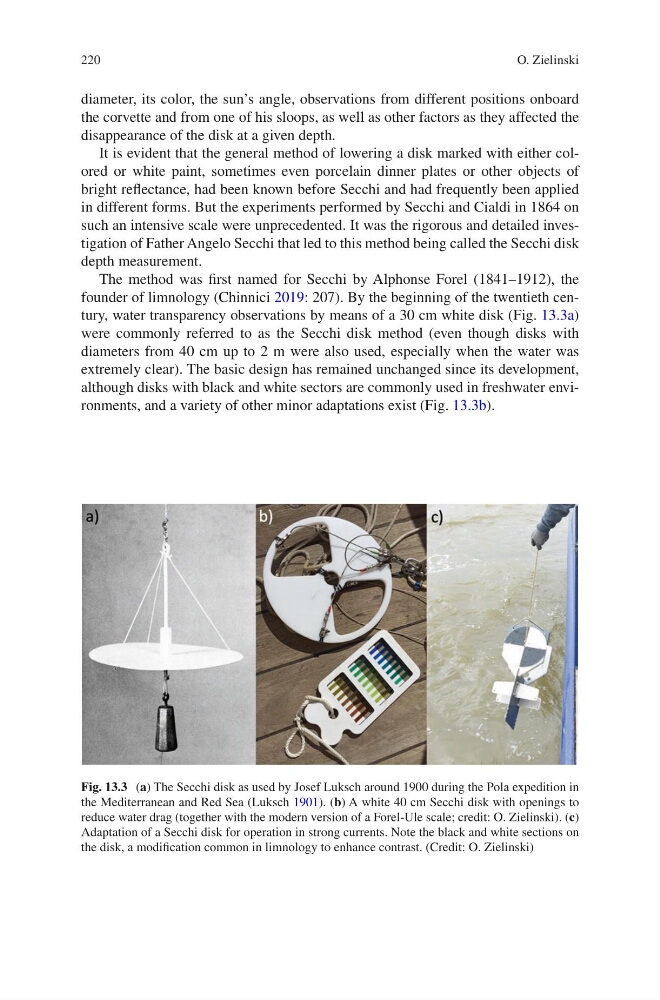
founder of limnology (Chinnici 2019: 207). By the beginning of the twentieth century, water transparency observations by means of a 30 cm white disk (Fig. 13.3a)
were commonly referred to as the Secchi disk method (even though disks with
diameters from 40 cm up to 2 m were also used, especially when the water was
extremely clear). The basic design has remained unchanged since its development,
although disks with black and white sectors are commonly used in freshwater environments, and a variety of other minor adaptations exist (Fig. 13.3b).
Fig. 13.3 (a) The Secchi disk as used by Josef Luksch around 1900 during the Pola expedition in
the Mediterranean and Red Sea (Luksch 1901). (b) A white 40 cm Secchi disk with openings to
reduce water drag (together with the modern version of a Forel-Ule scale; credit: O. Zielinski). (c)
Adaptation of a Secchi disk for operation in strong currents. Note the black and white sections on
the disk, a modification common in limnology to enhance contrast. (Credit: O. Zielinski)
O. Zielinski
diameter, its color, the sun’s angle, observations from different positions onboard
the corvette and from one of his sloops, as well as other factors as they affected the
disappearance of the disk at a given depth.
It is evident that the general method of lowering a disk marked with either colored or white paint, sometimes even porcelain dinner plates or other objects of
bright reflectance, had been known before Secchi and had frequently been applied
in different forms. But the experiments performed by Secchi and Cialdi in 1864 on
such an intensive scale were unprecedented. It was the rigorous and detailed investigation of Father Angelo Secchi that led to this method being called the Secchi disk
depth measurement.
The method was first named for Secchi by Alphonse Forel (1841–1912), the
founder of limnology (Chinnici 2019: 207). By the beginning of the twentieth century, water transparency observations by means of a 30 cm white disk (Fig. 13.3a)
were commonly referred to as the Secchi disk method (even though disks with
diameters from 40 cm up to 2 m were also used, especially when the water was
extremely clear). The basic design has remained unchanged since its development,
although disks with black and white sectors are commonly used in freshwater environments, and a variety of other minor adaptations exist (Fig. 13.3b).
Fig. 13.3 (a) The Secchi disk as used by Josef Luksch around 1900 during the Pola expedition in
the Mediterranean and Red Sea (Luksch 1901). (b) A white 40 cm Secchi disk with openings to
reduce water drag (together with the modern version of a Forel-Ule scale; credit: O. Zielinski). (c)
Adaptation of a Secchi disk for operation in strong currents. Note the black and white sections on
the disk, a modification common in limnology to enhance contrast. (Credit: O. Zielinski)
O. Zielinski