

217
can be potentially associated to human activities, such as bottom trawling fisheries
or increased use of fertilizers (Capuzzo et al. 2015).
Secchi disk depth changes can also indicate marine regime shifts, like the
increase in water clarity that was observed by Wiltshire et al. (2008) over the period
1975–2005 for the Helgoland Roads time series (in the German Bight, southern
North Sea).
The aforementioned examples all have in common their use of Secchi’s method
of determining water clarity based on the simple lowering of a white disk, which
provides the fundamental data covering large time spans at satisfiable spatial density. All studies dealing with these kinds of data must take care in applying quality
checks and appropriate statistical methods, as observations were performed mostly
at different locations, under different conditions, and by different observers. These
circumstances were already evident to Secchi and, as we will see, he addressed
them with due diligence. The theory of the Secchi disk visibility itself, based on
physical principles and human perception, has been subject of a number of publications (Duntley 1952; Tyler 1968; Preisendorfer 1986; Zaneveld and Pegau 2003)
and recently revised by Lee et al. (2015).
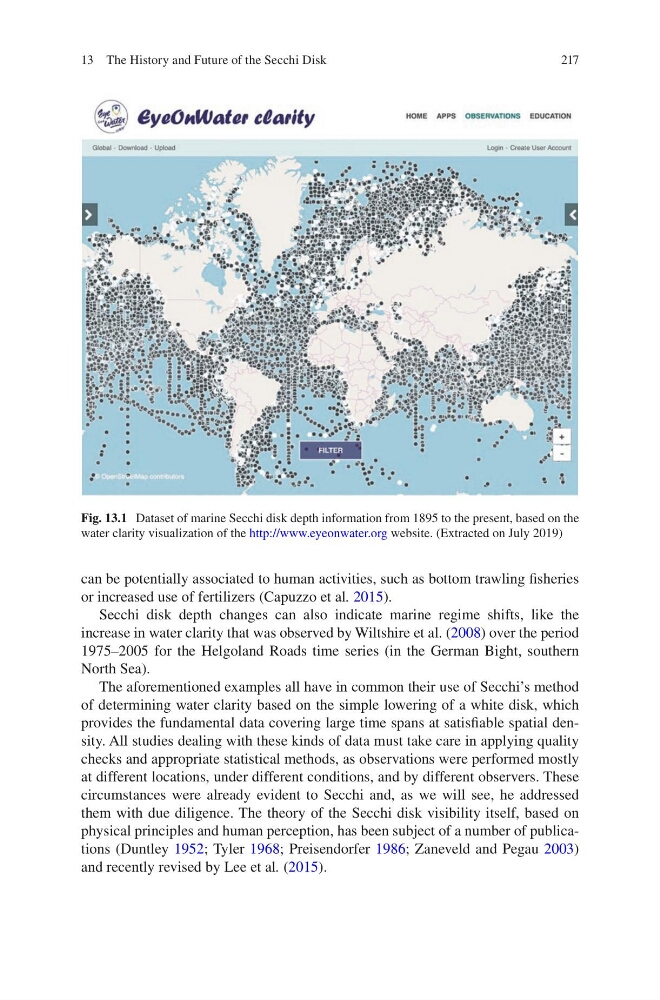
Fig. 13.1 Dataset of marine Secchi disk depth information from 1895 to the present, based on the
water clarity visualization of the http://www.eyeonwater.org website. (Extracted on July 2019)
13 The History and Future of the Secchi Disk
can be potentially associated to human activities, such as bottom trawling fisheries
or increased use of fertilizers (Capuzzo et al. 2015).
Secchi disk depth changes can also indicate marine regime shifts, like the
increase in water clarity that was observed by Wiltshire et al. (2008) over the period
1975–2005 for the Helgoland Roads time series (in the German Bight, southern
North Sea).
The aforementioned examples all have in common their use of Secchi’s method
of determining water clarity based on the simple lowering of a white disk, which
provides the fundamental data covering large time spans at satisfiable spatial density. All studies dealing with these kinds of data must take care in applying quality
checks and appropriate statistical methods, as observations were performed mostly
at different locations, under different conditions, and by different observers. These
circumstances were already evident to Secchi and, as we will see, he addressed
them with due diligence. The theory of the Secchi disk visibility itself, based on
physical principles and human perception, has been subject of a number of publications (Duntley 1952; Tyler 1968; Preisendorfer 1986; Zaneveld and Pegau 2003)
and recently revised by Lee et al. (2015).
Fig. 13.1 Dataset of marine Secchi disk depth information from 1895 to the present, based on the
water clarity visualization of the http://www.eyeonwater.org website. (Extracted on July 2019)
13 The History and Future of the Secchi Disk