

183
10.3.4 Washington-Cleveland (1871)
Only one Secchi meteorograph was installed in the USA; it was acquired by the
surgeon and army general Albert James Myer (1828–1880). The US Signal Corps,
a brainchild of Myers, was officially founded in 1863 by the Congress in order to
manage communications and information for the command and control of the armed
forces. In 1870 Congress also established a Weather Bureau, and, three years later,
Myer acquired a series of meteorological recording instruments which represented
the state of the art at that time. Among them was also a Secchi meteorograph (Abbe
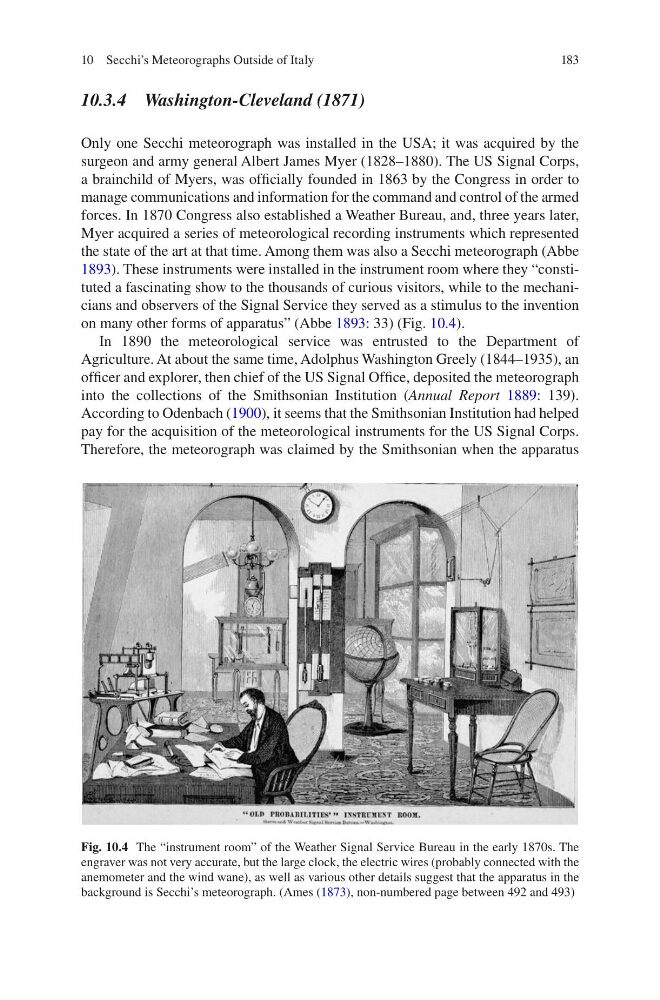
1893). These instruments were installed in the instrument room where they “constituted a fascinating show to the thousands of curious visitors, while to the mechanicians and observers of the Signal Service they served as a stimulus to the invention
on many other forms of apparatus” (Abbe 1893: 33) (Fig. 10.4).
In 1890 the meteorological service was entrusted to the Department of
Agriculture. At about the same time, Adolphus Washington Greely (1844–1935), an
officer and explorer, then chief of the US Signal Office, deposited the meteorograph
into the collections of the Smithsonian Institution (Annual Report 1889: 139).
According to Odenbach (1900), it seems that the Smithsonian Institution had helped
pay for the acquisition of the meteorological instruments for the US Signal Corps.
Therefore, the meteorograph was claimed by the Smithsonian when the apparatus
Fig. 10.4 The “instrument room” of the Weather Signal Service Bureau in the early 1870s. The
engraver was not very accurate, but the large clock, the electric wires (probably connected with the
anemometer and the wind wane), as well as various other details suggest that the apparatus in the
background is Secchi’s meteorograph. (Ames (1873), non-numbered page between 492 and 493)
10 Secchi’s Meteorographs Outside of Italy
10.3.4 Washington-Cleveland (1871)
Only one Secchi meteorograph was installed in the USA; it was acquired by the
surgeon and army general Albert James Myer (1828–1880). The US Signal Corps,
a brainchild of Myers, was officially founded in 1863 by the Congress in order to
manage communications and information for the command and control of the armed
forces. In 1870 Congress also established a Weather Bureau, and, three years later,
Myer acquired a series of meteorological recording instruments which represented
the state of the art at that time. Among them was also a Secchi meteorograph (Abbe
1893). These instruments were installed in the instrument room where they “constituted a fascinating show to the thousands of curious visitors, while to the mechanicians and observers of the Signal Service they served as a stimulus to the invention
on many other forms of apparatus” (Abbe 1893: 33) (Fig. 10.4).
In 1890 the meteorological service was entrusted to the Department of
Agriculture. At about the same time, Adolphus Washington Greely (1844–1935), an
officer and explorer, then chief of the US Signal Office, deposited the meteorograph
into the collections of the Smithsonian Institution (Annual Report 1889: 139).
According to Odenbach (1900), it seems that the Smithsonian Institution had helped
pay for the acquisition of the meteorological instruments for the US Signal Corps.
Therefore, the meteorograph was claimed by the Smithsonian when the apparatus
Fig. 10.4 The “instrument room” of the Weather Signal Service Bureau in the early 1870s. The
engraver was not very accurate, but the large clock, the electric wires (probably connected with the
anemometer and the wind wane), as well as various other details suggest that the apparatus in the
background is Secchi’s meteorograph. (Ames (1873), non-numbered page between 492 and 493)
10 Secchi’s Meteorographs Outside of Italy