

168
(1026.4 hPa). In this way, Angelo Secchi produced the first three-dimensional cartographic representation applied to meteorology, which then served as the basis for
the construction of isobaric maps that could be used for weather forecasts.
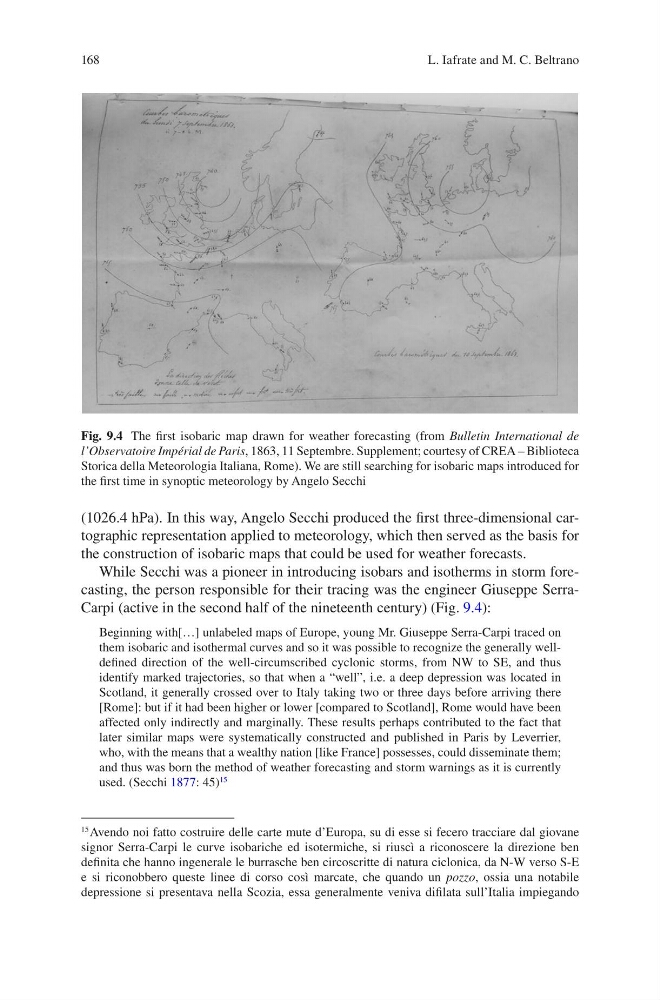
While Secchi was a pioneer in introducing isobars and isotherms in storm forecasting, the person responsible for their tracing was the engineer Giuseppe SerraCarpi (active in the second half of the nineteenth century) (Fig. 9.4):
Beginning with[…] unlabeled maps of Europe, young Mr. Giuseppe Serra-Carpi traced on
them isobaric and isothermal curves and so it was possible to recognize the generally welldefined direction of the well-circumscribed cyclonic storms, from NW to SE, and thus
identify marked trajectories, so that when a “well”, i.e. a deep depression was located in
Scotland, it generally crossed over to Italy taking two or three days before arriving there
[Rome]: but if it had been higher or lower [compared to Scotland], Rome would have been
affected only indirectly and marginally. These results perhaps contributed to the fact that
later similar maps were systematically constructed and published in Paris by Leverrier,
who, with the means that a wealthy nation [like France] possesses, could disseminate them;
and thus was born the method of weather forecasting and storm warnings as it is currently
used. (Secchi 1877: 45)
15
15 Avendo noi fatto costruire delle carte mute d’Europa, su di esse si fecero tracciare dal giovane
signor Serra-Carpi le curve isobariche ed isotermiche, si riuscì a riconoscere la direzione ben
definita che hanno ingenerale le burrasche ben circoscritte di natura ciclonica, da N-W verso S-E
e si riconobbero queste linee di corso così marcate, che quando un pozzo, ossia una notabile
depressione si presentava nella Scozia, essa generalmente veniva difilata sull’Italia impiegando
Fig. 9.4 The first isobaric map drawn for weather forecasting (from Bulletin International de
l’Observatoire Impérial de Paris, 1863, 11 Septembre. Supplement; courtesy of CREA – Biblioteca
Storica della Meteorologia Italiana, Rome). We are still searching for isobaric maps introduced for
the first time in synoptic meteorology by Angelo Secchi
L. Iafrate and M. C. Beltrano
(1026.4 hPa). In this way, Angelo Secchi produced the first three-dimensional cartographic representation applied to meteorology, which then served as the basis for
the construction of isobaric maps that could be used for weather forecasts.
While Secchi was a pioneer in introducing isobars and isotherms in storm forecasting, the person responsible for their tracing was the engineer Giuseppe SerraCarpi (active in the second half of the nineteenth century) (Fig. 9.4):
Beginning with[…] unlabeled maps of Europe, young Mr. Giuseppe Serra-Carpi traced on
them isobaric and isothermal curves and so it was possible to recognize the generally welldefined direction of the well-circumscribed cyclonic storms, from NW to SE, and thus
identify marked trajectories, so that when a “well”, i.e. a deep depression was located in
Scotland, it generally crossed over to Italy taking two or three days before arriving there
[Rome]: but if it had been higher or lower [compared to Scotland], Rome would have been
affected only indirectly and marginally. These results perhaps contributed to the fact that
later similar maps were systematically constructed and published in Paris by Leverrier,
who, with the means that a wealthy nation [like France] possesses, could disseminate them;
and thus was born the method of weather forecasting and storm warnings as it is currently
used. (Secchi 1877: 45)
15
15 Avendo noi fatto costruire delle carte mute d’Europa, su di esse si fecero tracciare dal giovane
signor Serra-Carpi le curve isobariche ed isotermiche, si riuscì a riconoscere la direzione ben
definita che hanno ingenerale le burrasche ben circoscritte di natura ciclonica, da N-W verso S-E
e si riconobbero queste linee di corso così marcate, che quando un pozzo, ossia una notabile
depressione si presentava nella Scozia, essa generalmente veniva difilata sull’Italia impiegando
Fig. 9.4 The first isobaric map drawn for weather forecasting (from Bulletin International de
l’Observatoire Impérial de Paris, 1863, 11 Septembre. Supplement; courtesy of CREA – Biblioteca
Storica della Meteorologia Italiana, Rome). We are still searching for isobaric maps introduced for
the first time in synoptic meteorology by Angelo Secchi
L. Iafrate and M. C. Beltrano