

146
output in the early 1860s (Waterson 1861: 60–7). The apparatus used was a predecessor of the modern resistance bolometer, first devised by Samuel P. Langley
(1834–1906) in 1878 (Walsh 2007). Secchi’s instrument, later titled a “thermoheliometer” in various English language periodicals in the 1870s (Webb 1875: 0.436;
Ericsson 1876: 254–65), was described as an “actinometer” by the physicist
Charles A. Young (1834–1908) in The Sun (Young 1895: 293; Habashi 2007).
Secchi provides both a description of his instrument and outlines its use in Le Soleil
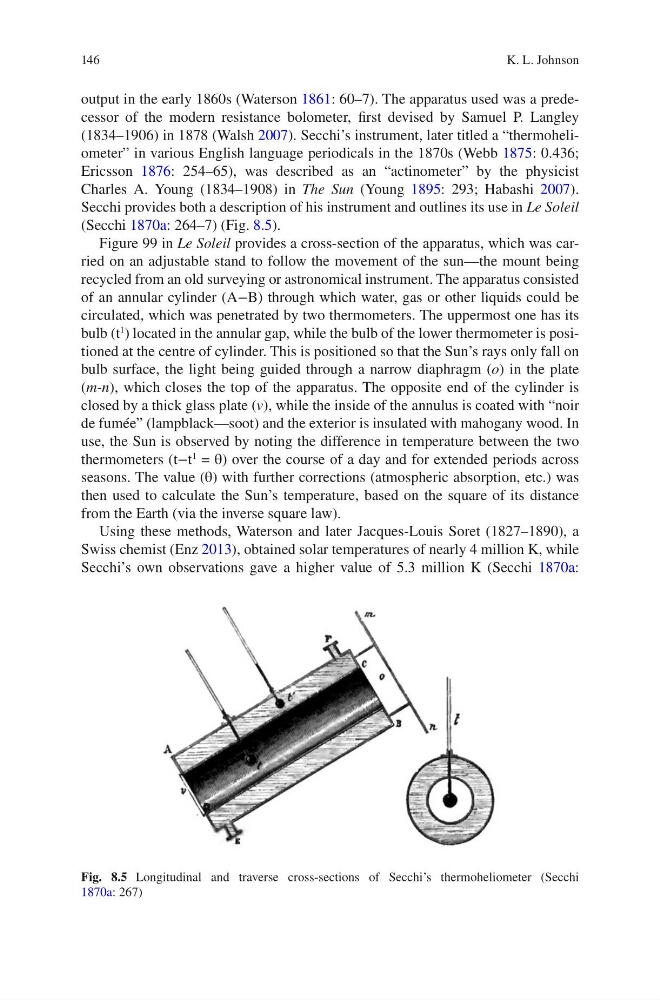
(Secchi 1870a: 264–7) (Fig. 8.5).
Figure 99 in Le Soleil provides a cross-section of the apparatus, which was carried on an adjustable stand to follow the movement of the sun—the mount being
recycled from an old surveying or astronomical instrument. The apparatus consisted
of an annular cylinder (A−B) through which water, gas or other liquids could be
circulated, which was penetrated by two thermometers. The uppermost one has its
bulb (t
1
) located in the annular gap, while the bulb of the lower thermometer is positioned at the centre of cylinder. This is positioned so that the Sun’s rays only fall on
bulb surface, the light being guided through a narrow diaphragm (o) in the plate
(m-n), which closes the top of the apparatus. The opposite end of the cylinder is
closed by a thick glass plate (v), while the inside of the annulus is coated with “noir
de fumée” (lampblack—soot) and the exterior is insulated with mahogany wood. In
use, the Sun is observed by noting the difference in temperature between the two
thermometers (t−t
1
= θ) over the course of a day and for extended periods across
seasons. The value (θ) with further corrections (atmospheric absorption, etc.) was
then used to calculate the Sun’s temperature, based on the square of its distance
from the Earth (via the inverse square law).
Using these methods, Waterson and later Jacques-Louis Soret (1827–1890), a
Swiss chemist (Enz 2013), obtained solar temperatures of nearly 4 million K, while
Secchi’s own observations gave a higher value of 5.3 million K (Secchi 1870a:
Fig. 8.5 Longitudinal and traverse cross-sections of Secchi’s thermoheliometer (Secchi
1870a: 267)
K. L. Johnson
output in the early 1860s (Waterson 1861: 60–7). The apparatus used was a predecessor of the modern resistance bolometer, first devised by Samuel P. Langley
(1834–1906) in 1878 (Walsh 2007). Secchi’s instrument, later titled a “thermoheliometer” in various English language periodicals in the 1870s (Webb 1875: 0.436;
Ericsson 1876: 254–65), was described as an “actinometer” by the physicist
Charles A. Young (1834–1908) in The Sun (Young 1895: 293; Habashi 2007).
Secchi provides both a description of his instrument and outlines its use in Le Soleil
(Secchi 1870a: 264–7) (Fig. 8.5).
Figure 99 in Le Soleil provides a cross-section of the apparatus, which was carried on an adjustable stand to follow the movement of the sun—the mount being
recycled from an old surveying or astronomical instrument. The apparatus consisted
of an annular cylinder (A−B) through which water, gas or other liquids could be
circulated, which was penetrated by two thermometers. The uppermost one has its
bulb (t
1
) located in the annular gap, while the bulb of the lower thermometer is positioned at the centre of cylinder. This is positioned so that the Sun’s rays only fall on
bulb surface, the light being guided through a narrow diaphragm (o) in the plate
(m-n), which closes the top of the apparatus. The opposite end of the cylinder is
closed by a thick glass plate (v), while the inside of the annulus is coated with “noir
de fumée” (lampblack—soot) and the exterior is insulated with mahogany wood. In
use, the Sun is observed by noting the difference in temperature between the two
thermometers (t−t
1
= θ) over the course of a day and for extended periods across
seasons. The value (θ) with further corrections (atmospheric absorption, etc.) was
then used to calculate the Sun’s temperature, based on the square of its distance
from the Earth (via the inverse square law).
Using these methods, Waterson and later Jacques-Louis Soret (1827–1890), a
Swiss chemist (Enz 2013), obtained solar temperatures of nearly 4 million K, while
Secchi’s own observations gave a higher value of 5.3 million K (Secchi 1870a:
Fig. 8.5 Longitudinal and traverse cross-sections of Secchi’s thermoheliometer (Secchi
1870a: 267)
K. L. Johnson