

139
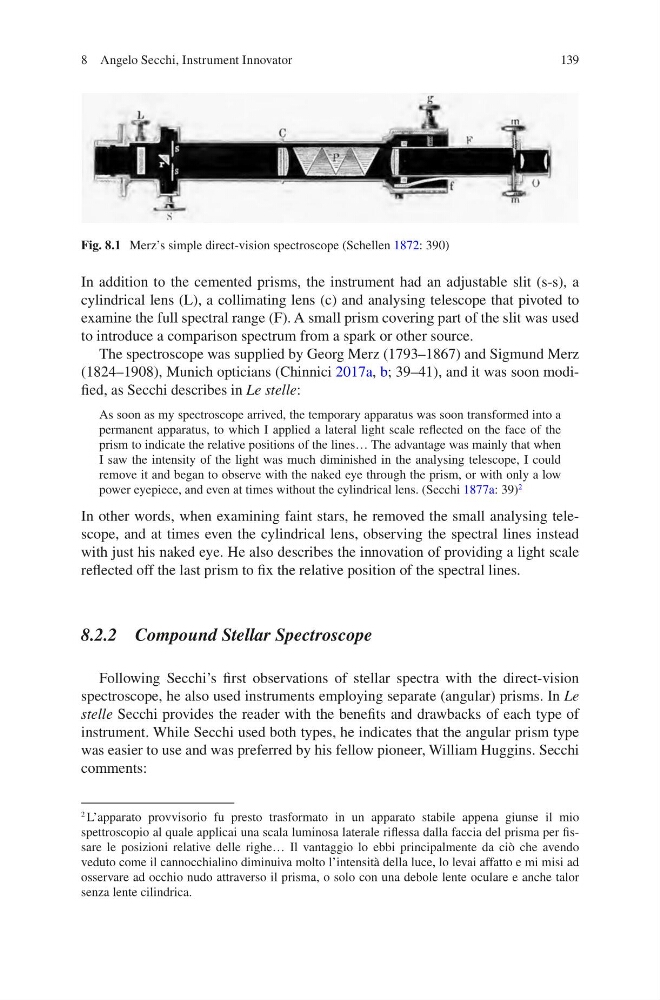
In addition to the cemented prisms, the instrument had an adjustable slit (s-s), a
cylindrical lens (L), a collimating lens (c) and analysing telescope that pivoted to
examine the full spectral range (F). A small prism covering part of the slit was used
to introduce a comparison spectrum from a spark or other source.
The spectroscope was supplied by Georg Merz (1793–1867) and Sigmund Merz
(1824–1908), Munich opticians (Chinnici 2017a, b; 39–41), and it was soon modified, as Secchi describes in Le stelle:
As soon as my spectroscope arrived, the temporary apparatus was soon transformed into a
permanent apparatus, to which I applied a lateral light scale reflected on the face of the
prism to indicate the relative positions of the lines… The advantage was mainly that when
I saw the intensity of the light was much diminished in the analysing telescope, I could
remove it and began to observe with the naked eye through the prism, or with only a low
power eyepiece, and even at times without the cylindrical lens. (Secchi 1877a: 39)
2
In other words, when examining faint stars, he removed the small analysing telescope, and at times even the cylindrical lens, observing the spectral lines instead
with just his naked eye. He also describes the innovation of providing a light scale
reflected off the last prism to fix the relative position of the spectral lines.
8.2.2 Compound Stellar Spectroscope
Following Secchi’s first observations of stellar spectra with the direct-vision
spectroscope, he also used instruments employing separate (angular) prisms. In Le
stelle Secchi provides the reader with the benefits and drawbacks of each type of
instrument. While Secchi used both types, he indicates that the angular prism type
was easier to use and was preferred by his fellow pioneer, William Huggins. Secchi
comments:
2 L’apparato provvisorio fu presto trasformato in un apparato stabile appena giunse il mio
spettroscopio al quale applicai una scala luminosa laterale riflessa dalla faccia del prisma per fissare le posizioni relative delle righe… Il vantaggio lo ebbi principalmente da ciò che avendo
veduto come il cannocchialino diminuiva molto l’intensità della luce, lo levai affatto e mi misi ad
osservare ad occhio nudo attraverso il prisma, o solo con una debole lente oculare e anche talor
senza lente cilindrica.
Fig. 8.1 Merz’s simple direct-vision spectroscope (Schellen 1872: 390)
8 Angelo Secchi, Instrument Innovator
In addition to the cemented prisms, the instrument had an adjustable slit (s-s), a
cylindrical lens (L), a collimating lens (c) and analysing telescope that pivoted to
examine the full spectral range (F). A small prism covering part of the slit was used
to introduce a comparison spectrum from a spark or other source.
The spectroscope was supplied by Georg Merz (1793–1867) and Sigmund Merz
(1824–1908), Munich opticians (Chinnici 2017a, b; 39–41), and it was soon modified, as Secchi describes in Le stelle:
As soon as my spectroscope arrived, the temporary apparatus was soon transformed into a
permanent apparatus, to which I applied a lateral light scale reflected on the face of the
prism to indicate the relative positions of the lines… The advantage was mainly that when
I saw the intensity of the light was much diminished in the analysing telescope, I could
remove it and began to observe with the naked eye through the prism, or with only a low
power eyepiece, and even at times without the cylindrical lens. (Secchi 1877a: 39)
2
In other words, when examining faint stars, he removed the small analysing telescope, and at times even the cylindrical lens, observing the spectral lines instead
with just his naked eye. He also describes the innovation of providing a light scale
reflected off the last prism to fix the relative position of the spectral lines.
8.2.2 Compound Stellar Spectroscope
Following Secchi’s first observations of stellar spectra with the direct-vision
spectroscope, he also used instruments employing separate (angular) prisms. In Le
stelle Secchi provides the reader with the benefits and drawbacks of each type of
instrument. While Secchi used both types, he indicates that the angular prism type
was easier to use and was preferred by his fellow pioneer, William Huggins. Secchi
comments:
2 L’apparato provvisorio fu presto trasformato in un apparato stabile appena giunse il mio
spettroscopio al quale applicai una scala luminosa laterale riflessa dalla faccia del prisma per fissare le posizioni relative delle righe… Il vantaggio lo ebbi principalmente da ciò che avendo
veduto come il cannocchialino diminuiva molto l’intensità della luce, lo levai affatto e mi misi ad
osservare ad occhio nudo attraverso il prisma, o solo con una debole lente oculare e anche talor
senza lente cilindrica.
Fig. 8.1 Merz’s simple direct-vision spectroscope (Schellen 1872: 390)
8 Angelo Secchi, Instrument Innovator