

130
short, and thick jets, isolated and low, and mostly divergent; the less active ones
with a filamentary structure, enormously high, but less shiny; and those with a structure resembling cumulus clouds.”
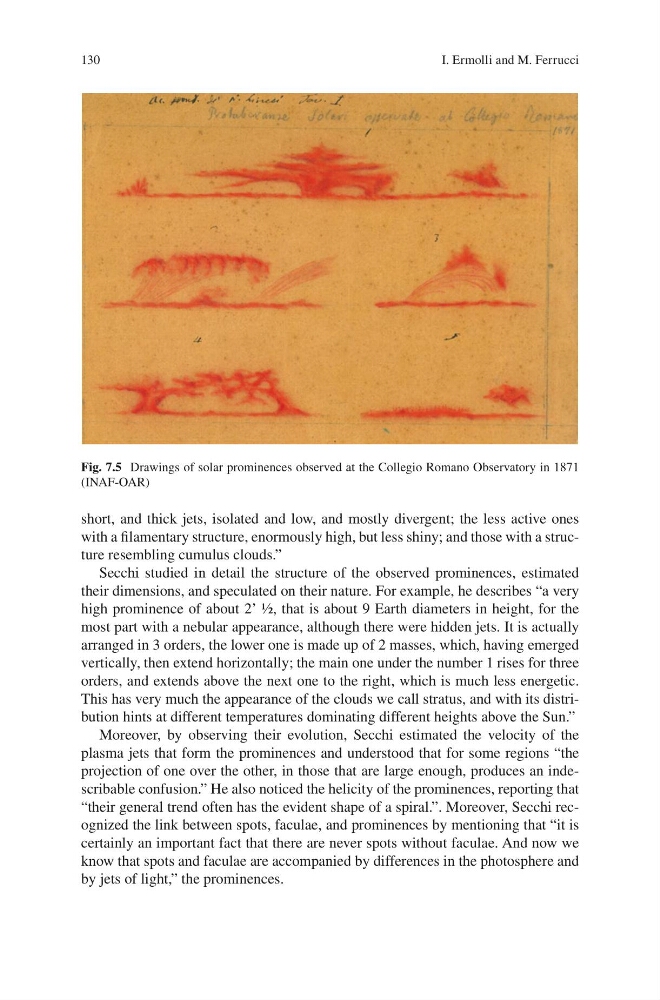
Secchi studied in detail the structure of the observed prominences, estimated
their dimensions, and speculated on their nature. For example, he describes “a very
high prominence of about 2’ ½, that is about 9 Earth diameters in height, for the
most part with a nebular appearance, although there were hidden jets. It is actually
arranged in 3 orders, the lower one is made up of 2 masses, which, having emerged
vertically, then extend horizontally; the main one under the number 1 rises for three
orders, and extends above the next one to the right, which is much less energetic.
This has very much the appearance of the clouds we call stratus, and with its distribution hints at different temperatures dominating different heights above the Sun.”
Moreover, by observing their evolution, Secchi estimated the velocity of the
plasma jets that form the prominences and understood that for some regions “the
projection of one over the other, in those that are large enough, produces an indescribable confusion.” He also noticed the helicity of the prominences, reporting that
“their general trend often has the evident shape of a spiral.”. Moreover, Secchi recognized the link between spots, faculae, and prominences by mentioning that “it is
certainly an important fact that there are never spots without faculae. And now we
know that spots and faculae are accompanied by differences in the photosphere and
by jets of light,” the prominences.
Fig. 7.5 Drawings of solar prominences observed at the Collegio Romano Observatory in 1871
(INAF-OAR)
I. Ermolli and M. Ferrucci
short, and thick jets, isolated and low, and mostly divergent; the less active ones
with a filamentary structure, enormously high, but less shiny; and those with a structure resembling cumulus clouds.”
Secchi studied in detail the structure of the observed prominences, estimated
their dimensions, and speculated on their nature. For example, he describes “a very
high prominence of about 2’ ½, that is about 9 Earth diameters in height, for the
most part with a nebular appearance, although there were hidden jets. It is actually
arranged in 3 orders, the lower one is made up of 2 masses, which, having emerged
vertically, then extend horizontally; the main one under the number 1 rises for three
orders, and extends above the next one to the right, which is much less energetic.
This has very much the appearance of the clouds we call stratus, and with its distribution hints at different temperatures dominating different heights above the Sun.”
Moreover, by observing their evolution, Secchi estimated the velocity of the
plasma jets that form the prominences and understood that for some regions “the
projection of one over the other, in those that are large enough, produces an indescribable confusion.” He also noticed the helicity of the prominences, reporting that
“their general trend often has the evident shape of a spiral.”. Moreover, Secchi recognized the link between spots, faculae, and prominences by mentioning that “it is
certainly an important fact that there are never spots without faculae. And now we
know that spots and faculae are accompanied by differences in the photosphere and
by jets of light,” the prominences.
Fig. 7.5 Drawings of solar prominences observed at the Collegio Romano Observatory in 1871
(INAF-OAR)
I. Ermolli and M. Ferrucci