

116
is that Schiaparelli began his studies of Mars only a few months before Secchi’s
death. Further, Schiaparelli insisted that the terms introduced on his map of
1877–1878 for the albedo features on the planet (the basis of what still used) were
meant to be taken only as conventions and did not imply any particular interpretations of what the features actually might be – though the sea/continent identification
is hard to resist. In his own words, Schiaparelli (1878) wrote:
One might wish to restrict oneself to what is seen without making any interpretations at all;
but this is difficult in practice…. I have found …. that in order to record the things that were
seen in the telescope, I had to attach names to each of the various shaded areas, lines, and
points observed on the planet. In general the configurations present such a striking analogy
to those of the terrestrial map that it is doubtful whether any other class of names would
have been preferable. And do not brevity and clarity compel us to make use of words such
as island, isthmus, strait, canale, peninsula, cape, etc.?…. Our map, then, like others already
published, includes a complete scheme of geographical names which they who wish to
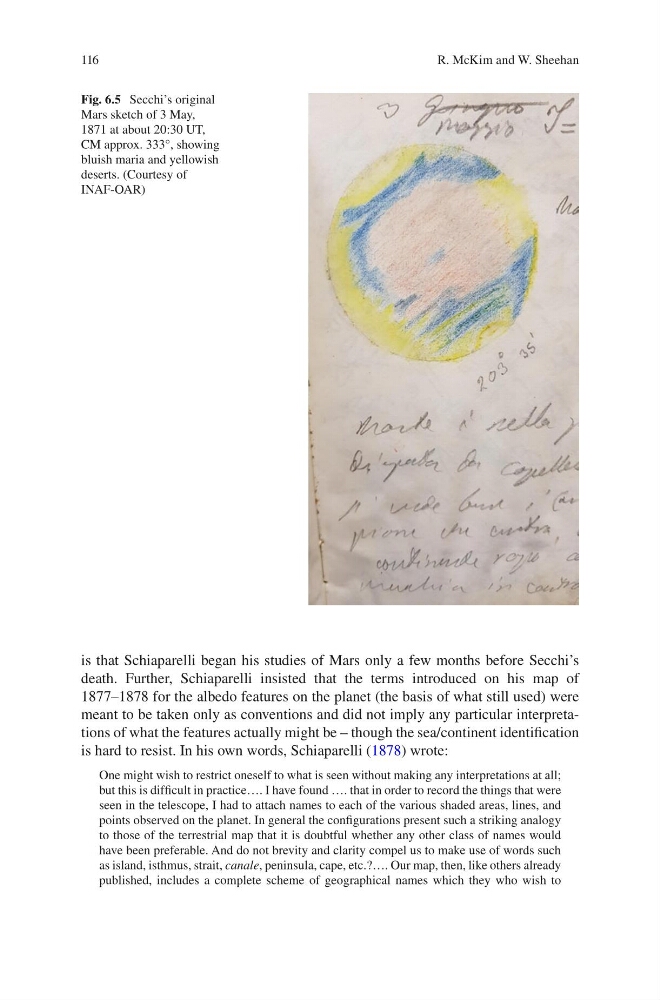
Fig. 6.5 Secchi’s original
Mars sketch of 3 May,
1871 at about 20:30 UT,
CM approx. 333°, showing
bluish maria and yellowish
deserts. (Courtesy of
INAF-OAR)
R. McKim and W. Sheehan
is that Schiaparelli began his studies of Mars only a few months before Secchi’s
death. Further, Schiaparelli insisted that the terms introduced on his map of
1877–1878 for the albedo features on the planet (the basis of what still used) were
meant to be taken only as conventions and did not imply any particular interpretations of what the features actually might be – though the sea/continent identification
is hard to resist. In his own words, Schiaparelli (1878) wrote:
One might wish to restrict oneself to what is seen without making any interpretations at all;
but this is difficult in practice…. I have found …. that in order to record the things that were
seen in the telescope, I had to attach names to each of the various shaded areas, lines, and
points observed on the planet. In general the configurations present such a striking analogy
to those of the terrestrial map that it is doubtful whether any other class of names would
have been preferable. And do not brevity and clarity compel us to make use of words such
as island, isthmus, strait, canale, peninsula, cape, etc.?…. Our map, then, like others already
published, includes a complete scheme of geographical names which they who wish to
Fig. 6.5 Secchi’s original
Mars sketch of 3 May,
1871 at about 20:30 UT,
CM approx. 333°, showing
bluish maria and yellowish
deserts. (Courtesy of
INAF-OAR)
R. McKim and W. Sheehan