

88
(including his earliest estimate for the radial motion of Sirius) even had to be corrected in sign, thus effectively inverting his former finding of a recession into an
approach of the same object. This did not help instill trust in the mindboggling
results of this new branch of spectroscopy. Therefore, Huggins was particularly
careful about how he put forward his claim at the meeting of the Royal Society on
April 23, 1868. He affirmed:
“The observation of the comparison of the lines was made many times, and I am certain that
the narrow line of hydrogen, though it appeared projected upon the dark line of Sirius, did
not coincide with the middle of that line, but crossed it at a distance from the middle, which
may be represented by saying that the want of coincidence was apparently equal to about
one-third or one-fourth of the interval separating the components of the double line D. […]
I have not been able to detect any probable source of error in this result, and it may therefore, I believe, be received as representing a relative motion of recession between Sirius and
the Earth”.
10
10 Huggins 1868: 547, original emphasis. See Huggins 1872 for an improved estimate, Hearnshaw
1986: 74, Hentschel 2002a: 343 and on Huggins: Becker 2011, 2014.
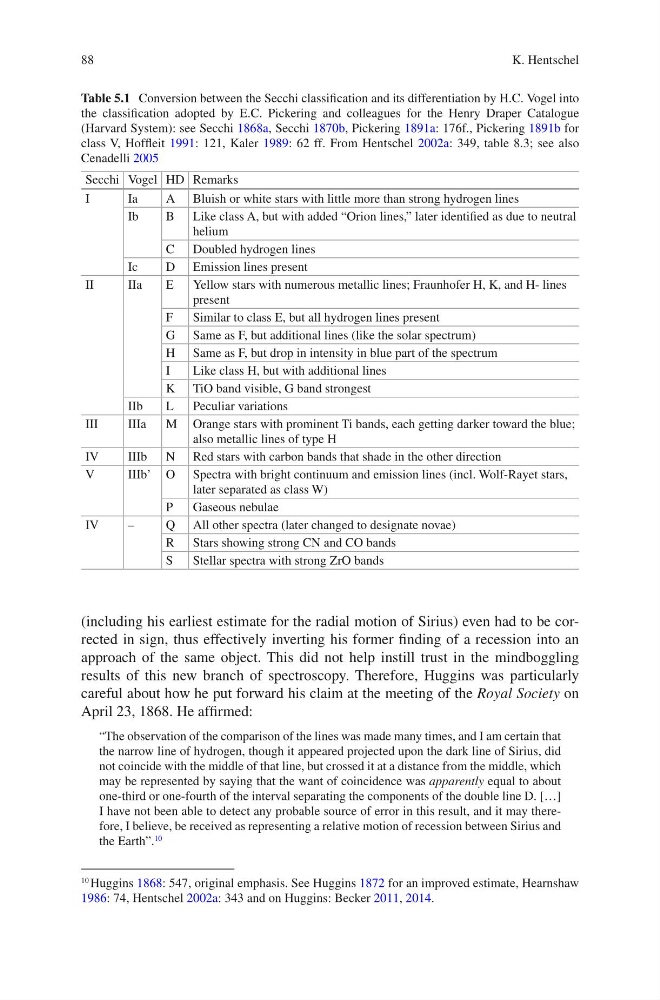
Table 5.1 Conversion between the Secchi classification and its differentiation by H.C. Vogel into
the classification adopted by E.C. Pickering and colleagues for the Henry Draper Catalogue
(Harvard System): see Secchi 1868a, Secchi 1870b, Pickering 1891a: 176f., Pickering 1891b for
class V, Hoffleit 1991: 121, Kaler 1989: 62 ff. From Hentschel 2002a: 349, table 8.3; see also
Cenadelli 2005
Secchi Vogel HD Remarks
I
Ia
A Bluish or white stars with little more than strong hydrogen lines
Ib
B Like class A, but with added “Orion lines,” later identified as due to neutral
helium
C Doubled hydrogen lines
Ic
D Emission lines present
II
IIa
E Yellow stars with numerous metallic lines; Fraunhofer H, K, and H- lines
present
F
Similar to class E, but all hydrogen lines present
G Same as F, but additional lines (like the solar spectrum)
H Same as F, but drop in intensity in blue part of the spectrum
I
Like class H, but with additional lines
K TiO band visible, G band strongest
IIb
L Peculiar variations
III
IIIa
M Orange stars with prominent Ti bands, each getting darker toward the blue;
also metallic lines of type H
IV
IIIb N Red stars with carbon bands that shade in the other direction
V
IIIb’ O Spectra with bright continuum and emission lines (incl. Wolf-Rayet stars,
later separated as class W)
P
Gaseous nebulae
IV
–
Q All other spectra (later changed to designate novae)
R Stars showing strong CN and CO bands
S
Stellar spectra with strong ZrO bands
K. Hentschel
(including his earliest estimate for the radial motion of Sirius) even had to be corrected in sign, thus effectively inverting his former finding of a recession into an
approach of the same object. This did not help instill trust in the mindboggling
results of this new branch of spectroscopy. Therefore, Huggins was particularly
careful about how he put forward his claim at the meeting of the Royal Society on
April 23, 1868. He affirmed:
“The observation of the comparison of the lines was made many times, and I am certain that
the narrow line of hydrogen, though it appeared projected upon the dark line of Sirius, did
not coincide with the middle of that line, but crossed it at a distance from the middle, which
may be represented by saying that the want of coincidence was apparently equal to about
one-third or one-fourth of the interval separating the components of the double line D. […]
I have not been able to detect any probable source of error in this result, and it may therefore, I believe, be received as representing a relative motion of recession between Sirius and
the Earth”.
10
10 Huggins 1868: 547, original emphasis. See Huggins 1872 for an improved estimate, Hearnshaw
1986: 74, Hentschel 2002a: 343 and on Huggins: Becker 2011, 2014.
Table 5.1 Conversion between the Secchi classification and its differentiation by H.C. Vogel into
the classification adopted by E.C. Pickering and colleagues for the Henry Draper Catalogue
(Harvard System): see Secchi 1868a, Secchi 1870b, Pickering 1891a: 176f., Pickering 1891b for
class V, Hoffleit 1991: 121, Kaler 1989: 62 ff. From Hentschel 2002a: 349, table 8.3; see also
Cenadelli 2005
Secchi Vogel HD Remarks
I
Ia
A Bluish or white stars with little more than strong hydrogen lines
Ib
B Like class A, but with added “Orion lines,” later identified as due to neutral
helium
C Doubled hydrogen lines
Ic
D Emission lines present
II
IIa
E Yellow stars with numerous metallic lines; Fraunhofer H, K, and H- lines
present
F
Similar to class E, but all hydrogen lines present
G Same as F, but additional lines (like the solar spectrum)
H Same as F, but drop in intensity in blue part of the spectrum
I
Like class H, but with additional lines
K TiO band visible, G band strongest
IIb
L Peculiar variations
III
IIIa
M Orange stars with prominent Ti bands, each getting darker toward the blue;
also metallic lines of type H
IV
IIIb N Red stars with carbon bands that shade in the other direction
V
IIIb’ O Spectra with bright continuum and emission lines (incl. Wolf-Rayet stars,
later separated as class W)
P
Gaseous nebulae
IV
–
Q All other spectra (later changed to designate novae)
R Stars showing strong CN and CO bands
S
Stellar spectra with strong ZrO bands
K. Hentschel