

76
J. Zhang et al.
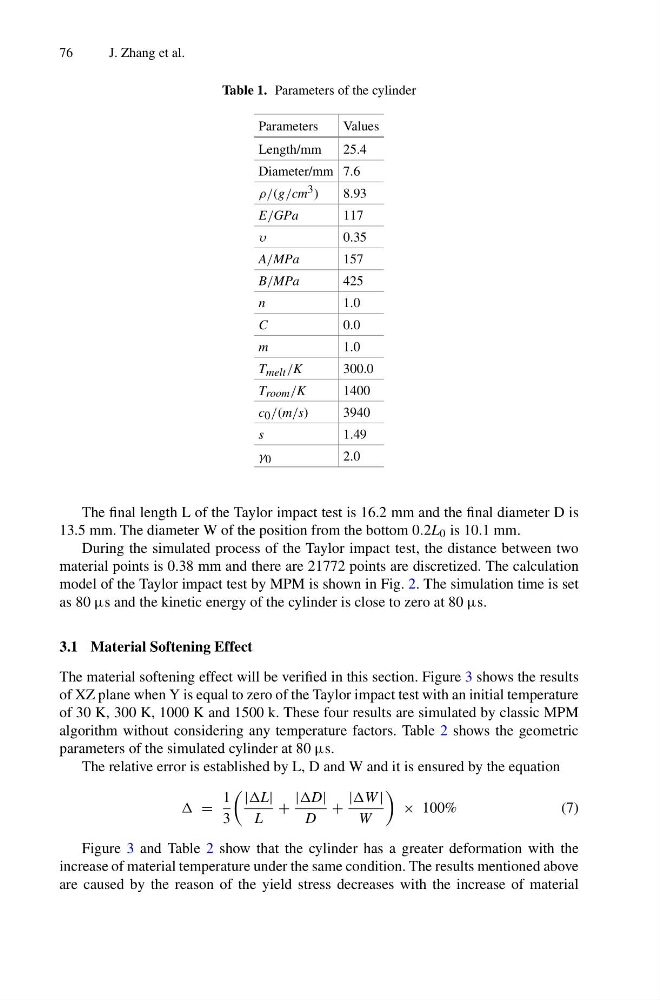
Table 1. Parameters of the cylinder
Parameters
Values
Length/mm
25.4
Diameter/mm 7.6
ρ/(g/cm 3 )
8.93
E/GPa
117
υ
0.35
A/MPa
157
B/MPa
425
n
1.0
C
0.0
m
1.0
T melt /K
300.0
T room /K
1400
c 0 /(m/s)
3940
s
1.49
γ 0
2.0
The final length L of the Taylor impact test is 16.2 mm and the final diameter D is
13.5 mm. The diameter W of the position from the bottom 0.2L 0 is 10.1 mm.
During the simulated process of the Taylor impact test, the distance between two
material points is 0.38 mm and there are 21772 points are discretized. The calculation
model of the Taylor impact test by MPM is shown in Fig. 2. The simulation time is set
as 80 µs and the kinetic energy of the cylinder is close to zero at 80 µs.
3.1 Material Softening Effect
The material softening effect will be verified in this section. Figure 3 shows the results
of XZ plane when Y is equal to zero of the Taylor impact test with an initial temperature
of 30 K, 300 K, 1000 K and 1500 k. These four results are simulated by classic MPM
algorithm without considering any temperature factors. Table 2 shows the geometric
parameters of the simulated cylinder at 80 µs.
The relative error is established by L, D and W and it is ensured by the equation
=
1
3
|L|
L
+
|D|
D
+
|W |
W
× 100%
(7)
Figure 3 and Table 2 show that the cylinder has a greater deformation with the
increase of material temperature under the same condition. The results mentioned above
are caused by the reason of the yield stress decreases with the increase of material
J. Zhang et al.
Table 1. Parameters of the cylinder
Parameters
Values
Length/mm
25.4
Diameter/mm 7.6
ρ/(g/cm 3 )
8.93
E/GPa
117
υ
0.35
A/MPa
157
B/MPa
425
n
1.0
C
0.0
m
1.0
T melt /K
300.0
T room /K
1400
c 0 /(m/s)
3940
s
1.49
γ 0
2.0
The final length L of the Taylor impact test is 16.2 mm and the final diameter D is
13.5 mm. The diameter W of the position from the bottom 0.2L 0 is 10.1 mm.
During the simulated process of the Taylor impact test, the distance between two
material points is 0.38 mm and there are 21772 points are discretized. The calculation
model of the Taylor impact test by MPM is shown in Fig. 2. The simulation time is set
as 80 µs and the kinetic energy of the cylinder is close to zero at 80 µs.
3.1 Material Softening Effect
The material softening effect will be verified in this section. Figure 3 shows the results
of XZ plane when Y is equal to zero of the Taylor impact test with an initial temperature
of 30 K, 300 K, 1000 K and 1500 k. These four results are simulated by classic MPM
algorithm without considering any temperature factors. Table 2 shows the geometric
parameters of the simulated cylinder at 80 µs.
The relative error is established by L, D and W and it is ensured by the equation
=
1
3
|L|
L
+
|D|
D
+
|W |
W
× 100%
(7)
Figure 3 and Table 2 show that the cylinder has a greater deformation with the
increase of material temperature under the same condition. The results mentioned above
are caused by the reason of the yield stress decreases with the increase of material