

A Flow Study in the Cyclone with Particle Separations
53
combining computational fluid dynamics (CFD) for continuum fluid and the discrete
element method (DEM) for discrete particles has been used to study the fundamentals
of coupled particle–fluid flows. Additionally different CFD–DEM models have been
adopted for the numerical testing. The developed DEM-CFD model was applied to
study the particles and air flow in a rotating drum and it can satisfactorily capture the
flow patterns in the drum such as the particle flow in the radial direction and air flow in the
horizontal direction, after particles falling show the tangential velocity and pressure drop
decreased as was demonstrated in [3]. In the other study showed in [7], the model CFDDEM successfully captured the key flow features in a gas cyclone, such as the strands
flow pattern of particles, and the decrease of pressure drop and tangential velocity after
loading solids. The effect of solid loading ratio is studied and analyzed in terms of gas and
solid flow structures, and the particle–gas, particle–particle and particle–wall interaction
forces. The same numerical approach was successfully used for the simulation in the
medium cyclones in [7] and [8].
Besides that there is an idea to express the influence of the particle in the flow by
a change of the appropriate flow properties. In the work [9], the presence of particles
is taken into account in terms of effective viscosity, which is defined by means of both
Newtonian and non-Newtonian (Bingham plastic) models. In this case the dispersed
phase equation closure is based on particle buoyancy as well as on shear-induced selfdiffusion effects. The proposed approach allows us to study sediment transport problems
and the related evolution of bed forms, without requiring the generation of curvilinear
coordinate systems and time-consuming step-by-step regridding.
This paper is organized as follows: in Sect. 2 a mathematical model is introduced with
details of the computational mesh. The experimental device and operation conditions
are discussed. In Sect. 3 results of numerical simulation and experimental measurement
of the pressure distribution is presented. In Sect. 4 main results are summarized and
further research in the field of the particle separation the cyclone is illuminated.
2 Problem Formulation
2.1 Mathematical Model and Simulation
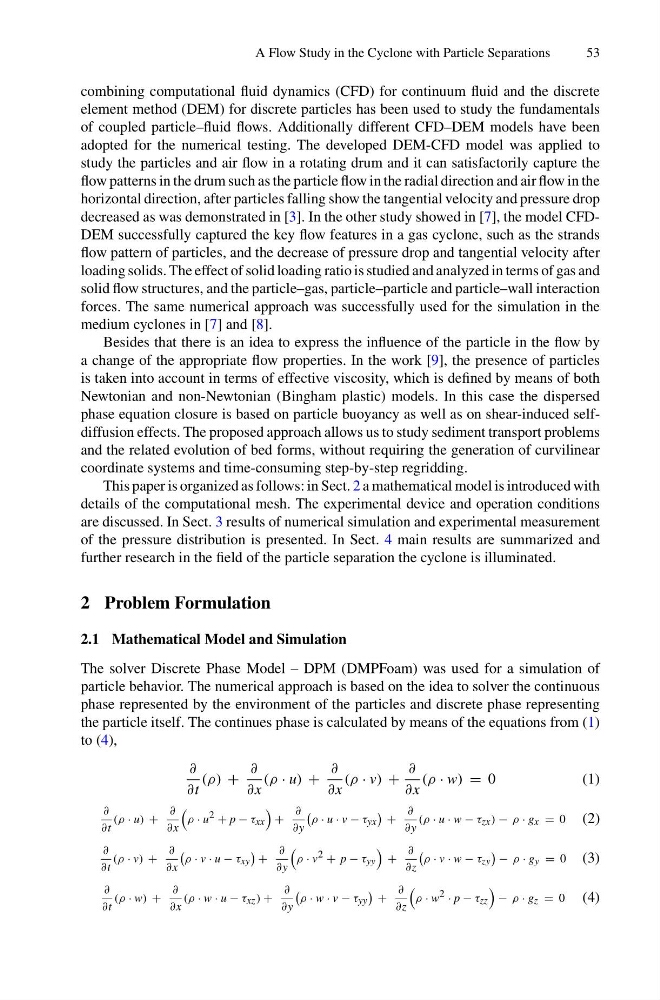
The solver Discrete Phase Model – DPM (DMPFoam) was used for a simulation of
particle behavior. The numerical approach is based on the idea to solver the continuous
phase represented by the environment of the particles and discrete phase representing
the particle itself. The continues phase is calculated by means of the equations from (1)
to (4),
∂
∂t
(ρ) +
∂
∂x
(ρ · u) +
∂
∂x
(ρ · v) +
∂
∂x
(ρ · w) = 0
( 1 )
∂
∂t
(ρ · u) +
∂
∂x
ρ · u 2 + p − τ xx
+
∂
∂y
ρ · u · v − τ yx
+
∂
∂y
(ρ · u · w − τ zx ) − ρ · g x = 0 (2)
∂
∂t
(ρ · v) +
∂
∂x
ρ · v · u − τ xy
+
∂
∂y
ρ · v 2 + p − τ yy
+
∂
∂z
ρ · v · w − τ zy
− ρ · g y = 0 (3)
∂
∂t
(ρ · w) +
∂
∂x
(ρ · w · u − τ xz ) +
∂
∂y
ρ · w · v − τ yy
+
∂
∂z
ρ · w 2 · p − τ zz
− ρ · g z = 0 (4)
53
combining computational fluid dynamics (CFD) for continuum fluid and the discrete
element method (DEM) for discrete particles has been used to study the fundamentals
of coupled particle–fluid flows. Additionally different CFD–DEM models have been
adopted for the numerical testing. The developed DEM-CFD model was applied to
study the particles and air flow in a rotating drum and it can satisfactorily capture the
flow patterns in the drum such as the particle flow in the radial direction and air flow in the
horizontal direction, after particles falling show the tangential velocity and pressure drop
decreased as was demonstrated in [3]. In the other study showed in [7], the model CFDDEM successfully captured the key flow features in a gas cyclone, such as the strands
flow pattern of particles, and the decrease of pressure drop and tangential velocity after
loading solids. The effect of solid loading ratio is studied and analyzed in terms of gas and
solid flow structures, and the particle–gas, particle–particle and particle–wall interaction
forces. The same numerical approach was successfully used for the simulation in the
medium cyclones in [7] and [8].
Besides that there is an idea to express the influence of the particle in the flow by
a change of the appropriate flow properties. In the work [9], the presence of particles
is taken into account in terms of effective viscosity, which is defined by means of both
Newtonian and non-Newtonian (Bingham plastic) models. In this case the dispersed
phase equation closure is based on particle buoyancy as well as on shear-induced selfdiffusion effects. The proposed approach allows us to study sediment transport problems
and the related evolution of bed forms, without requiring the generation of curvilinear
coordinate systems and time-consuming step-by-step regridding.
This paper is organized as follows: in Sect. 2 a mathematical model is introduced with
details of the computational mesh. The experimental device and operation conditions
are discussed. In Sect. 3 results of numerical simulation and experimental measurement
of the pressure distribution is presented. In Sect. 4 main results are summarized and
further research in the field of the particle separation the cyclone is illuminated.
2 Problem Formulation
2.1 Mathematical Model and Simulation
The solver Discrete Phase Model – DPM (DMPFoam) was used for a simulation of
particle behavior. The numerical approach is based on the idea to solver the continuous
phase represented by the environment of the particles and discrete phase representing
the particle itself. The continues phase is calculated by means of the equations from (1)
to (4),
∂
∂t
(ρ) +
∂
∂x
(ρ · u) +
∂
∂x
(ρ · v) +
∂
∂x
(ρ · w) = 0
( 1 )
∂
∂t
(ρ · u) +
∂
∂x
ρ · u 2 + p − τ xx
+
∂
∂y
ρ · u · v − τ yx
+
∂
∂y
(ρ · u · w − τ zx ) − ρ · g x = 0 (2)
∂
∂t
(ρ · v) +
∂
∂x
ρ · v · u − τ xy
+
∂
∂y
ρ · v 2 + p − τ yy
+
∂
∂z
ρ · v · w − τ zy
− ρ · g y = 0 (3)
∂
∂t
(ρ · w) +
∂
∂x
(ρ · w · u − τ xz ) +
∂
∂y
ρ · w · v − τ yy
+
∂
∂z
ρ · w 2 · p − τ zz
− ρ · g z = 0 (4)