

26
M. Tabatabaei and S. N. Atluri
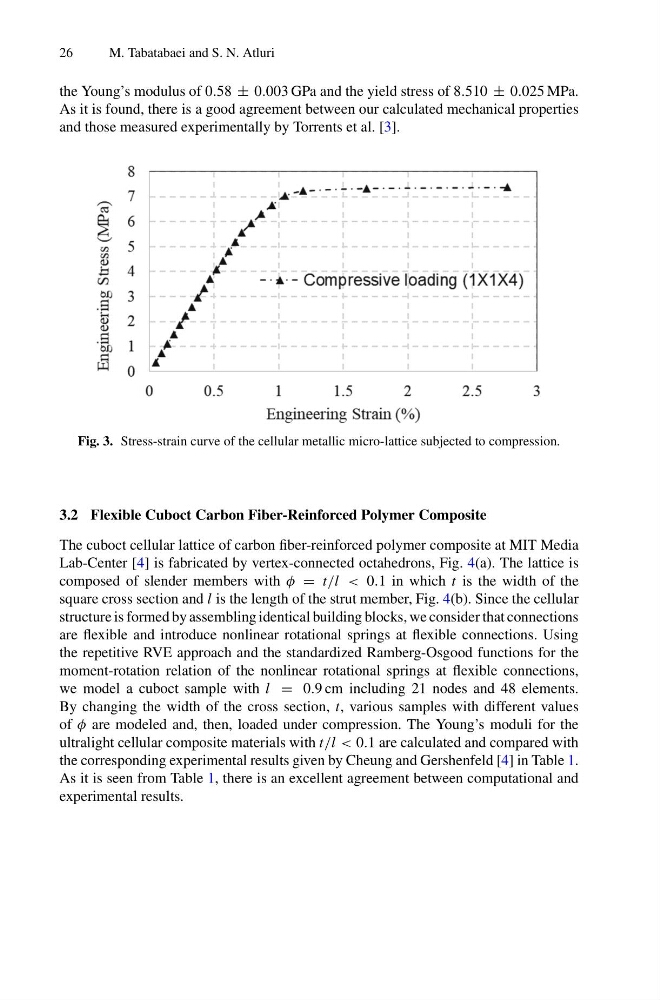
the Young’s modulus of 0.58 ± 0.003 GPa and the yield stress of 8.510 ± 0.025 MPa.
As it is found, there is a good agreement between our calculated mechanical properties
and those measured experimentally by Torrents et al. [3].
Fig. 3. Stress-strain curve of the cellular metallic micro-lattice subjected to compression.
3.2 Flexible Cuboct Carbon Fiber-Reinforced Polymer Composite
The cuboct cellular lattice of carbon fiber-reinforced polymer composite at MIT Media
Lab-Center [4] is fabricated by vertex-connected octahedrons, Fig. 4(a). The lattice is
composed of slender members with φ = t/l < 0.1 in which t is the width of the
square cross section and l is the length of the strut member, Fig. 4(b). Since the cellular
structure is formed by assembling identical building blocks, we consider that connections
are flexible and introduce nonlinear rotational springs at flexible connections. Using
the repetitive RVE approach and the standardized Ramberg-Osgood functions for the
moment-rotation relation of the nonlinear rotational springs at flexible connections,
we model a cuboct sample with l = 0.9 cm including 21 nodes and 48 elements.
By changing the width of the cross section, t, various samples with different values
of φ are modeled and, then, loaded under compression. The Young’s moduli for the
ultralight cellular composite materials with t/l < 0.1 are calculated and compared with
the corresponding experimental results given by Cheung and Gershenfeld [4] in Table 1.
As it is seen from Table 1, there is an excellent agreement between computational and
experimental results.
M. Tabatabaei and S. N. Atluri
the Young’s modulus of 0.58 ± 0.003 GPa and the yield stress of 8.510 ± 0.025 MPa.
As it is found, there is a good agreement between our calculated mechanical properties
and those measured experimentally by Torrents et al. [3].
Fig. 3. Stress-strain curve of the cellular metallic micro-lattice subjected to compression.
3.2 Flexible Cuboct Carbon Fiber-Reinforced Polymer Composite
The cuboct cellular lattice of carbon fiber-reinforced polymer composite at MIT Media
Lab-Center [4] is fabricated by vertex-connected octahedrons, Fig. 4(a). The lattice is
composed of slender members with φ = t/l < 0.1 in which t is the width of the
square cross section and l is the length of the strut member, Fig. 4(b). Since the cellular
structure is formed by assembling identical building blocks, we consider that connections
are flexible and introduce nonlinear rotational springs at flexible connections. Using
the repetitive RVE approach and the standardized Ramberg-Osgood functions for the
moment-rotation relation of the nonlinear rotational springs at flexible connections,
we model a cuboct sample with l = 0.9 cm including 21 nodes and 48 elements.
By changing the width of the cross section, t, various samples with different values
of φ are modeled and, then, loaded under compression. The Young’s moduli for the
ultralight cellular composite materials with t/l < 0.1 are calculated and compared with
the corresponding experimental results given by Cheung and Gershenfeld [4] in Table 1.
As it is seen from Table 1, there is an excellent agreement between computational and
experimental results.