

Operating Parameters Optimization of Natural Gas Purification Plant
285
1350
1400
1450
1500
1550
1600
1
3
5
7
9 11 13 15 17 19 21 23 25 27 29 31
Unit energy consumption(MJ/10 4
Nm 3
)
Number of iterations
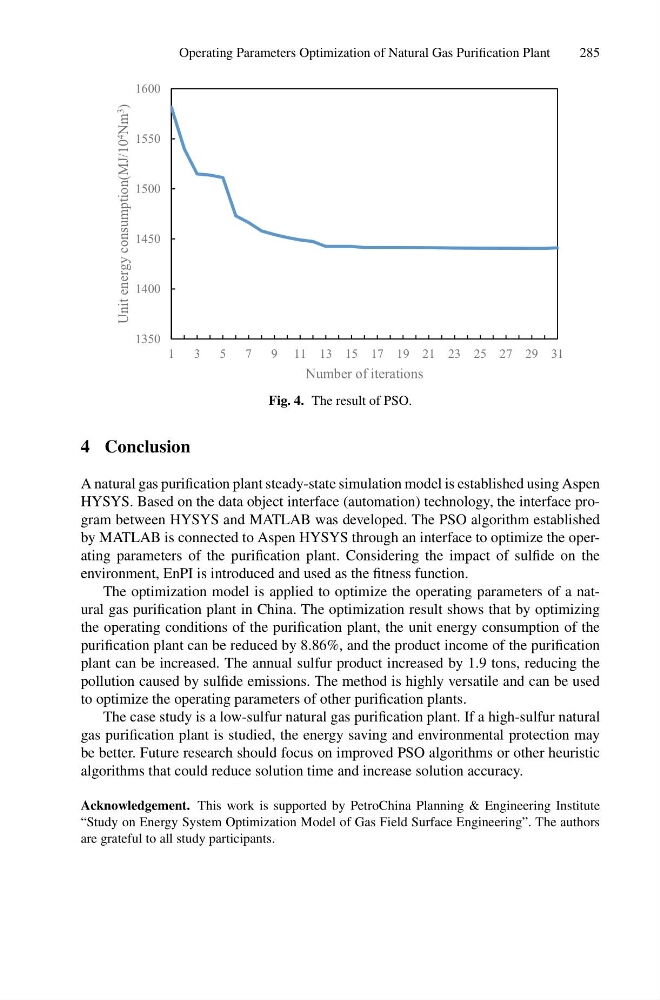
Fig. 4. The result of PSO.
4 Conclusion
A natural gas purification plant steady-state simulation model is established using Aspen
HYSYS. Based on the data object interface (automation) technology, the interface program between HYSYS and MATLAB was developed. The PSO algorithm established
by MATLAB is connected to Aspen HYSYS through an interface to optimize the operating parameters of the purification plant. Considering the impact of sulfide on the
environment, EnPI is introduced and used as the fitness function.
The optimization model is applied to optimize the operating parameters of a natural gas purification plant in China. The optimization result shows that by optimizing
the operating conditions of the purification plant, the unit energy consumption of the
purification plant can be reduced by 8.86%, and the product income of the purification
plant can be increased. The annual sulfur product increased by 1.9 tons, reducing the
pollution caused by sulfide emissions. The method is highly versatile and can be used
to optimize the operating parameters of other purification plants.
The case study is a low-sulfur natural gas purification plant. If a high-sulfur natural
gas purification plant is studied, the energy saving and environmental protection may
be better. Future research should focus on improved PSO algorithms or other heuristic
algorithms that could reduce solution time and increase solution accuracy.
Acknowledgement. This work is supported by PetroChina Planning & Engineering Institute
“Study on Energy System Optimization Model of Gas Field Surface Engineering”. The authors
are grateful to all study participants.
285
1350
1400
1450
1500
1550
1600
1
3
5
7
9 11 13 15 17 19 21 23 25 27 29 31
Unit energy consumption(MJ/10 4
Nm 3
)
Number of iterations
Fig. 4. The result of PSO.
4 Conclusion
A natural gas purification plant steady-state simulation model is established using Aspen
HYSYS. Based on the data object interface (automation) technology, the interface program between HYSYS and MATLAB was developed. The PSO algorithm established
by MATLAB is connected to Aspen HYSYS through an interface to optimize the operating parameters of the purification plant. Considering the impact of sulfide on the
environment, EnPI is introduced and used as the fitness function.
The optimization model is applied to optimize the operating parameters of a natural gas purification plant in China. The optimization result shows that by optimizing
the operating conditions of the purification plant, the unit energy consumption of the
purification plant can be reduced by 8.86%, and the product income of the purification
plant can be increased. The annual sulfur product increased by 1.9 tons, reducing the
pollution caused by sulfide emissions. The method is highly versatile and can be used
to optimize the operating parameters of other purification plants.
The case study is a low-sulfur natural gas purification plant. If a high-sulfur natural
gas purification plant is studied, the energy saving and environmental protection may
be better. Future research should focus on improved PSO algorithms or other heuristic
algorithms that could reduce solution time and increase solution accuracy.
Acknowledgement. This work is supported by PetroChina Planning & Engineering Institute
“Study on Energy System Optimization Model of Gas Field Surface Engineering”. The authors
are grateful to all study participants.