

Optimal Design of Natural Gas Gathering Systems
261
built pipelines, where 1 means the construction of the corresponding pipeline and 0
means no pipeline to build.
Update Process
The GA operators selected and used in this paper were the Roulette-Wheel selection,
single-point crossover, uniform mutation rate, and Elitism. Elitism is a method which
copies the best chromosome or a few best chromosomes to the off-spring without any
change that ensure the optimal solution will not be lost as the number of iterations
increases.
2.2 Particle Swarm Optimization
Standard Particle Swarm Optimization Algorithm
Particle swarm optimization (PSO) algorithm is an effective algorithm to solve the
MINLP problem. In PSO, particles are distributed in the feasible search space and each
represents a feasible solution. Each particle contains three aspects of information: the
current position x i , current velocity v i , and historical best position pbest i .
Assuming that the optimization problem is N-dimensional, M denotes population
size, and then the position, velocity and historical best position of the i th particle
can be expressed as x i =
x i,1 , x i,2 , . . . , x i,N
, v i =
v i,1 , v i,2 , . . . , v i,N
and
pbest i =
pbest i,1 , pbest i,2 , . . . , pbest i,N
respectively, for all i ∈ 1, . . . , M .
In addition, the best position of all particles is called the current global best position
gbest i = (gbest 1 , gbest 2 , . . . , gbest N ). In each iteration, the x i and v i can be updated
as follows.
v i,k (t + 1) = w · v i,k (t) + c 1 · r 1
pbest i,k (t) − x i,k (t)
+ c 2 · r 2
gbest i (t) − x i,k (t)
, k ∈ (1, 2, . . . , N )
(1)
x i,k (t + 1) = x i,k (t) + v i,k (t + 1)
(2)
Where c 1 and c 2 are individual cognitive learning factor and social cognitive learning factor, respectively, r 1 and r 2 are the random real numbers in the interval [0,1]. w
represents the inertia weight, a large value of it facilitates a global search while a small
value facilitates a local search.
Modified Particle Swarm Optimization Algorithm
As mentioned above, particles tend to move toward the current optimal particle and
historical best position, resulting in the aggregation of the population in the later iterations
(Liu, Chen et al. 2019). That decreases the exploration ability of the PSO algorithm which
causes the results are easy to trap in the local optimum. In order to obtain the optimal
solution efficiently, a linearly decreasing weight is introduced to form the modified
particle swarm optimization (MPSO) algorithm in this paper. The update equation of the
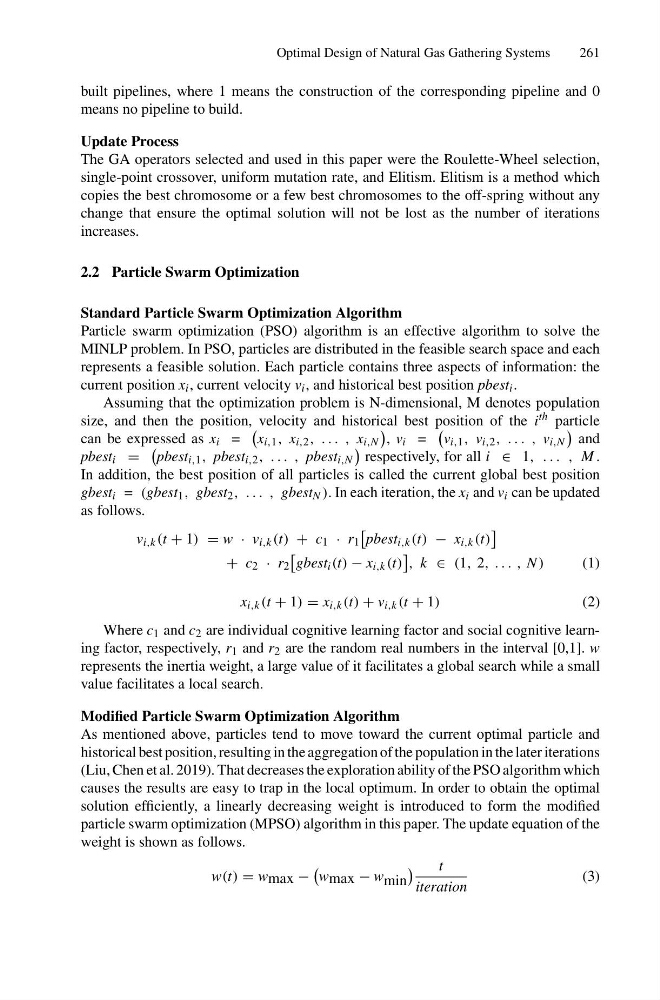
weight is shown as follows.
w(t) = w max −
w max − w min
t
iteration
(3)
261
built pipelines, where 1 means the construction of the corresponding pipeline and 0
means no pipeline to build.
Update Process
The GA operators selected and used in this paper were the Roulette-Wheel selection,
single-point crossover, uniform mutation rate, and Elitism. Elitism is a method which
copies the best chromosome or a few best chromosomes to the off-spring without any
change that ensure the optimal solution will not be lost as the number of iterations
increases.
2.2 Particle Swarm Optimization
Standard Particle Swarm Optimization Algorithm
Particle swarm optimization (PSO) algorithm is an effective algorithm to solve the
MINLP problem. In PSO, particles are distributed in the feasible search space and each
represents a feasible solution. Each particle contains three aspects of information: the
current position x i , current velocity v i , and historical best position pbest i .
Assuming that the optimization problem is N-dimensional, M denotes population
size, and then the position, velocity and historical best position of the i th particle
can be expressed as x i =
x i,1 , x i,2 , . . . , x i,N
, v i =
v i,1 , v i,2 , . . . , v i,N
and
pbest i =
pbest i,1 , pbest i,2 , . . . , pbest i,N
respectively, for all i ∈ 1, . . . , M .
In addition, the best position of all particles is called the current global best position
gbest i = (gbest 1 , gbest 2 , . . . , gbest N ). In each iteration, the x i and v i can be updated
as follows.
v i,k (t + 1) = w · v i,k (t) + c 1 · r 1
pbest i,k (t) − x i,k (t)
+ c 2 · r 2
gbest i (t) − x i,k (t)
, k ∈ (1, 2, . . . , N )
(1)
x i,k (t + 1) = x i,k (t) + v i,k (t + 1)
(2)
Where c 1 and c 2 are individual cognitive learning factor and social cognitive learning factor, respectively, r 1 and r 2 are the random real numbers in the interval [0,1]. w
represents the inertia weight, a large value of it facilitates a global search while a small
value facilitates a local search.
Modified Particle Swarm Optimization Algorithm
As mentioned above, particles tend to move toward the current optimal particle and
historical best position, resulting in the aggregation of the population in the later iterations
(Liu, Chen et al. 2019). That decreases the exploration ability of the PSO algorithm which
causes the results are easy to trap in the local optimum. In order to obtain the optimal
solution efficiently, a linearly decreasing weight is introduced to form the modified
particle swarm optimization (MPSO) algorithm in this paper. The update equation of the
weight is shown as follows.
w(t) = w max −
w max − w min
t
iteration
(3)