

Data-Driven Fluid Flow Simulations by Using Convolutional
17
Step 3: By use of the decoder network with the initial latent code, the velocity vector
fields at time step (t + s) are sequentially derived from those of time step t. As shown in
Fig. 3, the network consists of three fully-connected layers using the parametric softsign
activation functions [2] with batch normalization and dropout of 0.1.
The parametric softsign activation functions which were derived on the steady
advection-diffusion system in fluid dynamics framework, are given as follows:
g(v) =
v
(v ≥ 0)
e α v
e α +|v| (v < 0)
(8)
Where α is the ad hoc parameter.
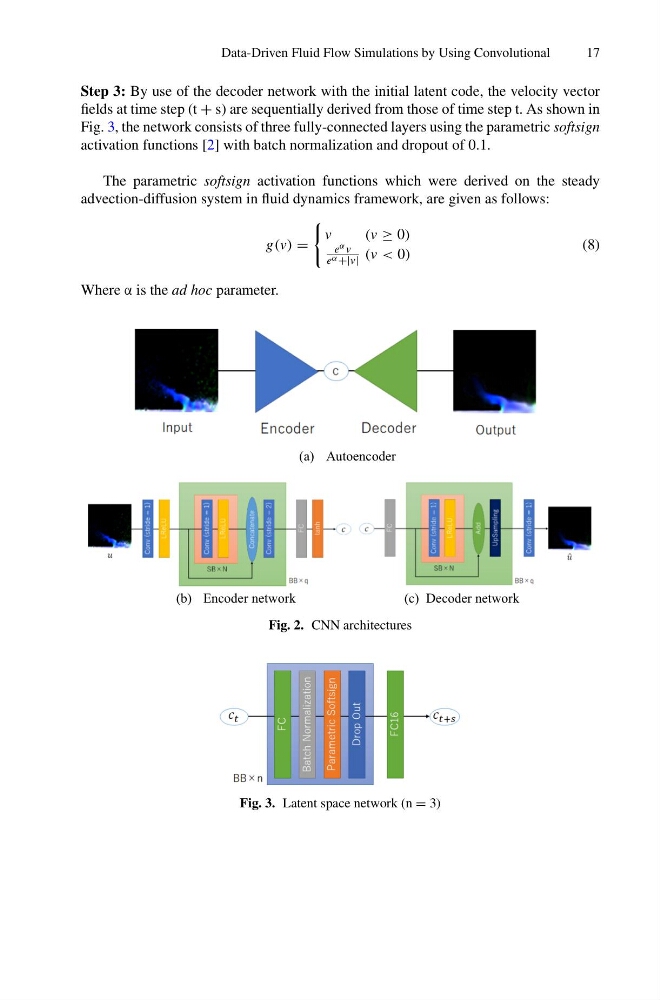
(a) Autoencoder
(b) Encoder network
(c) Decoder network
Fig. 2. CNN architectures
Fig. 3. Latent space network (n = 3)
17
Step 3: By use of the decoder network with the initial latent code, the velocity vector
fields at time step (t + s) are sequentially derived from those of time step t. As shown in
Fig. 3, the network consists of three fully-connected layers using the parametric softsign
activation functions [2] with batch normalization and dropout of 0.1.
The parametric softsign activation functions which were derived on the steady
advection-diffusion system in fluid dynamics framework, are given as follows:
g(v) =
v
(v ≥ 0)
e α v
e α +|v| (v < 0)
(8)
Where α is the ad hoc parameter.
(a) Autoencoder
(b) Encoder network
(c) Decoder network
Fig. 2. CNN architectures
Fig. 3. Latent space network (n = 3)