

Multi-period Infrared Image Generation Based on MCGAN
237
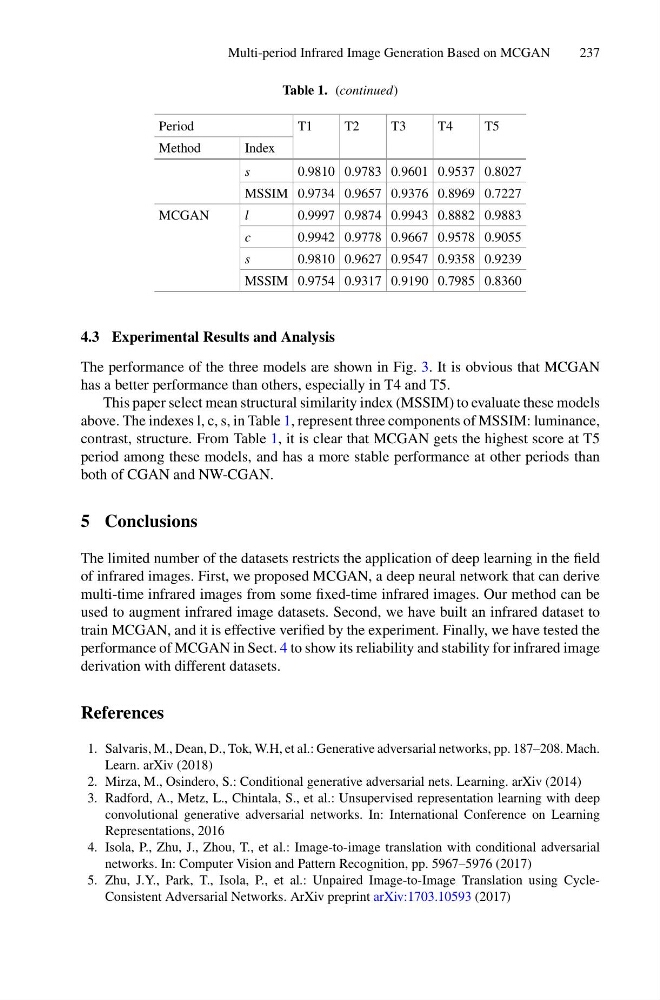
Table 1. (continued)
Period
T1
T2
T3
T4
T5
Method
Index
s
0.9810 0.9783 0.9601 0.9537 0.8027
MSSIM 0.9734 0.9657 0.9376 0.8969 0.7227
MCGAN
l
0.9997 0.9874 0.9943 0.8882 0.9883
c
0.9942 0.9778 0.9667 0.9578 0.9055
s
0.9810 0.9627 0.9547 0.9358 0.9239
MSSIM 0.9754 0.9317 0.9190 0.7985 0.8360
4.3 Experimental Results and Analysis
The performance of the three models are shown in Fig. 3. It is obvious that MCGAN
has a better performance than others, especially in T4 and T5.
This paper select mean structural similarity index (MSSIM) to evaluate these models
above. The indexes l, c, s, in Table 1, represent three components of MSSIM: luminance,
contrast, structure. From Table 1, it is clear that MCGAN gets the highest score at T5
period among these models, and has a more stable performance at other periods than
both of CGAN and NW-CGAN.
5 Conclusions
The limited number of the datasets restricts the application of deep learning in the field
of infrared images. First, we proposed MCGAN, a deep neural network that can derive
multi-time infrared images from some fixed-time infrared images. Our method can be
used to augment infrared image datasets. Second, we have built an infrared dataset to
train MCGAN, and it is effective verified by the experiment. Finally, we have tested the
performance of MCGAN in Sect. 4 to show its reliability and stability for infrared image
derivation with different datasets.
References
1. Salvaris, M., Dean, D., Tok, W.H, et al.: Generative adversarial networks, pp. 187–208. Mach.
Learn. arXiv (2018)
2. Mirza, M., Osindero, S.: Conditional generative adversarial nets. Learning. arXiv (2014)
3. Radford, A., Metz, L., Chintala, S., et al.: Unsupervised representation learning with deep
convolutional generative adversarial networks. In: International Conference on Learning
Representations, 2016
4. Isola, P., Zhu, J., Zhou, T., et al.: Image-to-image translation with conditional adversarial
networks. In: Computer Vision and Pattern Recognition, pp. 5967–5976 (2017)
5. Zhu, J.Y., Park, T., Isola, P., et al.: Unpaired Image-to-Image Translation using CycleConsistent Adversarial Networks. ArXiv preprint arXiv:1703.10593 (2017)
237
Table 1. (continued)
Period
T1
T2
T3
T4
T5
Method
Index
s
0.9810 0.9783 0.9601 0.9537 0.8027
MSSIM 0.9734 0.9657 0.9376 0.8969 0.7227
MCGAN
l
0.9997 0.9874 0.9943 0.8882 0.9883
c
0.9942 0.9778 0.9667 0.9578 0.9055
s
0.9810 0.9627 0.9547 0.9358 0.9239
MSSIM 0.9754 0.9317 0.9190 0.7985 0.8360
4.3 Experimental Results and Analysis
The performance of the three models are shown in Fig. 3. It is obvious that MCGAN
has a better performance than others, especially in T4 and T5.
This paper select mean structural similarity index (MSSIM) to evaluate these models
above. The indexes l, c, s, in Table 1, represent three components of MSSIM: luminance,
contrast, structure. From Table 1, it is clear that MCGAN gets the highest score at T5
period among these models, and has a more stable performance at other periods than
both of CGAN and NW-CGAN.
5 Conclusions
The limited number of the datasets restricts the application of deep learning in the field
of infrared images. First, we proposed MCGAN, a deep neural network that can derive
multi-time infrared images from some fixed-time infrared images. Our method can be
used to augment infrared image datasets. Second, we have built an infrared dataset to
train MCGAN, and it is effective verified by the experiment. Finally, we have tested the
performance of MCGAN in Sect. 4 to show its reliability and stability for infrared image
derivation with different datasets.
References
1. Salvaris, M., Dean, D., Tok, W.H, et al.: Generative adversarial networks, pp. 187–208. Mach.
Learn. arXiv (2018)
2. Mirza, M., Osindero, S.: Conditional generative adversarial nets. Learning. arXiv (2014)
3. Radford, A., Metz, L., Chintala, S., et al.: Unsupervised representation learning with deep
convolutional generative adversarial networks. In: International Conference on Learning
Representations, 2016
4. Isola, P., Zhu, J., Zhou, T., et al.: Image-to-image translation with conditional adversarial
networks. In: Computer Vision and Pattern Recognition, pp. 5967–5976 (2017)
5. Zhu, J.Y., Park, T., Isola, P., et al.: Unpaired Image-to-Image Translation using CycleConsistent Adversarial Networks. ArXiv preprint arXiv:1703.10593 (2017)