

140
R. Zhang et al.
proposed new drilling methods such as riser free drilling, submarine pump lifting drilling
system and dual-density drilling system [3, 4]. Compared with traditional drilling, as
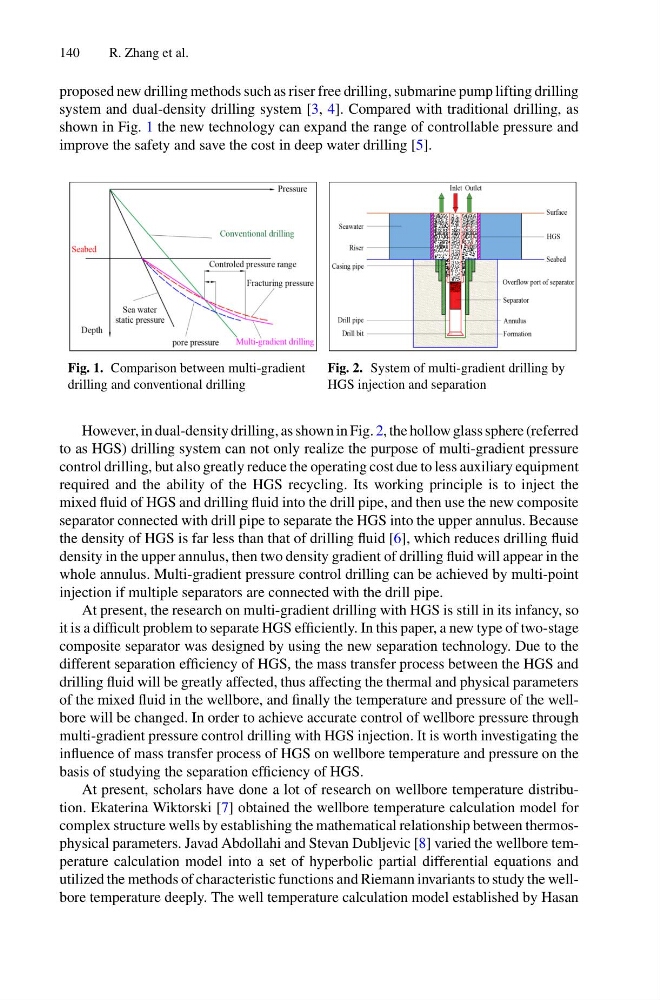
shown in Fig. 1 the new technology can expand the range of controllable pressure and
improve the safety and save the cost in deep water drilling [5].
Fig. 1. Comparison between multi-gradient
drilling and conventional drilling
Fig. 2. System of multi-gradient drilling by
HGS injection and separation
However, in dual-density drilling, as shown in Fig. 2, the hollow glass sphere (referred
to as HGS) drilling system can not only realize the purpose of multi-gradient pressure
control drilling, but also greatly reduce the operating cost due to less auxiliary equipment
required and the ability of the HGS recycling. Its working principle is to inject the
mixed fluid of HGS and drilling fluid into the drill pipe, and then use the new composite
separator connected with drill pipe to separate the HGS into the upper annulus. Because
the density of HGS is far less than that of drilling fluid [6], which reduces drilling fluid
density in the upper annulus, then two density gradient of drilling fluid will appear in the
whole annulus. Multi-gradient pressure control drilling can be achieved by multi-point
injection if multiple separators are connected with the drill pipe.
At present, the research on multi-gradient drilling with HGS is still in its infancy, so
it is a difficult problem to separate HGS efficiently. In this paper, a new type of two-stage
composite separator was designed by using the new separation technology. Due to the
different separation efficiency of HGS, the mass transfer process between the HGS and
drilling fluid will be greatly affected, thus affecting the thermal and physical parameters
of the mixed fluid in the wellbore, and finally the temperature and pressure of the wellbore will be changed. In order to achieve accurate control of wellbore pressure through
multi-gradient pressure control drilling with HGS injection. It is worth investigating the
influence of mass transfer process of HGS on wellbore temperature and pressure on the
basis of studying the separation efficiency of HGS.
At present, scholars have done a lot of research on wellbore temperature distribution. Ekaterina Wiktorski [7] obtained the wellbore temperature calculation model for
complex structure wells by establishing the mathematical relationship between thermosphysical parameters. Javad Abdollahi and Stevan Dubljevic [8] varied the wellbore temperature calculation model into a set of hyperbolic partial differential equations and
utilized the methods of characteristic functions and Riemann invariants to study the wellbore temperature deeply. The well temperature calculation model established by Hasan
R. Zhang et al.
proposed new drilling methods such as riser free drilling, submarine pump lifting drilling
system and dual-density drilling system [3, 4]. Compared with traditional drilling, as
shown in Fig. 1 the new technology can expand the range of controllable pressure and
improve the safety and save the cost in deep water drilling [5].
Fig. 1. Comparison between multi-gradient
drilling and conventional drilling
Fig. 2. System of multi-gradient drilling by
HGS injection and separation
However, in dual-density drilling, as shown in Fig. 2, the hollow glass sphere (referred
to as HGS) drilling system can not only realize the purpose of multi-gradient pressure
control drilling, but also greatly reduce the operating cost due to less auxiliary equipment
required and the ability of the HGS recycling. Its working principle is to inject the
mixed fluid of HGS and drilling fluid into the drill pipe, and then use the new composite
separator connected with drill pipe to separate the HGS into the upper annulus. Because
the density of HGS is far less than that of drilling fluid [6], which reduces drilling fluid
density in the upper annulus, then two density gradient of drilling fluid will appear in the
whole annulus. Multi-gradient pressure control drilling can be achieved by multi-point
injection if multiple separators are connected with the drill pipe.
At present, the research on multi-gradient drilling with HGS is still in its infancy, so
it is a difficult problem to separate HGS efficiently. In this paper, a new type of two-stage
composite separator was designed by using the new separation technology. Due to the
different separation efficiency of HGS, the mass transfer process between the HGS and
drilling fluid will be greatly affected, thus affecting the thermal and physical parameters
of the mixed fluid in the wellbore, and finally the temperature and pressure of the wellbore will be changed. In order to achieve accurate control of wellbore pressure through
multi-gradient pressure control drilling with HGS injection. It is worth investigating the
influence of mass transfer process of HGS on wellbore temperature and pressure on the
basis of studying the separation efficiency of HGS.
At present, scholars have done a lot of research on wellbore temperature distribution. Ekaterina Wiktorski [7] obtained the wellbore temperature calculation model for
complex structure wells by establishing the mathematical relationship between thermosphysical parameters. Javad Abdollahi and Stevan Dubljevic [8] varied the wellbore temperature calculation model into a set of hyperbolic partial differential equations and
utilized the methods of characteristic functions and Riemann invariants to study the wellbore temperature deeply. The well temperature calculation model established by Hasan