

Homogenization and Frequency Analysis
121
Natural angular velocity can we obtain from:
ω
2
mn =
QL 33 + 2L 12 L 23 L 13 − L 22 L 2
13 − L 11 L 2
23
ρ m hQ
,
(18)
where
Q = L 11 L 22 − L
2
12 .
(19)
4 Numerical Solution and Discussion
The parametric study of free vibration has been solved for simply supported panel on
each edge. Length of panel L is varied from 2 m to 3.8 m, with step of 0.2 m, width b =
1 m and thickness h of the panel is varied from 0.04 m to 0.12 m, with step of 0.02 m.
The thickness of outer layers h 1 = 0.0004 m and h 3 = 0.0006 m. Outer layers are
made of carbon/epoxy laminates with stacking sequence of layers [0/90/0], [0] 3 .
Carbon reinforced fiber polymer (CRFP) was considered [11] with the following
characteristics:
E f = 230 GPa; E m = 3 GPa; ν f = 0.3; ν m = 0.3; ξ f = 0.6.
Sandwich core, consisting of PUR foam, has material characteristics:
G = 4.3 MPa, ν = 0.3, ρ = 43 kg/m
3
.
Mass density of the laminated composite is ρ c = 1508 kg/m 3 .
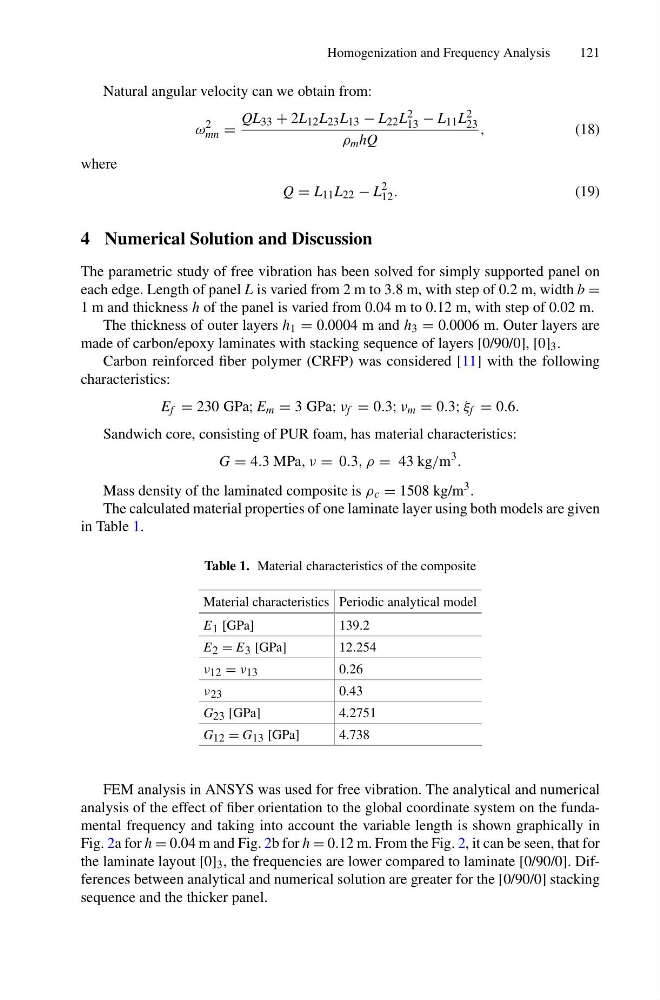
The calculated material properties of one laminate layer using both models are given
in Table 1.
Table 1. Material characteristics of the composite
Material characteristics Periodic analytical model
E 1 [GPa]
139.2
E 2 = E 3 [GPa]
12.254
ν 12 = ν 13
0.26
ν 23
0.43
G 23 [GPa]
4.2751
G 12 = G 13 [GPa]
4.738
FEM analysis in ANSYS was used for free vibration. The analytical and numerical
analysis of the effect of fiber orientation to the global coordinate system on the fundamental frequency and taking into account the variable length is shown graphically in
Fig. 2a for h = 0.04 m and Fig. 2b for h = 0.12 m. From the Fig. 2, it can be seen, that for
the laminate layout [0] 3 , the frequencies are lower compared to laminate [0/90/0]. Differences between analytical and numerical solution are greater for the [0/90/0] stacking
sequence and the thicker panel.
121
Natural angular velocity can we obtain from:
ω
2
mn =
QL 33 + 2L 12 L 23 L 13 − L 22 L 2
13 − L 11 L 2
23
ρ m hQ
,
(18)
where
Q = L 11 L 22 − L
2
12 .
(19)
4 Numerical Solution and Discussion
The parametric study of free vibration has been solved for simply supported panel on
each edge. Length of panel L is varied from 2 m to 3.8 m, with step of 0.2 m, width b =
1 m and thickness h of the panel is varied from 0.04 m to 0.12 m, with step of 0.02 m.
The thickness of outer layers h 1 = 0.0004 m and h 3 = 0.0006 m. Outer layers are
made of carbon/epoxy laminates with stacking sequence of layers [0/90/0], [0] 3 .
Carbon reinforced fiber polymer (CRFP) was considered [11] with the following
characteristics:
E f = 230 GPa; E m = 3 GPa; ν f = 0.3; ν m = 0.3; ξ f = 0.6.
Sandwich core, consisting of PUR foam, has material characteristics:
G = 4.3 MPa, ν = 0.3, ρ = 43 kg/m
3
.
Mass density of the laminated composite is ρ c = 1508 kg/m 3 .
The calculated material properties of one laminate layer using both models are given
in Table 1.
Table 1. Material characteristics of the composite
Material characteristics Periodic analytical model
E 1 [GPa]
139.2
E 2 = E 3 [GPa]
12.254
ν 12 = ν 13
0.26
ν 23
0.43
G 23 [GPa]
4.2751
G 12 = G 13 [GPa]
4.738
FEM analysis in ANSYS was used for free vibration. The analytical and numerical
analysis of the effect of fiber orientation to the global coordinate system on the fundamental frequency and taking into account the variable length is shown graphically in
Fig. 2a for h = 0.04 m and Fig. 2b for h = 0.12 m. From the Fig. 2, it can be seen, that for
the laminate layout [0] 3 , the frequencies are lower compared to laminate [0/90/0]. Differences between analytical and numerical solution are greater for the [0/90/0] stacking
sequence and the thicker panel.