

118
E. Kormanikova et al.
elements. For more complex structures, such as more general boundary conditions or
loading, numerical methods such as Finite Element Method, Boundary Element Method,
etc. are used [2–5].
The levels of micro, macro and structural modeling have to be considered [6–10] to
mechanical analysis of structural elements composed of fiber-reinforced composites.
2 Microscopic Stress-Strain Field
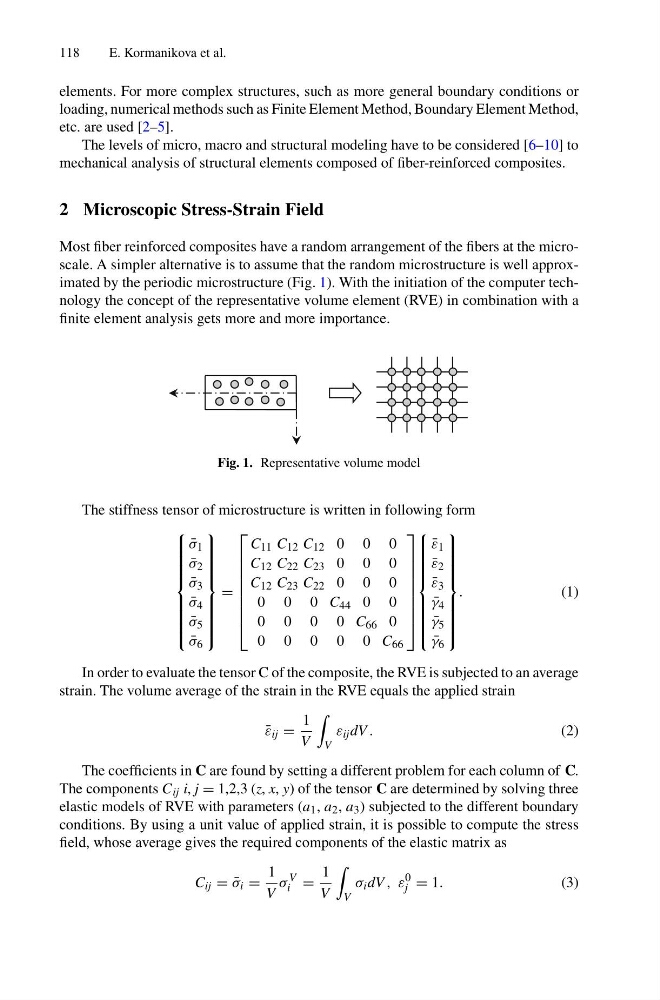
Most fiber reinforced composites have a random arrangement of the fibers at the microscale. A simpler alternative is to assume that the random microstructure is well approximated by the periodic microstructure (Fig. 1). With the initiation of the computer technology the concept of the representative volume element (RVE) in combination with a
finite element analysis gets more and more importance.
Fig. 1. Representative volume model
The stiffness tensor of microstructure is written in following form
⎧
⎪ ⎪ ⎪ ⎪ ⎪ ⎪ ⎪ ⎨
⎪ ⎪ ⎪ ⎪ ⎪ ⎪ ⎪ ⎩
¯
σ 1
¯
σ 2
¯
σ 3
¯
σ 4
¯
σ 5
¯
σ 6
⎫
⎪ ⎪ ⎪ ⎪ ⎪ ⎪ ⎪ ⎬
⎪ ⎪ ⎪ ⎪ ⎪ ⎪ ⎪ ⎭
=
⎡
⎢
⎢
⎢
⎢
⎢
⎢
⎢
⎣
C 11 C 12 C 12 0 0 0
C 12 C 22 C 23 0 0 0
C 12 C 23 C 22 0 0 0
0 0 0 C 44 0 0
0 0 0 0 C 66 0
0 0 0 0 0 C 66
⎤
⎥
⎥
⎥
⎥
⎥
⎥
⎥
⎦
⎧
⎪ ⎪ ⎪ ⎪ ⎪ ⎪ ⎪ ⎨
⎪ ⎪ ⎪ ⎪ ⎪ ⎪ ⎪ ⎩
¯
ε 1
¯
ε 2
¯
ε 3
¯
γ 4
¯
γ 5
¯
γ 6
⎫
⎪ ⎪ ⎪ ⎪ ⎪ ⎪ ⎪ ⎬
⎪ ⎪ ⎪ ⎪ ⎪ ⎪ ⎪ ⎭
.
(1)
In order to evaluate the tensor C of the composite, the RVE is subjected to an average
strain. The volume average of the strain in the RVE equals the applied strain
¯
ε ij =
1
V
V
ε ij dV .
(2)
The coefficients in C are found by setting a different problem for each column of C.
The components C ij i, j = 1,2,3 (z, x, y) of the tensor C are determined by solving three
elastic models of RVE with parameters (a 1 , a 2 , a 3 ) subjected to the different boundary
conditions. By using a unit value of applied strain, it is possible to compute the stress
field, whose average gives the required components of the elastic matrix as
C ij = ¯
σ i =
1
V
σ
V
i =
1
V
V
σ i dV , ε
0
j = 1.
(3)
E. Kormanikova et al.
elements. For more complex structures, such as more general boundary conditions or
loading, numerical methods such as Finite Element Method, Boundary Element Method,
etc. are used [2–5].
The levels of micro, macro and structural modeling have to be considered [6–10] to
mechanical analysis of structural elements composed of fiber-reinforced composites.
2 Microscopic Stress-Strain Field
Most fiber reinforced composites have a random arrangement of the fibers at the microscale. A simpler alternative is to assume that the random microstructure is well approximated by the periodic microstructure (Fig. 1). With the initiation of the computer technology the concept of the representative volume element (RVE) in combination with a
finite element analysis gets more and more importance.
Fig. 1. Representative volume model
The stiffness tensor of microstructure is written in following form
⎧
⎪ ⎪ ⎪ ⎪ ⎪ ⎪ ⎪ ⎨
⎪ ⎪ ⎪ ⎪ ⎪ ⎪ ⎪ ⎩
¯
σ 1
¯
σ 2
¯
σ 3
¯
σ 4
¯
σ 5
¯
σ 6
⎫
⎪ ⎪ ⎪ ⎪ ⎪ ⎪ ⎪ ⎬
⎪ ⎪ ⎪ ⎪ ⎪ ⎪ ⎪ ⎭
=
⎡
⎢
⎢
⎢
⎢
⎢
⎢
⎢
⎣
C 11 C 12 C 12 0 0 0
C 12 C 22 C 23 0 0 0
C 12 C 23 C 22 0 0 0
0 0 0 C 44 0 0
0 0 0 0 C 66 0
0 0 0 0 0 C 66
⎤
⎥
⎥
⎥
⎥
⎥
⎥
⎥
⎦
⎧
⎪ ⎪ ⎪ ⎪ ⎪ ⎪ ⎪ ⎨
⎪ ⎪ ⎪ ⎪ ⎪ ⎪ ⎪ ⎩
¯
ε 1
¯
ε 2
¯
ε 3
¯
γ 4
¯
γ 5
¯
γ 6
⎫
⎪ ⎪ ⎪ ⎪ ⎪ ⎪ ⎪ ⎬
⎪ ⎪ ⎪ ⎪ ⎪ ⎪ ⎪ ⎭
.
(1)
In order to evaluate the tensor C of the composite, the RVE is subjected to an average
strain. The volume average of the strain in the RVE equals the applied strain
¯
ε ij =
1
V
V
ε ij dV .
(2)
The coefficients in C are found by setting a different problem for each column of C.
The components C ij i, j = 1,2,3 (z, x, y) of the tensor C are determined by solving three
elastic models of RVE with parameters (a 1 , a 2 , a 3 ) subjected to the different boundary
conditions. By using a unit value of applied strain, it is possible to compute the stress
field, whose average gives the required components of the elastic matrix as
C ij = ¯
σ i =
1
V
σ
V
i =
1
V
V
σ i dV , ε
0
j = 1.
(3)