

2
M. D. Martínez-Rodrigo et al.
of train-track-bridge interaction mechanisms is essential in order to be able to predict
and assess the dynamic response of such structures. A state-of-the-art review on the
evolution of numerical models and experimental tests focusing on validation, safety
assessment and long-term performance investigation of train-track-bridge systems was
recently presented by Zhai et al. [5].
Railway axle loads and bridges interact through the track infrastructure. The track
distributes the axle loads and may exert a restraining effect on the bridges’ boundary
conditions [6] and a coupling effect among different spans of the same viaduct [7], or
between adjacent single-track decks [8]. Nevertheless, in many publications the effect
of the track is disregarded and the influence of the super-structure composed by the rails,
sleepers and ballast, in ballasted tracks, is still not well known.
In this contribution, the dynamic behavior of multi-span single-track bridges is investigated with the aim of evaluating the effect of the continuity of the track on the bridge
vertical response. In Sect. 2 an existing bridge object of study is described, along with
the numerical model. In Sect. 3, the results of a preliminary sensitivity analysis on a
few track parameters is presented. In Sect. 4, the results of an experimental campaign
recently performed on the bridge are compared with numerical predictions. Finally, some
conclusions are extracted regarding the effect of the track super-structure on the bridge
acceleration response.
2 Bridge Description and Numerical Model
2.1 Bridge Description
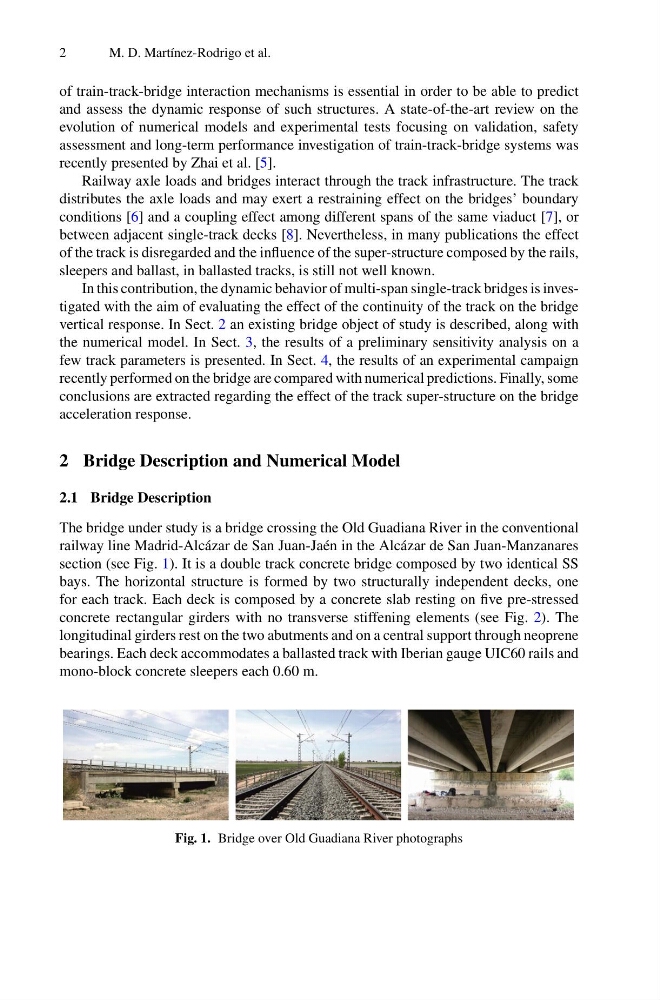
The bridge under study is a bridge crossing the Old Guadiana River in the conventional
railway line Madrid-Alcázar de San Juan-Jaén in the Alcázar de San Juan-Manzanares
section (see Fig. 1). It is a double track concrete bridge composed by two identical SS
bays. The horizontal structure is formed by two structurally independent decks, one
for each track. Each deck is composed by a concrete slab resting on five pre-stressed
concrete rectangular girders with no transverse stiffening elements (see Fig. 2). The
longitudinal girders rest on the two abutments and on a central support through neoprene
bearings. Each deck accommodates a ballasted track with Iberian gauge UIC60 rails and
mono-block concrete sleepers each 0.60 m.
Fig. 1. Bridge over Old Guadiana River photographs
M. D. Martínez-Rodrigo et al.
of train-track-bridge interaction mechanisms is essential in order to be able to predict
and assess the dynamic response of such structures. A state-of-the-art review on the
evolution of numerical models and experimental tests focusing on validation, safety
assessment and long-term performance investigation of train-track-bridge systems was
recently presented by Zhai et al. [5].
Railway axle loads and bridges interact through the track infrastructure. The track
distributes the axle loads and may exert a restraining effect on the bridges’ boundary
conditions [6] and a coupling effect among different spans of the same viaduct [7], or
between adjacent single-track decks [8]. Nevertheless, in many publications the effect
of the track is disregarded and the influence of the super-structure composed by the rails,
sleepers and ballast, in ballasted tracks, is still not well known.
In this contribution, the dynamic behavior of multi-span single-track bridges is investigated with the aim of evaluating the effect of the continuity of the track on the bridge
vertical response. In Sect. 2 an existing bridge object of study is described, along with
the numerical model. In Sect. 3, the results of a preliminary sensitivity analysis on a
few track parameters is presented. In Sect. 4, the results of an experimental campaign
recently performed on the bridge are compared with numerical predictions. Finally, some
conclusions are extracted regarding the effect of the track super-structure on the bridge
acceleration response.
2 Bridge Description and Numerical Model
2.1 Bridge Description
The bridge under study is a bridge crossing the Old Guadiana River in the conventional
railway line Madrid-Alcázar de San Juan-Jaén in the Alcázar de San Juan-Manzanares
section (see Fig. 1). It is a double track concrete bridge composed by two identical SS
bays. The horizontal structure is formed by two structurally independent decks, one
for each track. Each deck is composed by a concrete slab resting on five pre-stressed
concrete rectangular girders with no transverse stiffening elements (see Fig. 2). The
longitudinal girders rest on the two abutments and on a central support through neoprene
bearings. Each deck accommodates a ballasted track with Iberian gauge UIC60 rails and
mono-block concrete sleepers each 0.60 m.
Fig. 1. Bridge over Old Guadiana River photographs