

A New Locking-Free Thick/Thin Shell Element
97
2 Curvilinear Coordinate System of the Shell
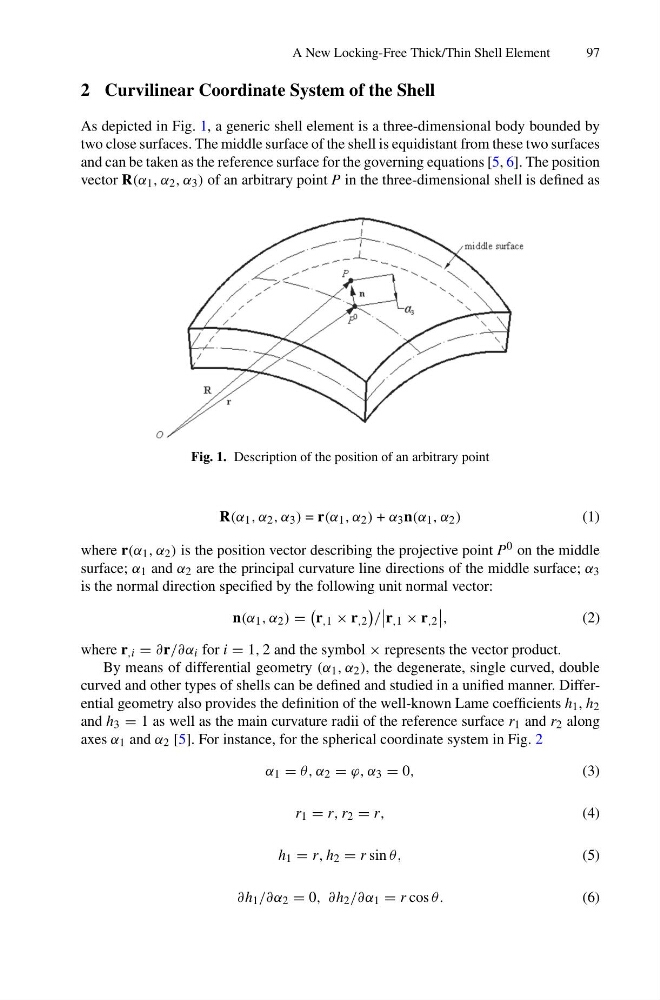
As depicted in Fig. 1, a generic shell element is a three-dimensional body bounded by
two close surfaces. The middle surface of the shell is equidistant from these two surfaces
and can be taken as the reference surface for the governing equations [5, 6]. The position
vector R(α 1 , α 2 , α 3 ) of an arbitrary point P in the three-dimensional shell is defined as
Fig. 1. Description of the position of an arbitrary point
R(α 1 , α 2 , α 3 ) = r(α 1 , α 2 ) + α 3 n(α 1 , α 2 )
(1)
where r(α 1 , α 2 ) is the position vector describing the projective point P 0 on the middle
surface; α 1 and α 2 are the principal curvature line directions of the middle surface; α 3
is the normal direction specified by the following unit normal vector:
n(α 1 , α 2 ) =
r ,1 × r ,2
/
r ,1 × r ,2
,
(2)
where r ,i = ∂r/∂α i for i = 1, 2 and the symbol × represents the vector product.
By means of differential geometry (α 1 , α 2 ), the degenerate, single curved, double
curved and other types of shells can be defined and studied in a unified manner. Differential geometry also provides the definition of the well-known Lame coefficients h 1 , h 2
and h 3 = 1 as well as the main curvature radii of the reference surface r 1 and r 2 along
axes α 1 and α 2 [5]. For instance, for the spherical coordinate system in Fig. 2
α 1 = θ, α 2 = ϕ, α 3 = 0,
(3)
r 1 = r, r 2 = r,
(4)
h 1 = r, h 2 = r sin θ,
(5)
∂h 1 /∂α 2 = 0, ∂h 2 /∂α 1 = r cos θ.
(6)
97
2 Curvilinear Coordinate System of the Shell
As depicted in Fig. 1, a generic shell element is a three-dimensional body bounded by
two close surfaces. The middle surface of the shell is equidistant from these two surfaces
and can be taken as the reference surface for the governing equations [5, 6]. The position
vector R(α 1 , α 2 , α 3 ) of an arbitrary point P in the three-dimensional shell is defined as
Fig. 1. Description of the position of an arbitrary point
R(α 1 , α 2 , α 3 ) = r(α 1 , α 2 ) + α 3 n(α 1 , α 2 )
(1)
where r(α 1 , α 2 ) is the position vector describing the projective point P 0 on the middle
surface; α 1 and α 2 are the principal curvature line directions of the middle surface; α 3
is the normal direction specified by the following unit normal vector:
n(α 1 , α 2 ) =
r ,1 × r ,2
/
r ,1 × r ,2
,
(2)
where r ,i = ∂r/∂α i for i = 1, 2 and the symbol × represents the vector product.
By means of differential geometry (α 1 , α 2 ), the degenerate, single curved, double
curved and other types of shells can be defined and studied in a unified manner. Differential geometry also provides the definition of the well-known Lame coefficients h 1 , h 2
and h 3 = 1 as well as the main curvature radii of the reference surface r 1 and r 2 along
axes α 1 and α 2 [5]. For instance, for the spherical coordinate system in Fig. 2
α 1 = θ, α 2 = ϕ, α 3 = 0,
(3)
r 1 = r, r 2 = r,
(4)
h 1 = r, h 2 = r sin θ,
(5)
∂h 1 /∂α 2 = 0, ∂h 2 /∂α 1 = r cos θ.
(6)