

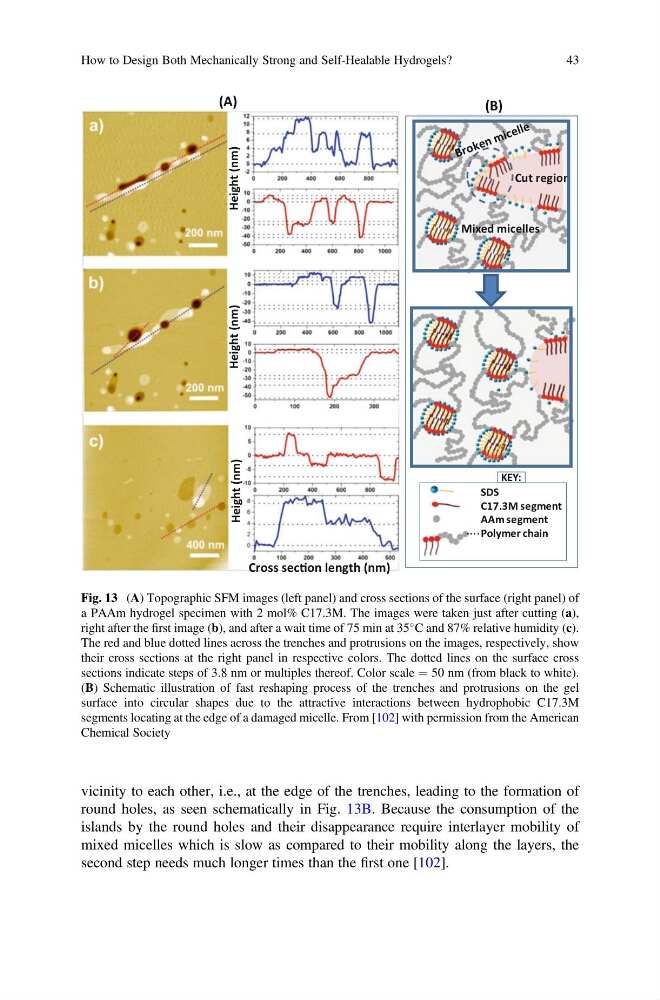
vicinity to each other, i.e., at the edge of the trenches, leading to the formation of
round holes, as seen schematically in Fig. 13B. Because the consumption of the
islands by the round holes and their disappearance require interlayer mobility of
mixed micelles which is slow as compared to their mobility along the layers, the
second step needs much longer times than the first one [102].
(A)
Cut region
SDS
C17.3M segment
AAm segment
Polymer chain
….
KEY:
Mixed micelles
(B)
Height (nm)
Height
(nm)
Height (nm)
Cross secƟon length (nm)
Fig. 13 (A) Topographic SFM images (left panel) and cross sections of the surface (right panel) of
a PAAm hydrogel specimen with 2 mol% C17.3M. The images were taken just after cutting (a),
right after the first image (b), and after a wait time of 75 min at 35
C and 87% relative humidity (c).
The red and blue dotted lines across the trenches and protrusions on the images, respectively, show
their cross sections at the right panel in respective colors. The dotted lines on the surface cross
sections indicate steps of 3.8 nm or multiples thereof. Color scale ¼ 50 nm (from black to white).
(B) Schematic illustration of fast reshaping process of the trenches and protrusions on the gel
surface into circular shapes due to the attractive interactions between hydrophobic C17.3M
segments locating at the edge of a damaged micelle. From [102] with permission from the American
Chemical Society
How to Design Both Mechanically Strong and Self-Healable Hydrogels?
43
round holes, as seen schematically in Fig. 13B. Because the consumption of the
islands by the round holes and their disappearance require interlayer mobility of
mixed micelles which is slow as compared to their mobility along the layers, the
second step needs much longer times than the first one [102].
(A)
Cut region
SDS
C17.3M segment
AAm segment
Polymer chain
….
KEY:
Mixed micelles
(B)
Height (nm)
Height
(nm)
Height (nm)
Cross secƟon length (nm)
Fig. 13 (A) Topographic SFM images (left panel) and cross sections of the surface (right panel) of
a PAAm hydrogel specimen with 2 mol% C17.3M. The images were taken just after cutting (a),
right after the first image (b), and after a wait time of 75 min at 35
C and 87% relative humidity (c).
The red and blue dotted lines across the trenches and protrusions on the images, respectively, show
their cross sections at the right panel in respective colors. The dotted lines on the surface cross
sections indicate steps of 3.8 nm or multiples thereof. Color scale ¼ 50 nm (from black to white).
(B) Schematic illustration of fast reshaping process of the trenches and protrusions on the gel
surface into circular shapes due to the attractive interactions between hydrophobic C17.3M
segments locating at the edge of a damaged micelle. From [102] with permission from the American
Chemical Society
How to Design Both Mechanically Strong and Self-Healable Hydrogels?
43