

containing 5 w/v % Laponite and 4 w/v % DNA at 90
C for 30 min results in an
almost complete healing with respect to the stretch ratio. Because denaturation of the
semiflexible ds-DNA at 90
C produces flexible ss-DNA strands with much higher
mobility [66, 68, 69], the single strands at the cut region can easily move between the
Wavelength / nm
600
650
700
Fluoresence intensity / a.u.
100
200
300
400
1
2
3
4
5
6
Temperature / °C
30 45 60 75 90
I max
300
400
H e a ti n g
C o o li n g
4
5
3
2
1
6
25 °C
90 °C
25 °C
(A)
(B)
Laponite
ds-DNA
ss-DNA
poly(DMAA)
KEY:
HeaƟng
above T m
Cooling
below T m
(a)
)
c
(
)
b
(
(C)
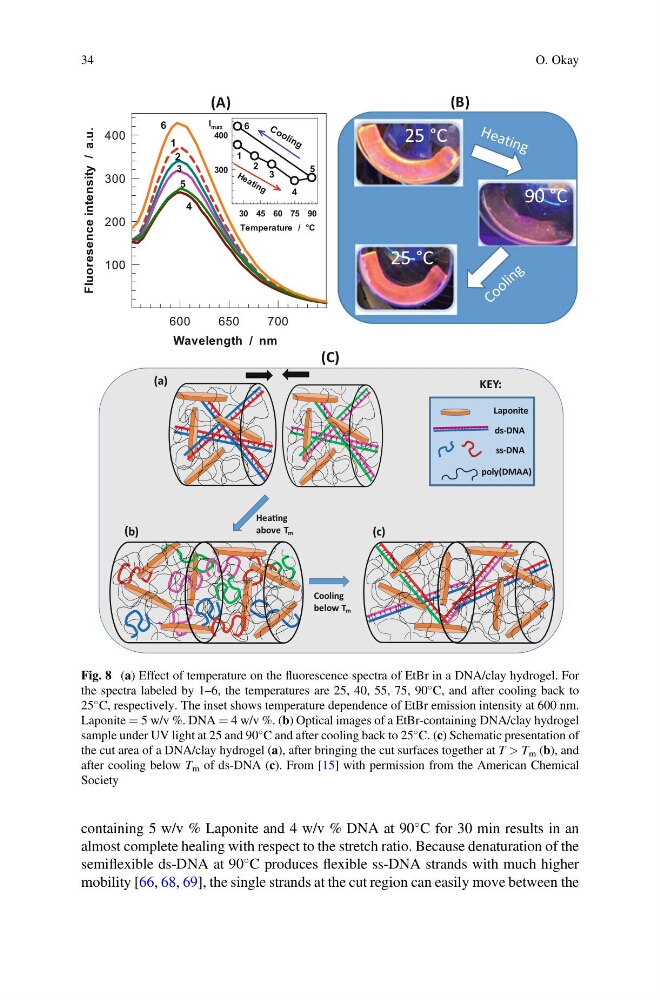
Fig. 8 (a) Effect of temperature on the fluorescence spectra of EtBr in a DNA/clay hydrogel. For
the spectra labeled by 1–6, the temperatures are 25, 40, 55, 75, 90
C, and after cooling back to
25
C, respectively. The inset shows temperature dependence of EtBr emission intensity at 600 nm.
Laponite ¼ 5 w/v %. DNA ¼ 4 w/v %. (b) Optical images of a EtBr-containing DNA/clay hydrogel
sample under UV light at 25 and 90
C and after cooling back to 25
C. (c) Schematic presentation of
the cut area of a DNA/clay hydrogel (a), after bringing the cut surfaces together at T > T m (b), and
after cooling below T m of ds-DNA (c). From [15] with permission from the American Chemical
Society
34
O. Okay
C for 30 min results in an
almost complete healing with respect to the stretch ratio. Because denaturation of the
semiflexible ds-DNA at 90
C produces flexible ss-DNA strands with much higher
mobility [66, 68, 69], the single strands at the cut region can easily move between the
Wavelength / nm
600
650
700
Fluoresence intensity / a.u.
100
200
300
400
1
2
3
4
5
6
Temperature / °C
30 45 60 75 90
I max
300
400
H e a ti n g
C o o li n g
4
5
3
2
1
6
25 °C
90 °C
25 °C
(A)
(B)
Laponite
ds-DNA
ss-DNA
poly(DMAA)
KEY:
HeaƟng
above T m
Cooling
below T m
(a)
)
c
(
)
b
(
(C)
Fig. 8 (a) Effect of temperature on the fluorescence spectra of EtBr in a DNA/clay hydrogel. For
the spectra labeled by 1–6, the temperatures are 25, 40, 55, 75, 90
C, and after cooling back to
25
C, respectively. The inset shows temperature dependence of EtBr emission intensity at 600 nm.
Laponite ¼ 5 w/v %. DNA ¼ 4 w/v %. (b) Optical images of a EtBr-containing DNA/clay hydrogel
sample under UV light at 25 and 90
C and after cooling back to 25
C. (c) Schematic presentation of
the cut area of a DNA/clay hydrogel (a), after bringing the cut surfaces together at T > T m (b), and
after cooling below T m of ds-DNA (c). From [15] with permission from the American Chemical
Society
34
O. Okay