

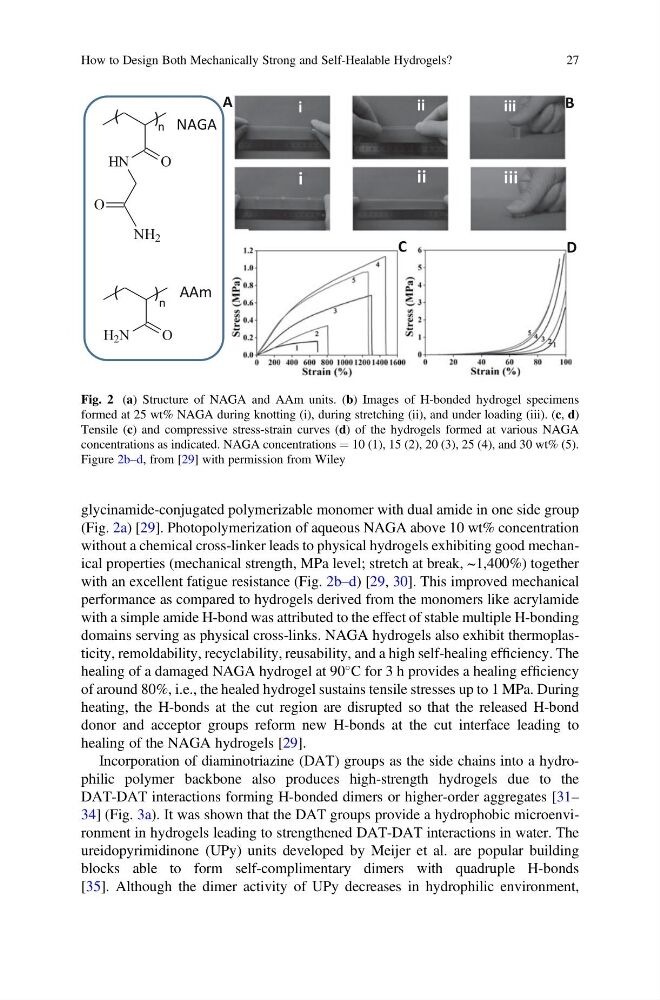
glycinamide-conjugated polymerizable monomer with dual amide in one side group
(Fig. 2a) [29]. Photopolymerization of aqueous NAGA above 10 wt% concentration
without a chemical cross-linker leads to physical hydrogels exhibiting good mechanical properties (mechanical strength, MPa level; stretch at break, ~1,400%) together
with an excellent fatigue resistance (Fig. 2b–d) [29, 30]. This improved mechanical
performance as compared to hydrogels derived from the monomers like acrylamide
with a simple amide H-bond was attributed to the effect of stable multiple H-bonding
domains serving as physical cross-links. NAGA hydrogels also exhibit thermoplasticity, remoldability, recyclability, reusability, and a high self-healing efficiency. The
healing of a damaged NAGA hydrogel at 90
C for 3 h provides a healing efficiency
of around 80%, i.e., the healed hydrogel sustains tensile stresses up to 1 MPa. During
heating, the H-bonds at the cut region are disrupted so that the released H-bond
donor and acceptor groups reform new H-bonds at the cut interface leading to
healing of the NAGA hydrogels [29].
Incorporation of diaminotriazine (DAT) groups as the side chains into a hydrophilic polymer backbone also produces high-strength hydrogels due to the
DAT-DAT interactions forming H-bonded dimers or higher-order aggregates [31–
34] (Fig. 3a). It was shown that the DAT groups provide a hydrophobic microenvironment in hydrogels leading to strengthened DAT-DAT interactions in water. The
ureidopyrimidinone (UPy) units developed by Meijer et al. are popular building
blocks able to form self-complimentary dimers with quadruple H-bonds
[35]. Although the dimer activity of UPy decreases in hydrophilic environment,
i
ii
iii
i
ii
iii
A
C
D
B
O
H 2 N
O
HN
O
NH 2
NAGA
AAm
(
)
n
(
)
n
Fig. 2 (a) Structure of NAGA and AAm units. (b) Images of H-bonded hydrogel specimens
formed at 25 wt% NAGA during knotting (i), during stretching (ii), and under loading (iii). (c, d)
Tensile (c) and compressive stress-strain curves (d) of the hydrogels formed at various NAGA
concentrations as indicated. NAGA concentrations ¼ 10 (1), 15 (2), 20 (3), 25 (4), and 30 wt% (5).
Figure 2b–d, from [29] with permission from Wiley
How to Design Both Mechanically Strong and Self-Healable Hydrogels?
27
(Fig. 2a) [29]. Photopolymerization of aqueous NAGA above 10 wt% concentration
without a chemical cross-linker leads to physical hydrogels exhibiting good mechanical properties (mechanical strength, MPa level; stretch at break, ~1,400%) together
with an excellent fatigue resistance (Fig. 2b–d) [29, 30]. This improved mechanical
performance as compared to hydrogels derived from the monomers like acrylamide
with a simple amide H-bond was attributed to the effect of stable multiple H-bonding
domains serving as physical cross-links. NAGA hydrogels also exhibit thermoplasticity, remoldability, recyclability, reusability, and a high self-healing efficiency. The
healing of a damaged NAGA hydrogel at 90
C for 3 h provides a healing efficiency
of around 80%, i.e., the healed hydrogel sustains tensile stresses up to 1 MPa. During
heating, the H-bonds at the cut region are disrupted so that the released H-bond
donor and acceptor groups reform new H-bonds at the cut interface leading to
healing of the NAGA hydrogels [29].
Incorporation of diaminotriazine (DAT) groups as the side chains into a hydrophilic polymer backbone also produces high-strength hydrogels due to the
DAT-DAT interactions forming H-bonded dimers or higher-order aggregates [31–
34] (Fig. 3a). It was shown that the DAT groups provide a hydrophobic microenvironment in hydrogels leading to strengthened DAT-DAT interactions in water. The
ureidopyrimidinone (UPy) units developed by Meijer et al. are popular building
blocks able to form self-complimentary dimers with quadruple H-bonds
[35]. Although the dimer activity of UPy decreases in hydrophilic environment,
i
ii
iii
i
ii
iii
A
C
D
B
O
H 2 N
O
HN
O
NH 2
NAGA
AAm
(
)
n
(
)
n
Fig. 2 (a) Structure of NAGA and AAm units. (b) Images of H-bonded hydrogel specimens
formed at 25 wt% NAGA during knotting (i), during stretching (ii), and under loading (iii). (c, d)
Tensile (c) and compressive stress-strain curves (d) of the hydrogels formed at various NAGA
concentrations as indicated. NAGA concentrations ¼ 10 (1), 15 (2), 20 (3), 25 (4), and 30 wt% (5).
Figure 2b–d, from [29] with permission from Wiley
How to Design Both Mechanically Strong and Self-Healable Hydrogels?
27