

Recently, Weder’s group has shown that sulfonated CNCs can be used as a
stimuli-responsive filler to create mechanically adaptive polymer nanocomposites
in a range of different polymer matrices [193–198]. Thus, the nanocomposite
stiffness can be controlled by switching on/off the attractive interactions between
the CNCs. Altering the surface chemistry of CNCs allowed access to pH-switchable
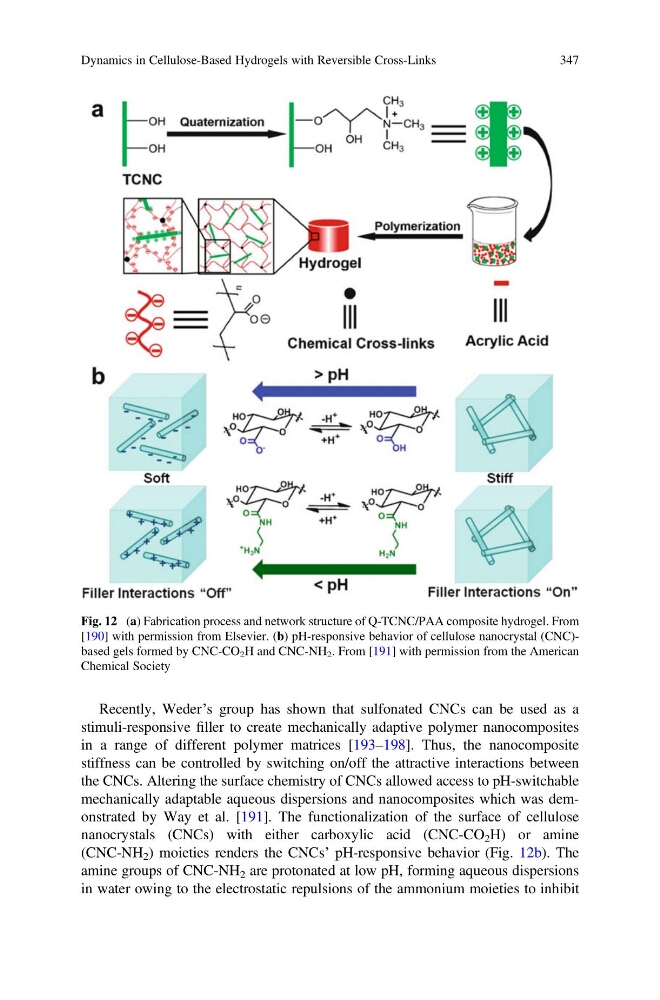
mechanically adaptable aqueous dispersions and nanocomposites which was demonstrated by Way et al. [191]. The functionalization of the surface of cellulose
nanocrystals (CNCs) with either carboxylic acid (CNC-CO 2 H) or amine
(CNC-NH 2 ) moieties renders the CNCs’ pH-responsive behavior (Fig. 12b). The
amine groups of CNC-NH 2 are protonated at low pH, forming aqueous dispersions
in water owing to the electrostatic repulsions of the ammonium moieties to inhibit
Fig. 12 (a) Fabrication process and network structure of Q-TCNC/PAA composite hydrogel. From
[190] with permission from Elsevier. (b) pH-responsive behavior of cellulose nanocrystal (CNC)based gels formed by CNC-CO 2 H and CNC-NH 2 . From [191] with permission from the American
Chemical Society
Dynamics in Cellulose-Based Hydrogels with Reversible Cross-Links
347
stimuli-responsive filler to create mechanically adaptive polymer nanocomposites
in a range of different polymer matrices [193–198]. Thus, the nanocomposite
stiffness can be controlled by switching on/off the attractive interactions between
the CNCs. Altering the surface chemistry of CNCs allowed access to pH-switchable
mechanically adaptable aqueous dispersions and nanocomposites which was demonstrated by Way et al. [191]. The functionalization of the surface of cellulose
nanocrystals (CNCs) with either carboxylic acid (CNC-CO 2 H) or amine
(CNC-NH 2 ) moieties renders the CNCs’ pH-responsive behavior (Fig. 12b). The
amine groups of CNC-NH 2 are protonated at low pH, forming aqueous dispersions
in water owing to the electrostatic repulsions of the ammonium moieties to inhibit
Fig. 12 (a) Fabrication process and network structure of Q-TCNC/PAA composite hydrogel. From
[190] with permission from Elsevier. (b) pH-responsive behavior of cellulose nanocrystal (CNC)based gels formed by CNC-CO 2 H and CNC-NH 2 . From [191] with permission from the American
Chemical Society
Dynamics in Cellulose-Based Hydrogels with Reversible Cross-Links
347