

with reversible cross-links [145, 146]. Ax and Wenz [147] developed a healable
liquid-crystalline material that was prepared by thermo-reversible cross-linking of
DA reaction between a cellulosic diene and a flexible bisdienophile. Hydroxyethyl
cellulose was esterified with both furoyl chloride and acetic anhydride, leading to a
processible polymer with pending furane substituents. The cross-linking was
achieved by heating to initiate the DA reaction with 1,6-bis(N-maleimido)hexane,
and the heating treatment gave rise to the back (retro-DA) reaction, thus restituting
the reactants. Consequently, temperature cycling triggers subsequent retro-DA and
DA reactions that allow self-healing of these materials. The use of cellulose enables
the construction of highly oriented specimens with high modulus and tensile
strength, and the introduction of flexible hexamethylene spacers avoids brittleness
of the material.
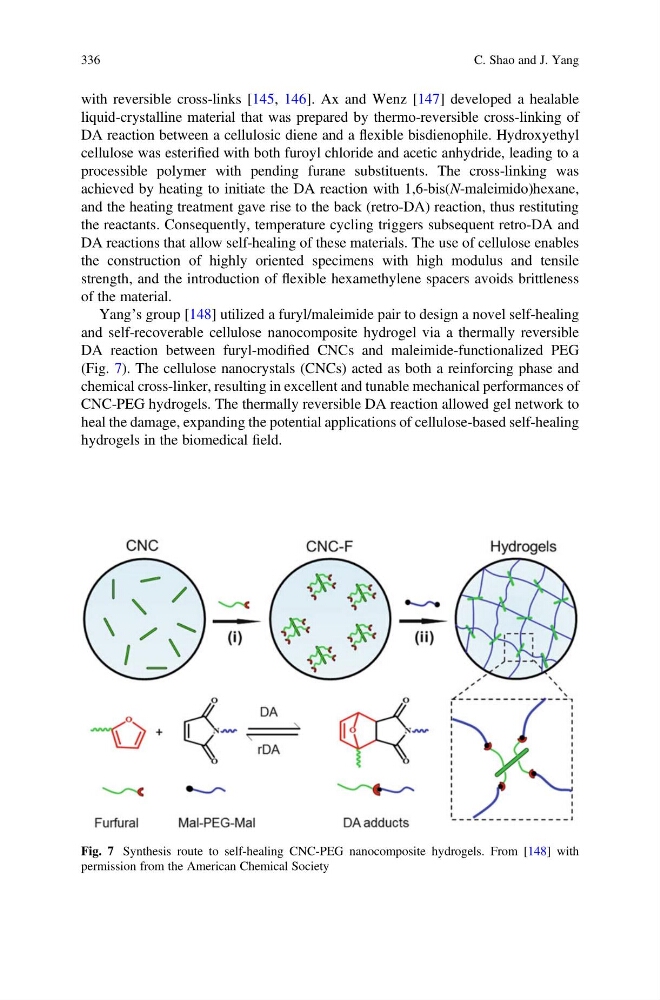
Yang’s group [148] utilized a furyl/maleimide pair to design a novel self-healing
and self-recoverable cellulose nanocomposite hydrogel via a thermally reversible
DA reaction between furyl-modified CNCs and maleimide-functionalized PEG
(Fig. 7). The cellulose nanocrystals (CNCs) acted as both a reinforcing phase and
chemical cross-linker, resulting in excellent and tunable mechanical performances of
CNC-PEG hydrogels. The thermally reversible DA reaction allowed gel network to
heal the damage, expanding the potential applications of cellulose-based self-healing
hydrogels in the biomedical field.
Fig. 7 Synthesis route to self-healing CNC-PEG nanocomposite hydrogels. From [148] with
permission from the American Chemical Society
336
C. Shao and J. Yang
liquid-crystalline material that was prepared by thermo-reversible cross-linking of
DA reaction between a cellulosic diene and a flexible bisdienophile. Hydroxyethyl
cellulose was esterified with both furoyl chloride and acetic anhydride, leading to a
processible polymer with pending furane substituents. The cross-linking was
achieved by heating to initiate the DA reaction with 1,6-bis(N-maleimido)hexane,
and the heating treatment gave rise to the back (retro-DA) reaction, thus restituting
the reactants. Consequently, temperature cycling triggers subsequent retro-DA and
DA reactions that allow self-healing of these materials. The use of cellulose enables
the construction of highly oriented specimens with high modulus and tensile
strength, and the introduction of flexible hexamethylene spacers avoids brittleness
of the material.
Yang’s group [148] utilized a furyl/maleimide pair to design a novel self-healing
and self-recoverable cellulose nanocomposite hydrogel via a thermally reversible
DA reaction between furyl-modified CNCs and maleimide-functionalized PEG
(Fig. 7). The cellulose nanocrystals (CNCs) acted as both a reinforcing phase and
chemical cross-linker, resulting in excellent and tunable mechanical performances of
CNC-PEG hydrogels. The thermally reversible DA reaction allowed gel network to
heal the damage, expanding the potential applications of cellulose-based self-healing
hydrogels in the biomedical field.
Fig. 7 Synthesis route to self-healing CNC-PEG nanocomposite hydrogels. From [148] with
permission from the American Chemical Society
336
C. Shao and J. Yang