

formation of dynamic covalent enamine bonds between carbonyl groups on CAA
and amino groups on chitosan. Enamine bonds belong to the family of imine
dynamic covalent bonds, possessing the ability of reversibly cleave and reform
under appropriate conditions during different dynamic processes [124]. The
dynamic equilibrium of reversible enamine bonds in the cross-linked network
endowed the polysaccharide hydrogel excellent self-healing ability and good stability under physiological conditions. The polysaccharide hydrogel showed
pH-dependent behavior that is confirmed by the gel-sol transition under pH stimuli.
However, the hydrogel could not be prepared under physiological conditions
because of the limited solubility of chitosan; thus an improved self-healing and
injectable polysaccharide hydrogel was developed in a subsequent work of Mao’s
group [125], where hydroxypropyl chitosan (HPCS) was used instead of chitosan for
its substantial solubility under physiological conditions. Further, amino-modified
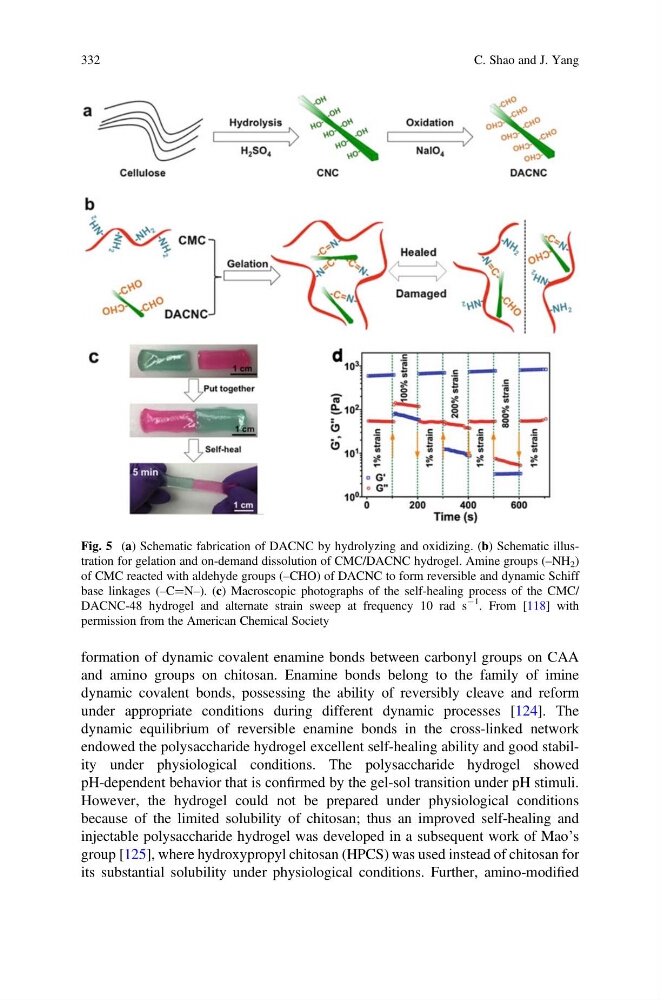
Fig. 5 (a) Schematic fabrication of DACNC by hydrolyzing and oxidizing. (b) Schematic illustration for gelation and on-demand dissolution of CMC/DACNC hydrogel. Amine groups (–NH 2 )
of CMC reacted with aldehyde groups (–CHO) of DACNC to form reversible and dynamic Schiff
base linkages (–C¼N–). (c) Macroscopic photographs of the self-healing process of the CMC/
DACNC-48 hydrogel and alternate strain sweep at frequency 10 rad s
À1
. From [118] with
permission from the American Chemical Society
332
C. Shao and J. Yang
and amino groups on chitosan. Enamine bonds belong to the family of imine
dynamic covalent bonds, possessing the ability of reversibly cleave and reform
under appropriate conditions during different dynamic processes [124]. The
dynamic equilibrium of reversible enamine bonds in the cross-linked network
endowed the polysaccharide hydrogel excellent self-healing ability and good stability under physiological conditions. The polysaccharide hydrogel showed
pH-dependent behavior that is confirmed by the gel-sol transition under pH stimuli.
However, the hydrogel could not be prepared under physiological conditions
because of the limited solubility of chitosan; thus an improved self-healing and
injectable polysaccharide hydrogel was developed in a subsequent work of Mao’s
group [125], where hydroxypropyl chitosan (HPCS) was used instead of chitosan for
its substantial solubility under physiological conditions. Further, amino-modified
Fig. 5 (a) Schematic fabrication of DACNC by hydrolyzing and oxidizing. (b) Schematic illustration for gelation and on-demand dissolution of CMC/DACNC hydrogel. Amine groups (–NH 2 )
of CMC reacted with aldehyde groups (–CHO) of DACNC to form reversible and dynamic Schiff
base linkages (–C¼N–). (c) Macroscopic photographs of the self-healing process of the CMC/
DACNC-48 hydrogel and alternate strain sweep at frequency 10 rad s
À1
. From [118] with
permission from the American Chemical Society
332
C. Shao and J. Yang