

as the capability of a material to heal macroscopic cracks such as cuts or scratches
autonomously or under the effect of a stimulus such as the temperature. Thus, selfhealing requires reformation of all bonds broken in a material to recover its original
shape and mechanical properties. Although self-healing and self-recovery have
sometimes been used synonymously, self-recovery more refers to cases of repairing
internal microcracks in a material remaining externally intact after damage. Thus,
cut-and-heal tests and rheological measurements have generally been conducted to
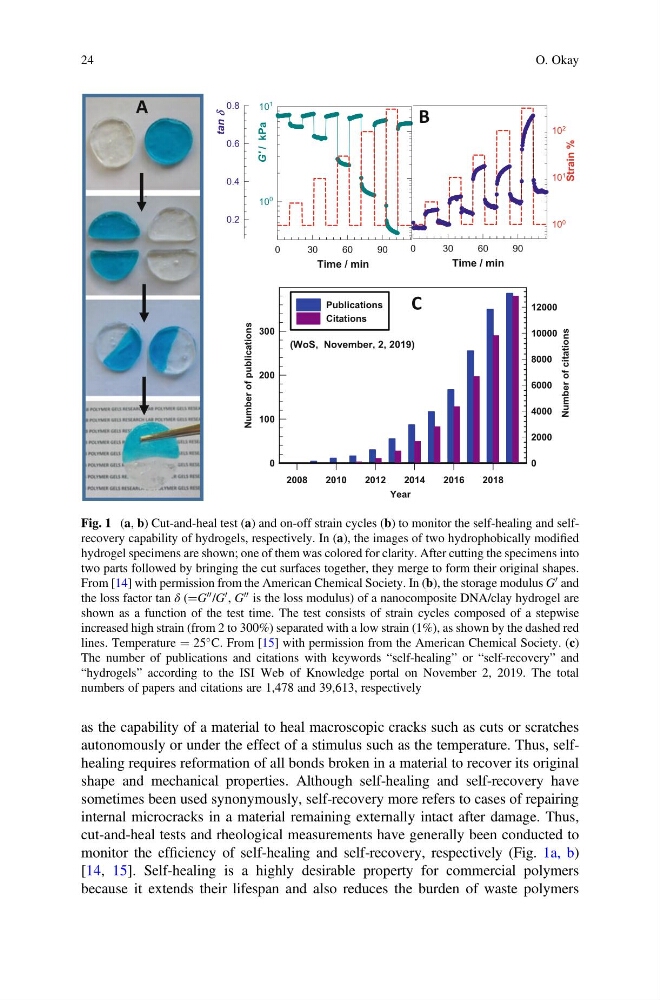
monitor the efficiency of self-healing and self-recovery, respectively (Fig. 1a, b)
[14, 15]. Self-healing is a highly desirable property for commercial polymers
because it extends their lifespan and also reduces the burden of waste polymers
Year
2008
2010
2012
2014
2016
2018
Number of publications
0
100
200
300
Number of citations
0
2000
4000
6000
8000
10000
12000
Publications
Citations
(WoS, November, 2, 2019)
Time / min
0
3 0
6 0
9 0
G' / kPa
10
0
10
1
Time / min
0
3 0
6 0
9 0
Strain %
10 0
10
1
10
2
tan
δ δ
0.2
0.4
0.6
0.8
B
C
A
Fig. 1 (a, b) Cut-and-heal test (a) and on-off strain cycles (b) to monitor the self-healing and selfrecovery capability of hydrogels, respectively. In (a), the images of two hydrophobically modified
hydrogel specimens are shown; one of them was colored for clarity. After cutting the specimens into
two parts followed by bringing the cut surfaces together, they merge to form their original shapes.
From [14] with permission from the American Chemical Society. In (b), the storage modulus G
0 and
the loss factor tan δ (¼G
00 /G
0 , G
00 is the loss modulus) of a nanocomposite DNA/clay hydrogel are
shown as a function of the test time. The test consists of strain cycles composed of a stepwise
increased high strain (from 2 to 300%) separated with a low strain (1%), as shown by the dashed red
lines. Temperature ¼ 25
C. From [15] with permission from the American Chemical Society. (c)
The number of publications and citations with keywords “self-healing” or “self-recovery” and
“hydrogels” according to the ISI Web of Knowledge portal on November 2, 2019. The total
numbers of papers and citations are 1,478 and 39,613, respectively
24
O. Okay
autonomously or under the effect of a stimulus such as the temperature. Thus, selfhealing requires reformation of all bonds broken in a material to recover its original
shape and mechanical properties. Although self-healing and self-recovery have
sometimes been used synonymously, self-recovery more refers to cases of repairing
internal microcracks in a material remaining externally intact after damage. Thus,
cut-and-heal tests and rheological measurements have generally been conducted to
monitor the efficiency of self-healing and self-recovery, respectively (Fig. 1a, b)
[14, 15]. Self-healing is a highly desirable property for commercial polymers
because it extends their lifespan and also reduces the burden of waste polymers
Year
2008
2010
2012
2014
2016
2018
Number of publications
0
100
200
300
Number of citations
0
2000
4000
6000
8000
10000
12000
Publications
Citations
(WoS, November, 2, 2019)
Time / min
0
3 0
6 0
9 0
G' / kPa
10
0
10
1
Time / min
0
3 0
6 0
9 0
Strain %
10 0
10
1
10
2
tan
δ δ
0.2
0.4
0.6
0.8
B
C
A
Fig. 1 (a, b) Cut-and-heal test (a) and on-off strain cycles (b) to monitor the self-healing and selfrecovery capability of hydrogels, respectively. In (a), the images of two hydrophobically modified
hydrogel specimens are shown; one of them was colored for clarity. After cutting the specimens into
two parts followed by bringing the cut surfaces together, they merge to form their original shapes.
From [14] with permission from the American Chemical Society. In (b), the storage modulus G
0 and
the loss factor tan δ (¼G
00 /G
0 , G
00 is the loss modulus) of a nanocomposite DNA/clay hydrogel are
shown as a function of the test time. The test consists of strain cycles composed of a stepwise
increased high strain (from 2 to 300%) separated with a low strain (1%), as shown by the dashed red
lines. Temperature ¼ 25
C. From [15] with permission from the American Chemical Society. (c)
The number of publications and citations with keywords “self-healing” or “self-recovery” and
“hydrogels” according to the ISI Web of Knowledge portal on November 2, 2019. The total
numbers of papers and citations are 1,478 and 39,613, respectively
24
O. Okay